Age Calculator
Last updated: 27 June 2026
Reviewed by Gavin Meiring, Lead research and primary author · Doctoral Candidate (Corporate Governance) · Research and drafting assisted by AI
- Jeanne Calment of France lived to 122 years and 164 days — the oldest verified human age on record. She met Vincent van Gogh in 1888 when he came to her father's shop to buy canvas.
- In Korea, everyone is considered 1 year old at birth, and everyone ages a year on New Year's Day — not their birthday. A Korean newborn on 31 December would be 2 by 2 January.
- A dog's 'seven human years' rule is a myth. Dogs age rapidly early in life and more slowly later. A 1-year-old dog is roughly equivalent to a 15-year-old human, not a 7-year-old.
Age Calculator
The age calculator tells you exactly how old you are in years, months, and days based on your date of birth and today's date. It is useful for filling in forms, checking eligibility for age-restricted services, and satisfying plain curiosity about how long you have been alive. It is also widely used in healthcare, education, legal, and human-resources contexts where precise age matters more than a simple birth-year subtraction would suggest.
How to Use the Age Calculator
- Enter your date of birth using the day, month, and year fields.
- The calculator uses today's date automatically, or you can enter a custom target date.
- Click the Calculate button.
- Read your age in years, months, and days in the results panel.
- Scroll down for additional breakdowns such as total days lived or weeks.
The Formula
Age is calculated by finding the difference between two dates: the date of birth and the reference date (usually today).
- Subtract the birth year from the current year to get the base number of years.
- If the birthday has not yet occurred this calendar year, subtract one from the years total.
- Calculate the remaining months by counting from the last birthday month to the current month.
- Calculate the remaining days by counting from the last birthday day to today.
For example, if you were born on 15 March 1990 and today is 28 June 2026:
- Base years: 2026 - 1990 = 36
- Birthday (15 March) has already passed this year, so no adjustment.
- Months since 15 March: April, May, June = 3 months
- Days since 15 June: 28 - 15 = 13 days
- Result: 36 years, 3 months, 13 days
Real-World Example
A parent wants to know their child's exact age for a school enrolment form. The child was born on 3 September 2019. The form is being filled in on 28 June 2026.
- Base years: 2026 - 2019 = 7
- Birthday (3 September) has not yet occurred in 2026, so subtract one: 6 years.
- Months from 3 September 2025 to 3 June 2026 = 9 months.
- Days from 3 June to 28 June = 25 days.
- Result: 6 years, 9 months, 25 days.
The child is 6 years old and will turn 7 in September 2026.
Age Milestones and Legal Thresholds
Knowing your exact age in years and months matters for many legal and practical thresholds. In the UK, key age milestones include: 16 (school leaving age, consent for certain medical decisions), 17 (provisional driving licence), 18 (voting, purchasing alcohol, full driving licence), 21 (some car hire companies require this age), 25 (brain fully developed, relevant for some insurers), 60 and 65 (various pension and concession thresholds, though these change with legislation). Age calculators are also used in healthcare to determine paediatric drug dosages and growth percentile charts.
In the United States, additional milestones include 16 (driving permit in most states), 18 (federal voting age, military enlistment without parental consent), 21 (legal drinking age), and 59.5 (the age at which retirement account withdrawals avoid the 10% early withdrawal penalty). Different jurisdictions have different rules, and the calculator is commonly used to verify eligibility for benefits or restrictions tied to age.
Age in Other Units
Beyond years, months, and days, the calculator can show age in alternative units: total days lived, total weeks, total hours, total minutes, and even seconds. These are useful for framing life events in relatable terms (e.g., "I have been alive for approximately 14,000 days") or for working out service anniversaries or parenting milestones.
Common conversions approximate as follows:
- 1 year ≈ 365.25 days (accounting for leap years on average)
- 1 year ≈ 52.18 weeks
- 1 year ≈ 8,766 hours
- 1 year ≈ 525,949 minutes
Time Zones and Edge Cases
The age calculator is timezone-agnostic for date-of-birth purposes, because civil registration documents record dates rather than times. However, if a baby is born at 11:59 PM, the date of birth depends on the timezone used at the hospital. For ages that matter in hours (e.g., airline infant ticketing, which applies to under-2s), the calculation may differ between departure and arrival timezones. The day-counting version of the calculator handles these edge cases consistently, while a simple year-subtraction approach can introduce off-by-one errors.
Reference Table: Age in years, days and hours
Ages for five birth dates, measured on 10 September 2026. Days are whole calendar days and hours assume 24-hour days. A birth date of 1 January 2010 gives 16 years and 6,096 days.
| Date of birth | Age in years | Age in days | Age in hours |
|---|---|---|---|
| 15 Mar 1990 | 36 | 13,328 | 319,872 h |
| 02 Nov 1985 | 40 | 14,922 | 358,128 h |
| 30 Jun 2000 | 26 | 9,568 | 229,632 h |
| 01 Jan 2010 | 16 | 6,096 | 146,304 h |
| 25 Dec 1975 | 50 | 18,522 | 444,528 h |
Worked Example on Screen
The capture below shows Age Calculator after the inputs were entered, with the result on screen. Enter the same values to reproduce it.
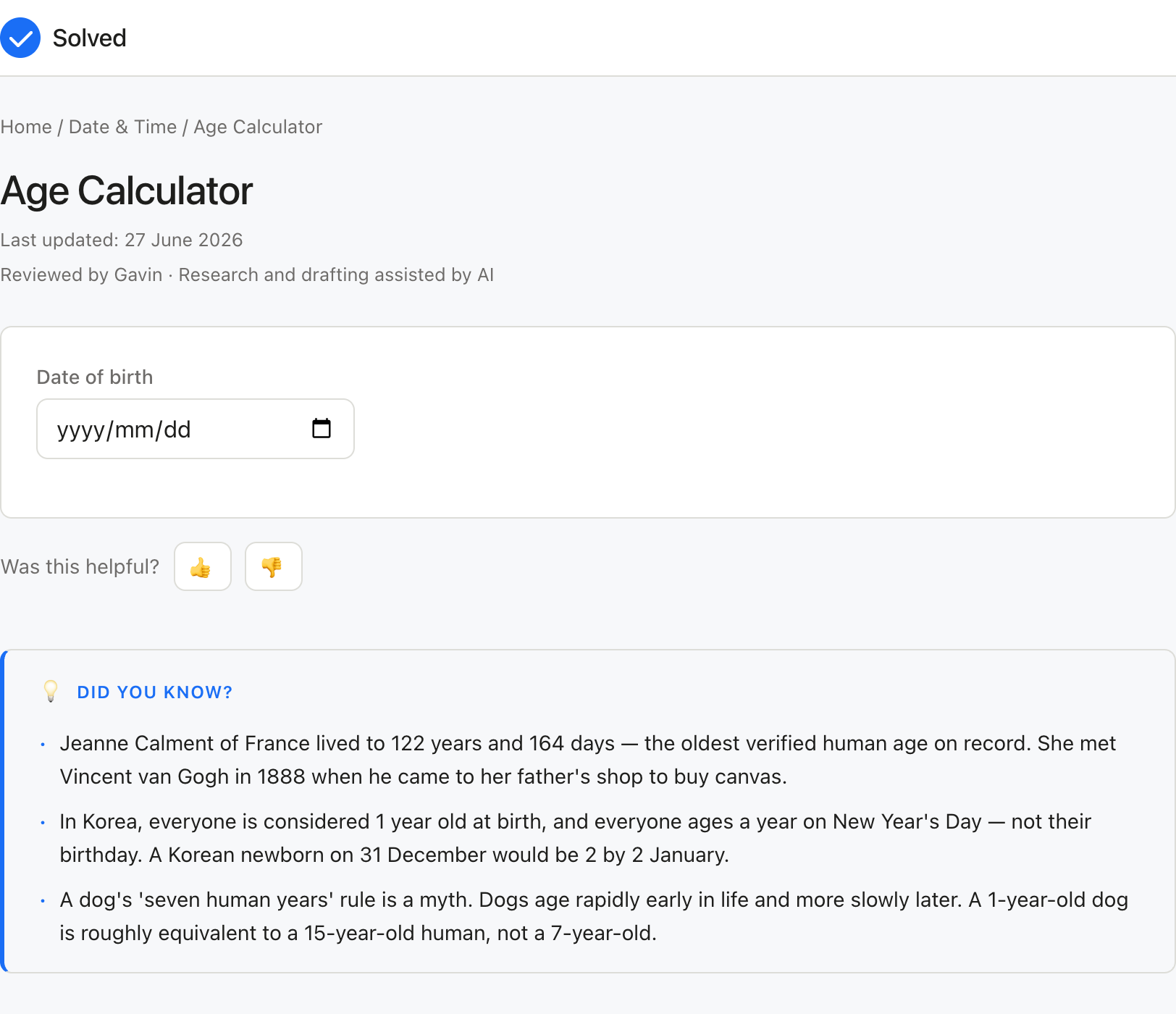
Captured from solved.tools on 10 September 2026.
Frequently Asked Questions
Does the age calculator account for leap years? Yes. When calculating the number of days lived, the tool correctly accounts for the extra day in February during leap years. Leap years occur every four years, except for century years not divisible by 400.
Why does my age differ by one day sometimes? Discrepancies can arise from how "midnight" on a birthday is counted, and whether the birth day itself is included or excluded from the count. The tool counts age in completed years, meaning your age increases on your birthday, not the day before.
Can I calculate the age of someone who has not been born yet? The tool works with any two dates. You can enter a future birth date and a future target date to calculate a projected age, which can be useful for planning purposes.
How old am I in days? To calculate your age in total days, multiply your completed years by 365, add the days for leap years within that span, then add the remaining months and days. The calculator does this automatically and displays total days in the detailed results section.
How does the calculator handle different date formats? Most age calculators accept the standard day-month-year input format (DD/MM/YYYY in most of the world, MM/DD/YYYY in the United States). The tool interprets the fields based on the selected locale or explicit format option. Avoid ambiguous formats where the day and month could be reversed; explicit formatting prevents errors.
Also try these free tools:
What Else the Age Calculator Can Tell You
Once the basic age is calculated, the tool can compute additional derived statistics that are useful in different contexts. Most calculators will offer:
- Total days, weeks, hours, minutes, and seconds lived.
- Age in months at a granularity useful for infants and toddlers (e.g., 18 months old).
- Age on a specific future date, useful for milestone planning.
- Time until the next birthday, in days and weeks.
- The day of the week on which you were born.
In paediatrics, age is often expressed in months for the first two years because growth and developmental milestones are more meaningfully tracked at monthly granularity. In gerontology, age in completed years is usually sufficient, except for medication dosing adjustments in the very old, where biological age may differ from chronological age.
Cultural and Administrative Notes
Age is a culturally loaded number. In much of East Asia, age is traditionally counted differently, a baby is considered one year old at birth and increments by one year at each Lunar New Year, rather than on the day of birth. Most age calculators use the Western system because that is what official documents (passports, IDs, visas) require. If you are filling in a form for a country that uses a different system, ensure the calculator's output matches the convention expected by the issuing authority.
For migration and visa applications, age is often calculated at the time of the application decision, not the time of submission. Some visa categories use the applicant's age on the date of the decision letter; the calculator can be used to project age forward to confirm eligibility.
Why Exact Age Matters
In many situations, the difference between being 17 years and 364 days old versus 18 years and 1 day old is the difference between eligibility and ineligibility for a benefit. Insurance pricing, prescription dosing, school enrolment, and competitive sports categories all rely on precise age. The age calculator removes the ambiguity by computing the exact years, months, and days between two dates, and is preferred over mental arithmetic or simple year subtraction for any situation where the answer matters.