Calorie Calculator
Last updated: 27 June 2026
Reviewed by Gavin Meiring, Lead research and primary author · Doctoral Candidate (Corporate Governance) · Research and drafting assisted by AI
- The word 'calorie' comes from the Latin 'calor', meaning heat. A food calorie (kcal) is the amount of energy needed to raise 1 kilogram of water by 1°C.
- The original US daily calorie recommendation (2,000 kcal) was based on the average woman's intake in 1990 — it was a political compromise, not a precise nutritional target.
- Cooking food dramatically increases the calories your body actually absorbs. Raw sweet potato yields about 70 kcal per 100g. Boiled yields 87 kcal. Roasted yields 100 kcal.
Calorie Calculator
A calorie calculator estimates your daily calorie needs based on your age, sex, height, weight, and activity level. It is used by people looking to lose weight, maintain their current weight, or gain muscle mass through an appropriate calorie intake. The tool calculates your Total Daily Energy Expenditure (TDEE), which is the number of calories your body burns in a typical day.
How to Use the Calorie Calculator
- Enter your age, sex (male or female), height, and current weight.
- Select your activity level from the options provided (sedentary, lightly active, moderately active, very active, or extra active).
- Choose your goal: weight loss, weight maintenance, or weight gain.
- The calculator first computes your Basal Metabolic Rate (BMR) using the Mifflin-St Jeor equation.
- It then multiplies the BMR by an activity factor to produce your TDEE and adjusts for your selected goal.
The Formula
Step 1: Calculate BMR using the Mifflin-St Jeor equation.
For men: BMR = (10 multiplied by weight in kg) plus (6.25 multiplied by height in cm) minus (5 multiplied by age in years) plus 5
For women: BMR = (10 multiplied by weight in kg) plus (6.25 multiplied by height in cm) minus (5 multiplied by age in years) minus 161
Step 2: Multiply BMR by an activity factor to get TDEE.
Sedentary (little or no exercise): BMR multiplied by 1.2 Lightly active (light exercise 1 to 3 days per week): BMR multiplied by 1.375 Moderately active (moderate exercise 3 to 5 days per week): BMR multiplied by 1.55 Very active (hard exercise 6 to 7 days per week): BMR multiplied by 1.725 Extra active (very hard exercise, physical job, or twice-daily training): BMR multiplied by 1.9
Real-World Example
A 35-year-old woman weighs 70 kg and is 165 cm tall. She exercises moderately 3 to 5 days per week.
BMR = (10 multiplied by 70) plus (6.25 multiplied by 165) minus (5 multiplied by 35) minus 161 = 700 plus 1,031.25 minus 175 minus 161 = 1,395 calories per day
TDEE = 1,395 multiplied by 1.55 = 2,162 calories per day
This means she burns approximately 2,162 calories per day. For each goal:
Weight maintenance: eat approximately 2,162 calories per day. Weight loss (0.5 kg per week): reduce by 500 calories to approximately 1,662 per day. (One kg of fat contains approximately 7,700 calories; a 500-calorie daily deficit creates roughly 0.5 kg of loss per week.) Weight gain: increase by 250 to 500 calories above TDEE, depending on the rate of gain desired.
Calorie Quality and Macronutrient Balance
The total calorie count is the primary driver of weight change, but the quality and composition of those calories matters enormously for health, satiety, and body composition.
Protein is the most important macronutrient for body composition. Adequate protein (typically 1.6 to 2.2 grams per kg of body weight per day for active individuals) preserves muscle mass during weight loss and supports muscle building during a calorie surplus. Protein is also the most satiating macronutrient, helping control hunger on a calorie-restricted diet.
Carbohydrates and fats both serve essential roles, and neither needs to be eliminated for healthy weight management. The key is choosing whole, minimally processed sources: oats, potatoes, and vegetables over refined sugars; olive oil, nuts, and avocado over processed vegetable oils.
Fibre from vegetables, legumes, and whole grains supports gut health, improves satiety, and is associated with reduced risk of several chronic diseases. Most UK adults consume far less fibre than the recommended 30 grams per day.
Reference Table: Daily calorie needs by activity level
Maintenance calories for two sample adults, using the Mifflin-St Jeor equation and the standard activity multipliers. The man is 35, 70 kg and 175 cm; the woman is 35, 60 kg and 165 cm. Subtract roughly 500 calories a day for about 0.45 kg of loss a week.
| Activity level | Multiplier | Man (35, 70 kg, 175 cm) | Woman (35, 60 kg, 165 cm) |
|---|---|---|---|
| Sedentary | 1.2 | 1948 kcal | 1554 kcal |
| Lightly active | 1.375 | 2233 kcal | 1781 kcal |
| Moderately active | 1.55 | 2517 kcal | 2008 kcal |
| Very active | 1.725 | 2801 kcal | 2234 kcal |
| Athlete | 1.9 | 3085 kcal | 2461 kcal |
Worked Example on Screen
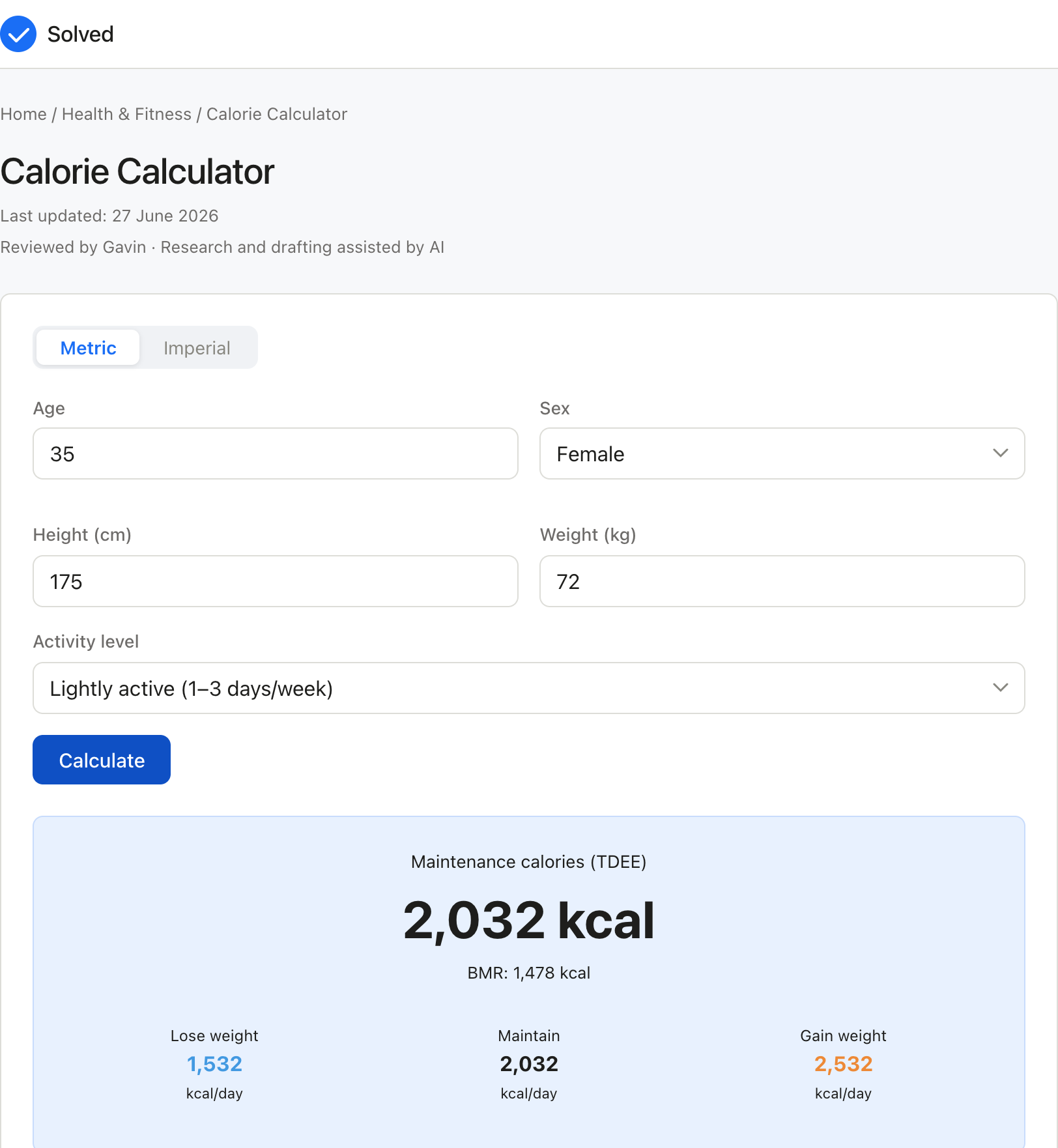
The capture below shows Calorie Calculator after the inputs were entered, with the result on screen. Enter the same values to reproduce it.
Captured from solved.tools on 10 September 2026.
Frequently Asked Questions
How accurate are calorie calculators? Calorie calculators provide estimates based on population averages. Individual metabolic rates can vary by up to 15% to 20% from the calculated figure. This is why tracking actual intake and monitoring weight changes over 2 to 4 weeks, then adjusting calories based on real results, is more accurate than relying entirely on a formula. The Mifflin-St Jeor equation has the best evidence base for accuracy in general populations.
Why do I seem to burn fewer calories than the calculator suggests? Several factors can reduce actual calorie burn below the estimate. Metabolic adaptation occurs when the body reduces its energy expenditure in response to sustained calorie restriction, a phenomenon sometimes called "adaptive thermogenesis." Activity levels may also be overestimated; people tend to think they are more active than they are. Tracking food intake carefully and comparing results to expected weight change is the most reliable way to calibrate your actual needs.
Do I need to count calories to lose weight? Not necessarily. Many people lose weight successfully by focusing on food quality, protein intake, and hunger cues without explicitly tracking calories. However, for those who are not seeing results with a general approach, calorie tracking provides valuable feedback about actual intake. Apps such as MyFitnessPal, Cronometer, or Nutracheck make tracking relatively straightforward.
How does age affect calorie needs? Calorie needs typically decline with age due to a reduction in muscle mass (sarcopenia), reduced activity levels, and a slight decrease in basal metabolic rate. Each decade after age 30, BMR may decline by approximately 2% to 3%. This is why many people gain weight gradually even without changing their eating habits, as the same diet that maintained weight at 30 may create a small surplus at 50.
Also try these free tools:
Extended Reference Notes
The notes below cover the broader context that informs how to use the Calorie Calculator well.
Typical Input Ranges
Most real-world uses of the Calorie Calculator fall into a middle band where the result is stable and useful. Very small inputs to the Calorie Calculator often round to zero or near-zero, and very large inputs amplify every rounding error in the calculation. The middle band, where the Calorie Calculator inputs are ordinary sizes, is where the tool is most reliable.
Assumptions Behind the Formula
The Calorie Calculator assumes the inputs stay fixed across the period or scenario being modelled. Rates move, values change, and fees appear, so treat the Calorie Calculator output as a clean reference and layer in the frictions your own situation adds.
Common Edge Cases
Three situations change the Calorie Calculator answer in ways the formula does not surface: boundary values near zero, rounding cascades across many steps, and unit mismatches between fields. When any of these apply, sanity-check the Calorie Calculator result against an independent estimate.
When to Revisit the Calculation
The Calorie Calculator output is only as current as its inputs, so re-run the calculation whenever a key value changes materially. A quarterly re-check of the Calorie Calculator suits personal planning; monthly suits active business or investment decisions.
Relationship to Other Tools
The Calorie Calculator shares inputs and outputs with the other tools in its category. If the same numbers feed several tools, capture them once and run each tool so the comparison stays consistent with the Calorie Calculator.
Practical Checklist Before Relying on the Result
Before acting on the Calorie Calculator output, run a short mental checklist: inputs in the right units, direction of the result matching intuition, and magnitude plausible. Each check takes seconds and catches the most common classes of Calorie Calculator error before they reach a decision.
Putting the Result to Work
A single Calorie Calculator run usually narrows the range of plausible answers rather than settling the question. Compare the Calorie Calculator result against a benchmark or a previous run, and ask what would have to change for the answer to flip a decision.
Sensitivity to Inputs
Some inputs move the Calorie Calculator result more than others; changing each by a small amount shows which ones matter. Spend the effort on the high-impact Calorie Calculator inputs and treat the low-impact ones as approximate.
A Note on Stale Inputs
A calculation is only as fresh as the inputs that feed it, so note the date the Calorie Calculator inputs were last refreshed. A six-month-old Calorie Calculator result can be as wrong as a wrong calculation when the underlying values have moved on.