Word Counter
Last updated: 27 June 2026
Reviewed by Gavin Meiring, Lead research and primary author · Doctoral Candidate (Corporate Governance) · Research and drafting assisted by AI
- The average person reads at 200–250 words per minute. J.F. Kennedy was tested at 1,200 wpm. Studies suggest comprehension starts dropping significantly above 400 wpm.
- The longest word in the Oxford English Dictionary is 'pneumonoultramicroscopicsilicovolcanoconiosis' (45 letters) — a lung disease caused by inhaling fine silica dust.
- Shakespeare invented over 1,700 words still used in English today: bedroom, lonely, generous, obscene, swagger, eyeball, and many more.
Word Counter
The word counter calculates the number of words, characters, sentences, and paragraphs in any text you paste or type. It is used by students checking essay limits, writers tracking manuscript progress, journalists meeting word count targets, and SEO professionals optimising content length.
How to Use the Word Counter
- Paste or type your text into the input field.
- The counter updates instantly as you type; no button press is required.
- Read the word count, character count (with and without spaces), sentence count, and paragraph count in the summary panel.
- Use the reading time estimate to gauge how long your text takes to read aloud.
- Clear the field and start a new count whenever needed.
The Formula
Word count: Split the text by whitespace (spaces, tabs, newlines) and count the non-empty segments. Punctuation attached to words (such as commas and full stops) is not treated as a separate word. The formula: words = number of tokens when text is split on whitespace and empty strings are removed.
Character count with spaces: Total number of characters including every space, newline, and punctuation mark. This equals the length of the string.
Character count without spaces: Remove all whitespace characters, then count the remaining characters.
Sentence count: Count the number of sentence-ending punctuation marks: full stops, exclamation marks, and question marks, adjusted for abbreviations and ellipses.
Paragraph count: Count the number of blocks of text separated by one or more blank lines.
Real-World Example
A student submits an essay with a 2,000-word limit. They paste their text into the word counter and see:
- Words: 2,187
- Characters (with spaces): 12,943
- Characters (without spaces): 10,756
- Sentences: 91
- Paragraphs: 14
The student needs to cut 187 words. They look for redundant phrases, passive voice constructions, and overly long introductions to reduce. After editing, a second paste confirms the count is now 1,998.
Word Counts for Common Writing Tasks
Different contexts have different typical word count expectations:
- Tweet: 280 characters
- Blog post (short): 500-800 words
- Blog post (long-form, SEO): 1,500-3,000 words
- University essay (undergraduate): 1,500-3,000 words
- Dissertation chapter: 8,000-12,000 words
- Short story: 1,000-10,000 words
- Novel: 70,000-100,000 words
- Job application cover letter: 250-400 words
Average adult reading speed is approximately 200-250 words per minute, so a 1,000-word article takes about 4-5 minutes to read.
Reference Table: Word count to reading time
Reading time uses 200 words a minute for a careful read and 250 for a fast one. The page column assumes 250 words a page. A 1,500-word article runs about 7.5 minutes at a normal pace.
| Words | At 200 wpm | At 250 wpm | Pages at 250 words |
|---|---|---|---|
| 250 | 1.2 min | 1.0 min | 1 pages |
| 500 | 2.5 min | 2.0 min | 2 pages |
| 800 | 4.0 min | 3.2 min | 4 pages |
| 1,500 | 7.5 min | 6.0 min | 6 pages |
| 3,000 | 15.0 min | 12.0 min | 12 pages |
Worked Example on Screen
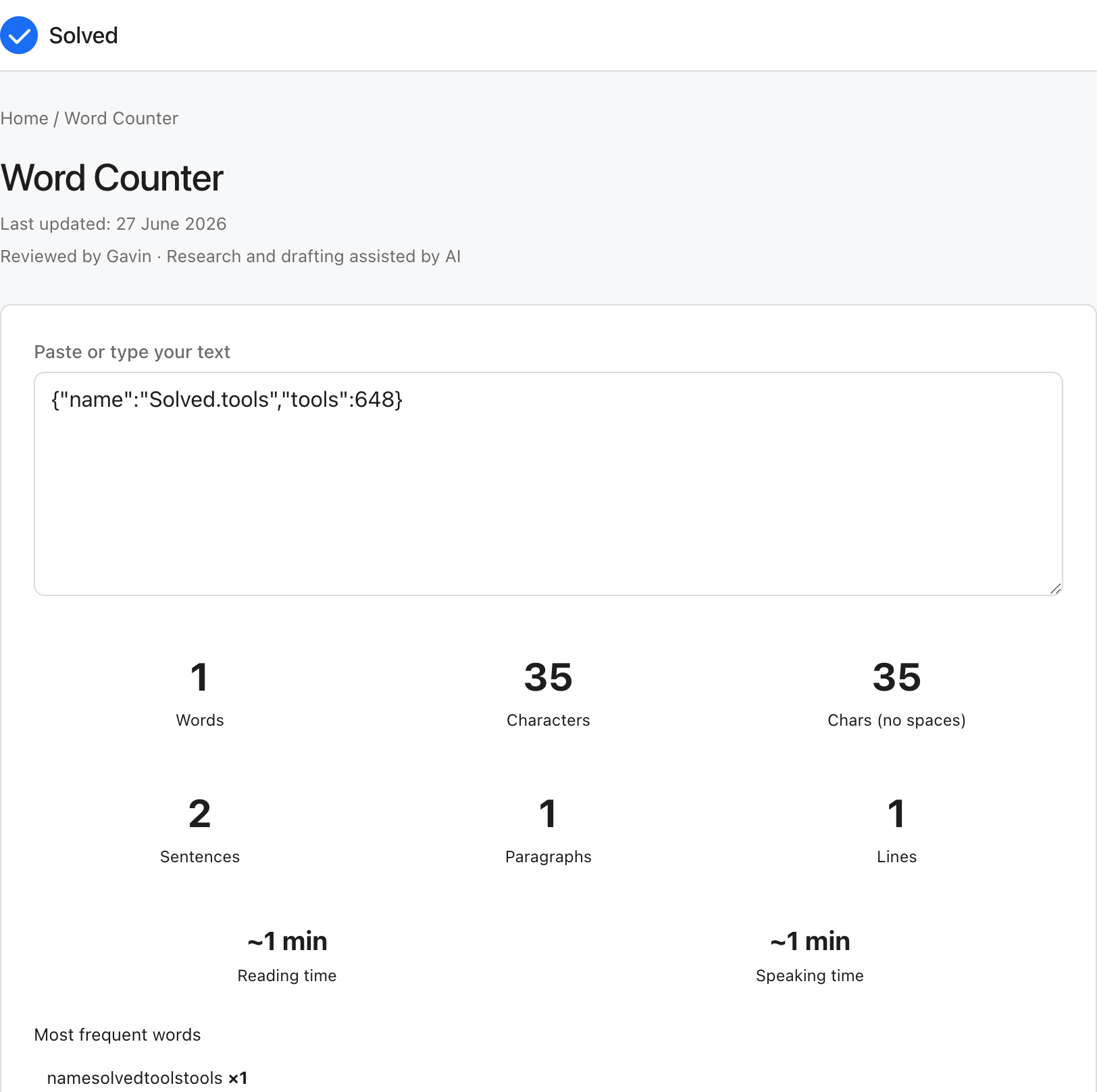
The capture below shows Word Counter after the inputs were entered, with the result on screen. Enter the same values to reproduce it.
Captured from solved.tools on 10 September 2026.
Frequently Asked Questions
Does the word counter include headings and subheadings in the count? Yes. The counter counts all text in the input field, including any headings, bullet points, or subheadings you paste in. If you want to count only body text, paste just the body paragraphs without the headings.
Why does my word count differ from Microsoft Word or Google Docs? Different tools handle edge cases slightly differently, such as hyphenated compounds ("well-being" may be counted as 1 or 2 words), numbers with symbols ("£5,000"), or text in headers, footnotes, and text boxes that Word counts separately. Small discrepancies of 1-5 words are common. For submission deadlines, use the count from the tool specified by your institution or publisher.
What counts as a sentence? A sentence is typically counted by identifying terminal punctuation: full stops, question marks, and exclamation marks. Abbreviations like "Dr." and "e.g." can cause false sentence breaks, so automated sentence counts may vary slightly from a manual count. For most purposes, the automated count is close enough.
Can I count words in multiple languages? Yes. The word counter works with any language that uses whitespace to separate words. Languages that do not use spaces between words (such as Chinese, Japanese, and Thai) require character-based counting rather than word-based counting, and results may differ from what you expect.
Counting a short sample by hand
Any paste with a known shape can be checked against the panel in a few seconds. Two short samples show how the figures on screen relate to each other.
The pangram "The quick brown fox jumps over the lazy dog." counts as 9 words. The string runs to 44 characters including the full stop, and it holds 8 spaces, so the count without spaces is 36. It carries one sentence mark, and with no blank line inside it the paragraph count is 1.
A two-sentence sample behaves the same way. "Pack my box with five dozen liquor jugs. She sells sea shells by the sea shore." counts as 16 words over 79 characters. It holds 15 spaces, so the count without spaces is 64, and it carries two sentence marks. The paragraph count stays at 1 because the two sentences sit on one line with no blank line between them.
Ratios that hold across longer documents
Those two samples and the essay in the example above give three rows of ratios, and characters per word is the useful one.
| Sample | Words | Characters with spaces | Characters without spaces | Characters per word |
|---|---|---|---|---|
| Pangram sentence | 9 | 44 | 36 | 4.89 |
| Two-sentence sample | 16 | 79 | 64 | 4.94 |
| Essay in the example | 2,187 | 12,943 | 10,756 | 5.92 |
Short samples carry fewer characters per word because a pangram packs short words together. Ordinary prose sits near 5.9, and the ratio turns a word target into a character budget. The table below applies both ratios to four common targets.
| Target words | At 4.94 characters per word | At 5.92 characters per word |
|---|---|---|
| 800 | 3,952 | 4,736 |
| 1,500 | 7,410 | 8,880 |
| 2,000 | 9,880 | 11,840 |
| 3,000 | 14,820 | 17,760 |
The essay figures carry further because they all come from one paste. At 2,187 words over 91 sentences the text runs at 24.03 words a sentence, and at 14 paragraphs it runs at 156.21 words a paragraph. Taking the characters without spaces away from the characters with spaces leaves 2,187 characters of whitespace, which is 16.9 percent of the paste.
One pair of figures in the example does not agree. The text says the student cuts 187 words and that a second paste confirms a count of 1,998. A cut from 2,187 to 1,998 removes 189 words, and a cut of 187 words lands on 2,000. The printed pair is left as it stands, and 189 is the figure the two counts imply. A 189-word cut from a 2,187-word essay is 8.6 percent of the words.
The same arithmetic plans a cut in the other direction, from the essay to a lower target:
| Target | Words to remove | Share of the text |
|---|---|---|
| 2,000 | 187 | 8.6 percent |
| 1,800 | 387 | 17.7 percent |
| 1,500 | 687 | 31.4 percent |
| 1,000 | 1,187 | 54.3 percent |
Reaching 1,500 words from 2,187 means removing 687 words, which is close to a third of the text. A cut of that size usually means dropping a whole section rather than trimming sentences, and the sentence and paragraph counts in the panel are the quickest way to see whether a section has gone.
How this counter splits words, sentences and paragraphs
The method behind the panel is short enough to state in full. Words are the segments left when the text is split on whitespace, so a hyphenated compound such as well-being counts once. Characters are the length of the paste, which includes spaces, line breaks and punctuation. Characters without spaces strip every whitespace character first. Sentences are the runs left when the text is split on full stops, question marks and exclamation marks. Paragraphs are the blocks left when the text is split on a blank line, so two paragraphs separated by a single line break count as one.
Two of those rules have limits that show up on ordinary writing. The sentence count treats any full stop as the end of a sentence, so "Dr. Smith went home. He left early." counts as 3 sentences rather than 2, and "See e.g. the note. Then stop." counts as 4. Nothing in the counter adjusts for abbreviations, whatever the formula section above says on that point.
The reading and speaking estimates work at their own rates. Reading time divides the word count by 238 and rounds up, and speaking time divides by 130 and rounds up. A 2,187-word paste therefore reads as 10 minutes and as 17 minutes. The reference table above works at 200 and 250 words a minute, so its 7.5 minutes for 1,500 words and the panel's 7 minutes for the same text come from two different rates rather than from one of them being wrong.
Also try these free tools: