Body Fat Calculator
Last updated: 27 June 2026
Reviewed by Gavin Meiring, Lead research and primary author · Doctoral Candidate (Corporate Governance) · Research and drafting assisted by AI
Uses the US Navy circumference method. Measure at the narrowest point for waist, widest for hips.
- Essential body fat is about 3–5% for men and 10–13% for women. Below these levels, organ function is compromised. The extra fat in women supports hormonal function.
- Body fat percentage can't be accurately measured at home. DEXA scans (dual-energy X-ray absorptiometry) are the gold standard. Skinfold callipers and BIA scales have ±3–5% error.
- Visceral fat (fat around organs) is far more dangerous than subcutaneous fat (fat under skin). A large waist circumference is a better health predictor than total body fat.
Body Fat Calculator
A body fat calculator estimates the percentage of your total body weight that is made up of fat tissue. It is used by fitness enthusiasts, athletes, and health-conscious individuals who want a more detailed picture of their body composition than BMI alone provides. Body fat percentage is a better indicator of health and fitness than weight or BMI because it distinguishes between fat mass and lean mass (muscle, bone, and organs).
How to Use the Body Fat Calculator
- Enter your sex (male or female), as the formulas and healthy ranges differ significantly.
- Input your age, height, and weight.
- Take circumference measurements as prompted: typically waist, neck, and (for women) hips, measured in centimetres or inches.
- The calculator applies the US Navy body fat formula to estimate your body fat percentage.
- Your result is compared to age- and sex-specific healthy body fat ranges.
The Formula
The US Navy method uses body circumference measurements, which are widely accessible without specialist equipment.
For men:
Body Fat % = 86.010 multiplied by log10(Waist minus Neck) minus 70.041 multiplied by log10(Height) plus 36.76
For women:
Body Fat % = 163.205 multiplied by log10(Waist plus Hips minus Neck) minus 97.684 multiplied by log10(Height) minus 78.387
Where all measurements are in centimetres and log10 is the base-10 logarithm.
The waist is measured at the narrowest point (or at the navel for men). The neck is measured below the larynx, sloping slightly downward to the front. The hips (women only) are measured at the widest point.
Real-World Example
A 30-year-old man has the following measurements:
Height: 178 cm Waist: 86 cm Neck: 38 cm
Body Fat % = 86.010 multiplied by log10(86 minus 38) minus 70.041 multiplied by log10(178) plus 36.76
log10(48) = 1.6812 log10(178) = 2.2504
= 86.010 multiplied by 1.6812 minus 70.041 multiplied by 2.2504 plus 36.76 = 144.601 minus 157.606 plus 36.76 = 23.75%
A body fat percentage of 23.75% for a 30-year-old man falls in the "acceptable" category. The American Council on Exercise (ACE) classifications for men are:
Essential fat: 2% to 5% Athletes: 6% to 13% Fitness: 14% to 17% Acceptable: 18% to 24% Obesity: 25% and above
For women, the classifications are shifted upward by approximately 8 to 10 percentage points, reflecting women's physiologically higher essential fat levels.
Methods for Measuring Body Fat
Several methods exist to estimate body fat percentage, ranging from simple to highly accurate.
Tape measure (US Navy method): uses circumference measurements and the formula above. Free and easy at home, but accuracy is moderate. Suitable for tracking trends over time.
Bioelectrical impedance analysis (BIA): a small electrical current passes through the body; fat and lean tissue have different resistance levels. Consumer BIA scales are widely available and convenient but can give variable readings depending on hydration levels.
Skinfold callipers: a trained technician pinches skin at multiple sites and measures the fold thickness with callipers. Moderately accurate when performed by a skilled practitioner using a validated protocol.
DEXA (dual-energy X-ray absorptiometry) scan: the gold standard for body composition measurement. A whole-body DEXA scan provides highly accurate measurements of fat mass, lean mass, and bone density, segmented by body region. Available at sports science facilities and some private health clinics.
Reference Table: Body fat reference ranges for adults
Commonly used adult body fat ranges from the American Council on Exercise. These are population reference bands, not clinical thresholds, and a single measurement carries error. Tape and caliper estimates typically vary by three to four percentage points against a DEXA scan.
| Category | Men | Women |
|---|---|---|
| Essential fat | 2 to 5% | 10 to 13% |
| Athletes | 6 to 13% | 14 to 20% |
| Fitness | 14 to 17% | 21 to 24% |
| Acceptable | 18 to 24% | 25 to 31% |
| Obesity | 25% and above | 32% and above |
Worked Example on Screen
The capture below shows Body Fat Calculator after the inputs were entered, with the result on screen. Enter the same values to reproduce it.
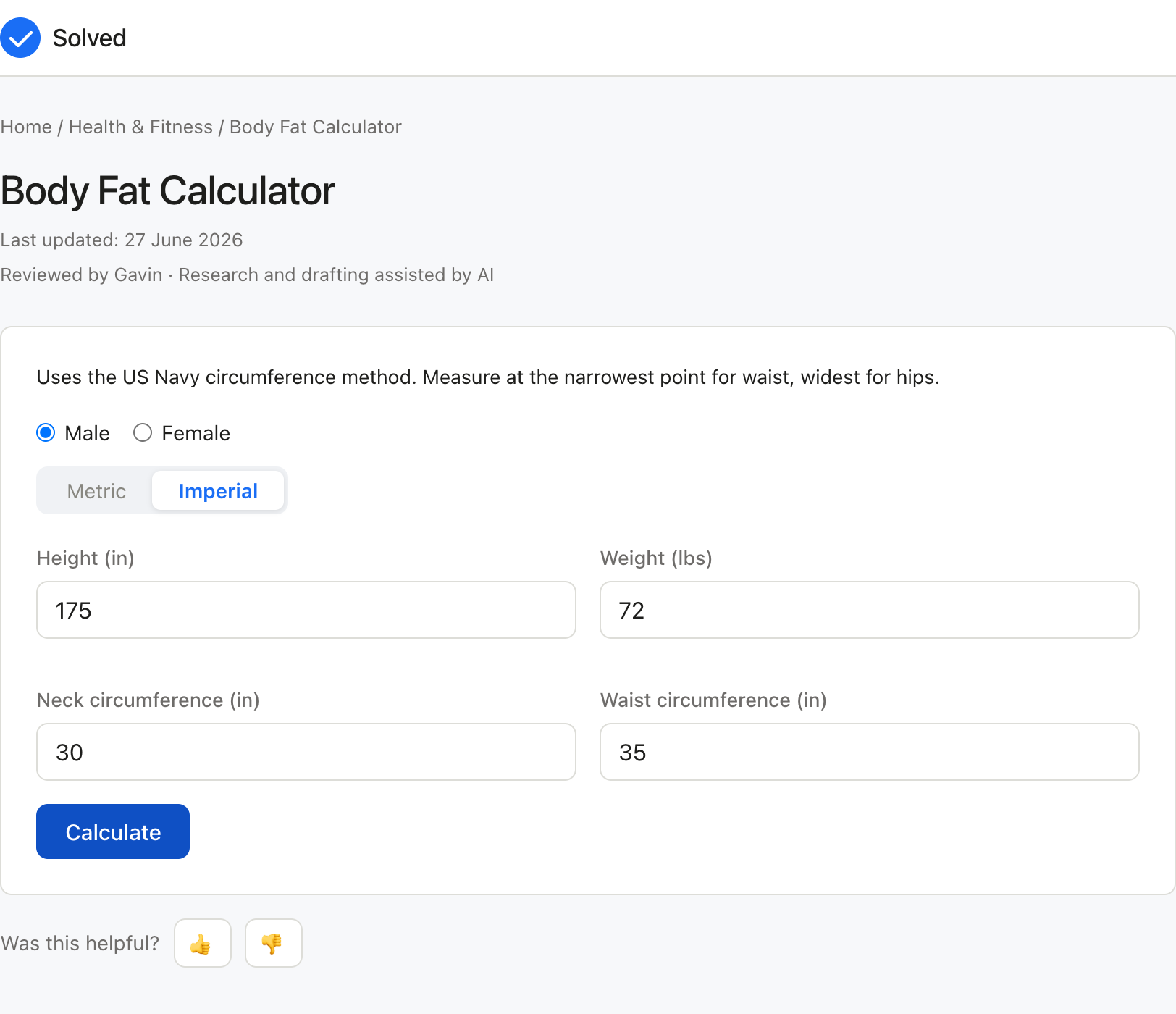
Captured from solved.tools on 10 September 2026.
Frequently Asked Questions
What is a healthy body fat percentage? Healthy body fat ranges depend on age and sex. For men aged 20 to 39, a healthy range is approximately 8% to 19%; for women in the same age group, approximately 21% to 32%. These ranges increase slightly with age. Athletes typically carry less fat: male athletes commonly fall between 6% and 13%, and female athletes between 14% and 20%. Very low body fat below essential levels is dangerous and associated with hormonal disruption and other health issues.
Why does body fat percentage differ between men and women? Women have higher essential fat stores due to the physiological demands of reproduction, including fat stored in the breasts, pelvis, and around organs. This essential fat is approximately 10% to 12% of total body weight in women, compared to approximately 2% to 5% in men. Consequently, all healthy body fat ranges for women are set approximately 8 to 10 percentage points higher than equivalent male ranges.
How accurate is the US Navy formula? The US Navy formula has been validated against underwater weighing (hydrostatic weighing), which is one of the more accurate reference methods. Studies suggest accuracy within approximately 3 to 4 percentage points for most individuals. It is less accurate for very lean or very obese individuals, and circumference measurement technique significantly affects results. Take measurements consistently at the same time of day, before eating or exercising, for best comparability.
How often should I measure my body fat? Measuring body fat more than once a month is generally not useful, as changes in composition occur slowly. Monthly measurements provide enough data to assess trends without the noise of day-to-day fluctuations. More important than the absolute number is the direction of change: if you are losing fat and maintaining or gaining muscle over months, the programme is working.
Also try these free tools:
Extended Reference Notes
The notes below cover the broader context that informs how to use the Body Fat Calculator well.
Typical Input Ranges
Most real-world uses of the Body Fat Calculator fall into a middle band where the result is stable and useful. Very small inputs to the Body Fat Calculator often round to zero or near-zero, and very large inputs amplify every rounding error in the calculation. The middle band, where the Body Fat Calculator inputs are ordinary sizes, is where the tool is most reliable.
Assumptions Behind the Formula
The Body Fat Calculator assumes the inputs stay fixed across the period or scenario being modelled. Rates move, values change, and fees appear, so treat the Body Fat Calculator output as a clean reference and layer in the frictions your own situation adds.
Common Edge Cases
Three situations change the Body Fat Calculator answer in ways the formula does not surface: boundary values near zero, rounding cascades across many steps, and unit mismatches between fields. When any of these apply, sanity-check the Body Fat Calculator result against an independent estimate.
When to Revisit the Calculation
The Body Fat Calculator output is only as current as its inputs, so re-run the calculation whenever a key value changes materially. A quarterly re-check of the Body Fat Calculator suits personal planning; monthly suits active business or investment decisions.
Relationship to Other Tools
The Body Fat Calculator shares inputs and outputs with the other tools in its category. If the same numbers feed several tools, capture them once and run each tool so the comparison stays consistent with the Body Fat Calculator.
Practical Checklist Before Relying on the Result
Before acting on the Body Fat Calculator output, run a short mental checklist: inputs in the right units, direction of the result matching intuition, and magnitude plausible. Each check takes seconds and catches the most common classes of Body Fat Calculator error before they reach a decision.
Putting the Result to Work
A single Body Fat Calculator run usually narrows the range of plausible answers rather than settling the question. Compare the Body Fat Calculator result against a benchmark or a previous run, and ask what would have to change for the answer to flip a decision.
Sensitivity to Inputs
Some inputs move the Body Fat Calculator result more than others; changing each by a small amount shows which ones matter. Spend the effort on the high-impact Body Fat Calculator inputs and treat the low-impact ones as approximate.
A Note on Stale Inputs
A calculation is only as fresh as the inputs that feed it, so note the date the Body Fat Calculator inputs were last refreshed. A six-month-old Body Fat Calculator result can be as wrong as a wrong calculation when the underlying values have moved on.