BMR Calculator
Last updated: 27 June 2026
Reviewed by Gavin Meiring, Lead research and primary author · Doctoral Candidate (Corporate Governance) · Research and drafting assisted by AI
- Your Basal Metabolic Rate accounts for 60–70% of your total daily calorie burn — even if you sit completely still all day.
- The Mifflin-St Jeor equation (used by most BMR calculators) was developed in 1990 and is considered more accurate than the older Harris-Benedict equation from 1919.
- Muscle tissue burns about 3x more calories at rest than fat tissue. This is why strength training is so effective for long-term weight management — it raises your resting metabolic rate.
BMR Calculator (Basal Metabolic Rate)
A BMR calculator estimates the number of calories your body burns at complete rest, simply to maintain basic physiological functions such as breathing, circulation, and cell repair. It is the foundation for all calorie-based nutrition planning and is used by dietitians, personal trainers, and individuals who want to understand their baseline energy needs before accounting for physical activity. Knowing your BMR helps you set realistic calorie targets for weight loss, maintenance, or muscle gain.
How to Use the BMR Calculator
- Enter your sex (male or female), as the formulas differ significantly between sexes.
- Input your age in years.
- Enter your height in centimetres (or feet and inches).
- Enter your weight in kilograms (or pounds).
- The calculator applies the Mifflin-St Jeor equation (the most validated formula) and displays your BMR in calories per day.
- To find your Total Daily Energy Expenditure (TDEE), multiply the BMR by your activity factor.
The Formula
The Mifflin-St Jeor equation (recommended by the Academy of Nutrition and Dietetics):
For men: BMR = (10 multiplied by weight in kg) plus (6.25 multiplied by height in cm) minus (5 multiplied by age in years) plus 5
For women: BMR = (10 multiplied by weight in kg) plus (6.25 multiplied by height in cm) minus (5 multiplied by age in years) minus 161
The Harris-Benedict equation is an older alternative still widely used:
For men: BMR = 88.362 plus (13.397 multiplied by weight in kg) plus (4.799 multiplied by height in cm) minus (5.677 multiplied by age in years)
For women: BMR = 447.593 plus (9.247 multiplied by weight in kg) plus (3.098 multiplied by height in cm) minus (4.330 multiplied by age in years)
Mifflin-St Jeor is generally more accurate for modern populations and is preferred.
Real-World Example
A 40-year-old man weighs 85 kg and is 180 cm tall.
BMR (Mifflin-St Jeor) = (10 multiplied by 85) plus (6.25 multiplied by 180) minus (5 multiplied by 40) plus 5 = 850 plus 1,125 minus 200 plus 5 = 1,780 calories per day
This means the man burns approximately 1,780 calories per day simply to keep his organs functioning, even if he stayed in bed all day. To find his TDEE (total calories burned with activity), multiply by an activity factor:
Sedentary: 1,780 multiplied by 1.2 = 2,136 calories Moderately active: 1,780 multiplied by 1.55 = 2,759 calories Very active: 1,780 multiplied by 1.725 = 3,071 calories
For weight maintenance at a moderate activity level, this man should consume approximately 2,759 calories per day. To lose 0.5 kg per week, he would subtract approximately 500 calories, targeting around 2,259 per day.
What Affects Your BMR
Several factors influence your basal metabolic rate beyond age, sex, height, and weight.
Muscle mass is the most impactful modifiable factor. Muscle tissue burns significantly more calories at rest than fat tissue. Each kilogram of muscle burns approximately 13 calories per day at rest, compared to roughly 4 calories per kilogram of fat. This is why two people of the same weight but different body compositions can have meaningfully different BMRs.
Thyroid function directly controls metabolic rate. An underactive thyroid (hypothyroidism) suppresses BMR, leading to weight gain and fatigue. An overactive thyroid (hyperthyroidism) raises BMR, causing weight loss and restlessness. If your weight refuses to respond to diet and exercise as expected, thyroid function is worth investigating with your GP.
Genetics account for some variation in BMR that cannot be explained by body composition or activity alone. Some individuals simply have faster or slower metabolisms, which is one reason people respond differently to identical calorie-controlled diets.
Temperature also plays a role. Living in a cold environment slightly increases BMR as the body expends energy to maintain core temperature. This effect is small in modern climate-controlled environments.
Reference Table: Mifflin-St Jeor basal rates for sample profiles
Basal metabolic rate at rest for four profiles, using the Mifflin-St Jeor equation. Age matters: the same 80 kg man needs about 100 more calories a day at 30 than at 50. Multiply the value by an activity factor for maintenance calories.
| Profile | BMR |
|---|---|
| Man, 30, 80 kg, 180 cm | 1780 kcal |
| Man, 50, 80 kg, 180 cm | 1680 kcal |
| Woman, 30, 60 kg, 165 cm | 1320 kcal |
| Woman, 50, 60 kg, 165 cm | 1220 kcal |
Worked Example on Screen
The capture below shows BMR Calculator after the inputs were entered, with the result on screen. Enter the same values to reproduce it.
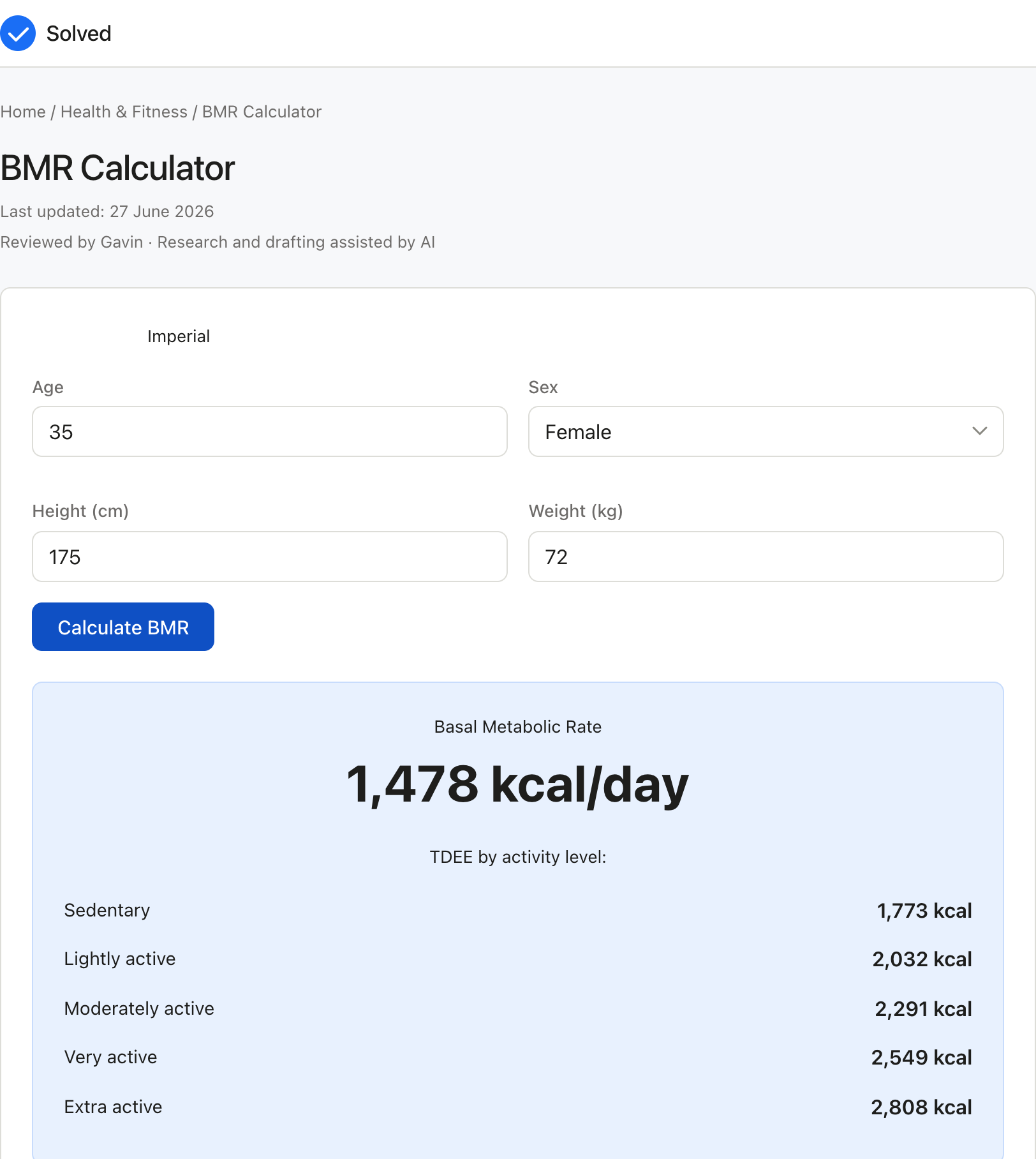
Captured from solved.tools on 10 September 2026.
Frequently Asked Questions
What is the difference between BMR and TDEE? BMR (Basal Metabolic Rate) is the calories burned at complete rest. TDEE (Total Daily Energy Expenditure) is the total calories burned including all physical activity. TDEE is calculated by multiplying BMR by an activity multiplier (typically between 1.2 for sedentary individuals and 1.9 for very active ones). TDEE is the figure you use for practical nutrition planning.
Does BMR decrease with age? Yes. BMR typically declines by approximately 1% to 2% per decade after age 20, largely because muscle mass tends to decrease with age (sarcopenia). However, individuals who maintain muscle mass through resistance training can significantly slow this decline. The age-related decrease in BMR is one reason why eating habits that maintained weight at 30 may lead to gradual weight gain at 50.
Can I increase my BMR? The most effective way to increase BMR is to build and maintain muscle mass through resistance training. Muscle tissue is more metabolically active than fat. Eating adequate protein also contributes through the thermic effect of food (protein requires more energy to digest than carbohydrates or fat). Extreme calorie restriction paradoxically lowers BMR through metabolic adaptation, which is why very low-calorie diets are counterproductive long-term.
Is BMR different from RMR? BMR (Basal Metabolic Rate) technically refers to calories burned under highly controlled clinical conditions: lying completely still after a full night's sleep in a thermoneutral environment, at least 12 hours after eating. RMR (Resting Metabolic Rate) is the more practical measurement taken under regular resting conditions. RMR is typically 10% to 20% higher than true BMR because it includes slightly more activity. In everyday use, the terms are often used interchangeably, and the distinction rarely matters for practical nutrition planning.
Also try these free tools:
Extended Reference Notes
The notes below cover the broader context that informs how to use the BMR Calculator (Basal Metabolic Rate) well.
Typical Input Ranges
Most real-world uses of the BMR Calculator (Basal Metabolic Rate) fall into a middle band where the result is stable and useful. Very small inputs to the BMR Calculator (Basal Metabolic Rate) often round to zero or near-zero, and very large inputs amplify every rounding error in the calculation. The middle band, where the BMR Calculator (Basal Metabolic Rate) inputs are ordinary sizes, is where the tool is most reliable.
Assumptions Behind the Formula
The BMR Calculator (Basal Metabolic Rate) assumes the inputs stay fixed across the period or scenario being modelled. Rates move, values change, and fees appear, so treat the BMR Calculator (Basal Metabolic Rate) output as a clean reference and layer in the frictions your own situation adds.
Common Edge Cases
Three situations change the BMR Calculator (Basal Metabolic Rate) answer in ways the formula does not surface: boundary values near zero, rounding cascades across many steps, and unit mismatches between fields. When any of these apply, sanity-check the BMR Calculator (Basal Metabolic Rate) result against an independent estimate.
When to Revisit the Calculation
The BMR Calculator (Basal Metabolic Rate) output is only as current as its inputs, so re-run the calculation whenever a key value changes materially. A quarterly re-check of the BMR Calculator (Basal Metabolic Rate) suits personal planning; monthly suits active business or investment decisions.
Relationship to Other Tools
The BMR Calculator (Basal Metabolic Rate) shares inputs and outputs with the other tools in its category. If the same numbers feed several tools, capture them once and run each tool so the comparison stays consistent with the BMR Calculator (Basal Metabolic Rate).
Practical Checklist Before Relying on the Result
Before acting on the BMR Calculator (Basal Metabolic Rate) output, run a short mental checklist: inputs in the right units, direction of the result matching intuition, and magnitude plausible. Each check takes seconds and catches the most common classes of BMR Calculator (Basal Metabolic Rate) error before they reach a decision.
Putting the Result to Work
A single BMR Calculator (Basal Metabolic Rate) run usually narrows the range of plausible answers rather than settling the question. Compare the BMR Calculator (Basal Metabolic Rate) result against a benchmark or a previous run, and ask what would have to change for the answer to flip a decision.
Sensitivity to Inputs
Some inputs move the BMR Calculator (Basal Metabolic Rate) result more than others; changing each by a small amount shows which ones matter. Spend the effort on the high-impact BMR Calculator (Basal Metabolic Rate) inputs and treat the low-impact ones as approximate.
A Note on Stale Inputs
A calculation is only as fresh as the inputs that feed it, so note the date the BMR Calculator (Basal Metabolic Rate) inputs were last refreshed. A six-month-old BMR Calculator (Basal Metabolic Rate) result can be as wrong as a wrong calculation when the underlying values have moved on.