Auto Loan Calculator
Last updated: 27 June 2026
Reviewed by Gavin Meiring, Lead research and primary author · Doctoral Candidate (Corporate Governance) · Research and drafting assisted by AI
- The average new car loan in the US is now over $40,000, with monthly payments averaging $738. Around a third of buyers owe more than their car is worth.
- Cars typically lose about 20% of their value in the first year and around 50% after three years. This depreciation is often a bigger cost than the loan interest.
- The first auto loan was issued by Guaranty Securities Company in 1919 to help buyers afford the $525 Model T Ford — a sum most workers couldn't pay outright.
Auto Loan Calculator
An auto loan calculator works out your monthly car finance payment, total interest paid, and total cost of the loan based on the vehicle price, deposit, interest rate, and term. It is used by anyone buying a new or used car on finance who wants to compare deals, understand the full cost of borrowing, and decide on the right loan term.
How to Use the Auto Loan Calculator
- Enter the vehicle price.
- Enter your deposit or part-exchange value to find the loan amount needed.
- Enter the annual interest rate from the finance agreement or the representative APR.
- Set the loan term in months (typically 24, 36, 48, or 60 months).
- Click calculate to see the monthly payment, total interest, and total amount repaid.
The Formula
Auto loan repayments use the standard amortisation formula:
M = P x (r(1 + r)^n) / ((1 + r)^n - 1)
Where M is the monthly payment, P is the loan principal (vehicle price minus deposit), r is the monthly interest rate (annual rate divided by 12, expressed as a decimal), and n is the total number of monthly payments. Total interest paid equals (M x n) - P.
Real-World Example
Vehicle price: £22,000. Deposit: £4,000. Loan amount: £18,000. APR: 6.9%. Term: 48 months.
- Monthly rate: 6.9% / 12 / 100 = 0.00575
- Monthly payment: 18,000 x (0.00575 x (1.00575)^48) / ((1.00575)^48 - 1) = approximately £428
- Total repaid: £428 x 48 = £20,544
- Total interest: £20,544 - £18,000 = £2,544
Extending the term to 60 months reduces the monthly payment to approximately £356 but increases total interest to approximately £3,360. The longer term saves £72 per month but costs an extra £816 overall.
PCP Versus HP: Choosing the Right Finance Type
Most car finance in the UK takes one of two forms. Hire Purchase (HP) spreads the full vehicle cost over the term with equal monthly payments; you own the car outright at the end. Personal Contract Purchase (PCP) has lower monthly payments because you only finance the depreciation during the term, not the full value. At the end of a PCP agreement, you either pay a final balloon payment (the Guaranteed Minimum Future Value) to own the car, return it, or use any positive equity as a deposit on a new deal. PCP monthly payments are lower, but the total cost including the balloon payment is usually higher than HP. Use this calculator to model the HP cost; for PCP, also factor in the balloon payment and compare the total cost of ownership across both options before deciding.
Reference Table: Car loan payment ladder on $35,000
Monthly payments on a $35,000 vehicle at four rates and three terms, before insurance, fuel and maintenance. One extra year of term cuts the payment but raises the interest bill: at 8% the six-year option costs $9,184 in interest against $4,484 over three years.
| Rate | 3 years | 5 years | 6 years |
|---|---|---|---|
| 4% | $1,033 | $645 | $548 |
| 6% | $1,065 | $677 | $580 |
| 8% | $1,097 | $710 | $614 |
| 10% | $1,129 | $744 | $648 |
Worked Example on Screen
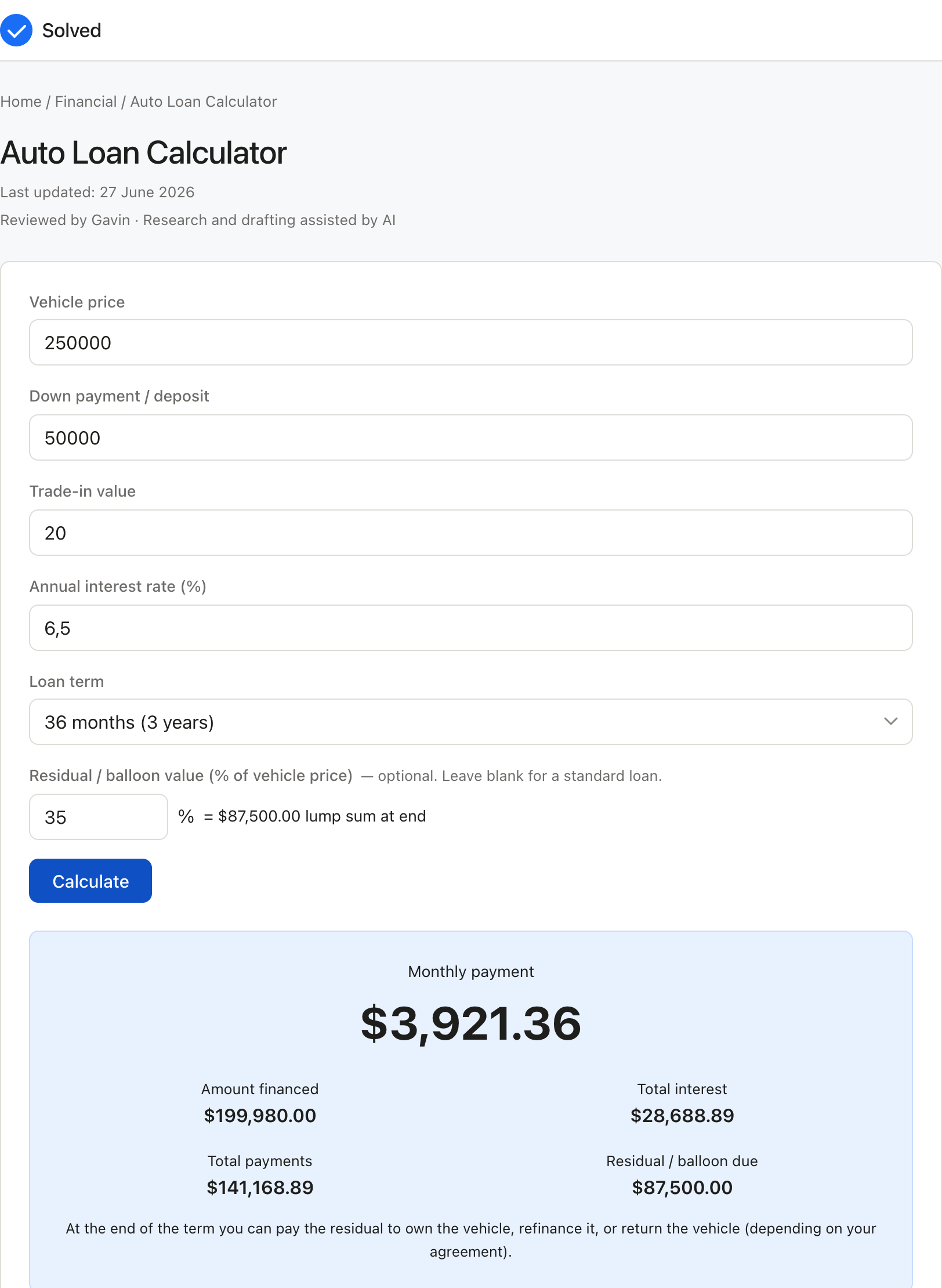
The capture below shows Auto Loan Calculator after the inputs were entered, with the result on screen. Enter the same values to reproduce it.
Captured from solved.tools on 10 September 2026.
Frequently Asked Questions
What is a reasonable APR for a car loan? New car finance from manufacturers often offers promotional rates of 0 to 3.9% APR on specific models. Standard personal loans for used cars typically range from 5 to 10% APR depending on your credit score and the lender. Dealer finance arranged on the forecourt is often more expensive than a pre-arranged personal loan from a bank or comparison site. Always compare the total amount repayable, not just the monthly payment.
Should I put down a larger deposit? A larger deposit reduces the loan principal, which lowers both the monthly payment and the total interest paid. It also improves your loan-to-value ratio, which may qualify you for a better interest rate. However, tying up a large cash sum in a depreciating asset has an opportunity cost. Balance the interest saving against what else the deposit could earn if invested elsewhere.
Does car finance affect my credit score? Taking out car finance adds a hard search to your credit file and a new credit account. Making all payments on time builds a positive payment history, which improves your score over time. Missing payments has a significant negative effect. If you are planning to apply for a mortgage, be aware that car finance increases your total monthly debt commitments, which affects the mortgage affordability calculation.
Can I pay off a car loan early? Yes. Most HP and personal loan agreements allow early settlement, and doing so saves interest. Under the Consumer Credit Act, you are entitled to a rebate of charges for early repayment. Some agreements include an early settlement fee, typically one to two months of interest. Request a settlement figure from your lender before paying off early.
Deposit ladder at 6.9% over 48 months
The example above finances £18,000 of a £22,000 car. Hold the term at 48 months and the rate at 6.9%, and each deposit does the following.
| Deposit | Amount financed | Monthly payment | Total interest | | £2,000 | £20,000 | £478.00 | £2,943.88 | | £4,000 | £18,000 | £430.20 | £2,649.49 | | £6,000 | £16,000 | £382.40 | £2,355.11 | | £8,000 | £14,000 | £334.60 | £2,060.72 |
Each extra £2,000 of deposit cuts the monthly payment by about £48 and the interest bill by between £294 and £295. The saving stays close to linear across this range, so the first £2,000 of deposit is worth about as much as the last on a loan of this size.
Which rate the formula expects
The formula on this page divides the annual rate by 12, so 6.9% becomes a monthly rate of 0.575%. On the £18,000 loan over 48 months that returns £430.20 a month.
Lenders quote APR on the effective annual basis, where interest compounds through the year. Converting 6.9% as an effective annual rate gives a monthly rate of 0.5576% and a payment of £428.46, which is where the £428 in the example above comes from. The two conventions sit £1.74 apart on this loan, and the gap widens as the rate and the term rise.
One more comparison repays the arithmetic. At 5.9% rather than 6.9% on the same £18,000 over 48 months, the payment falls to £421.91 and total interest falls to £2,251.48. One percentage point of APR is worth about £398 of interest on this loan, which is usually more than the discount a dealer offers in place of a lower rate.
Also try these free tools related to Auto Loan Calculator: - Loan Calculator
Extended Reference Notes
The notes below cover the broader context that informs how to use the Auto Loan Calculator well.
Typical Input Ranges
Most real-world uses of the Auto Loan Calculator fall into a middle band where the result is stable and useful. Very small inputs to the Auto Loan Calculator often round to zero or near-zero, and very large inputs amplify every rounding error in the calculation. The middle band, where the Auto Loan Calculator inputs are ordinary sizes, is where the tool is most reliable.
Assumptions Behind the Formula
The Auto Loan Calculator assumes the inputs stay fixed across the period or scenario being modelled. Rates move, values change, and fees appear, so treat the Auto Loan Calculator output as a clean reference and layer in the frictions your own situation adds.
Common Edge Cases
Three situations change the Auto Loan Calculator answer in ways the formula does not surface: boundary values near zero, rounding cascades across many steps, and unit mismatches between fields. When any of these apply, sanity-check the Auto Loan Calculator result against an independent estimate.
When to Revisit the Calculation
The Auto Loan Calculator output is only as current as its inputs, so re-run the calculation whenever a key value changes materially. A quarterly re-check of the Auto Loan Calculator suits personal planning; monthly suits active business or investment decisions.
Relationship to Other Tools
The Auto Loan Calculator shares inputs and outputs with the other tools in its category. If the same numbers feed several tools, capture them once and run each tool so the comparison stays consistent with the Auto Loan Calculator.
Practical Checklist Before Relying on the Result
Before acting on the Auto Loan Calculator output, run a short mental checklist: inputs in the right units, direction of the result matching intuition, and magnitude plausible. Each check takes seconds and catches the most common classes of Auto Loan Calculator error before they reach a decision.
Putting the Result to Work
A single Auto Loan Calculator run usually narrows the range of plausible answers rather than settling the question. Compare the Auto Loan Calculator result against a benchmark or a previous run, and ask what would have to change for the answer to flip a decision.
Sensitivity to Inputs
Some inputs move the Auto Loan Calculator result more than others; changing each by a small amount shows which ones matter. Spend the effort on the high-impact Auto Loan Calculator inputs and treat the low-impact ones as approximate.
A Note on Stale Inputs
A calculation is only as fresh as the inputs that feed it, so note the date the Auto Loan Calculator inputs were last refreshed. A six-month-old Auto Loan Calculator result can be as wrong as a wrong calculation when the underlying values have moved on.