Percentage Calculator
Last updated: 28 June 2026
Reviewed by Gavin Meiring, Lead research and primary author · Doctoral Candidate (Corporate Governance) · Research and drafting assisted by AI
- The % symbol evolved from the Italian 'per cento' (per hundred). By the 17th century, it was often written as 'p cento', then 'pc', then the strokes became the modern % sign.
- 'Percent' means per hundred. So 200% doesn't mean 'all of it twice' — it means 200 out of every 100, or 2 times the original.
- Percentage points and percentages are different. If unemployment rises from 4% to 5%, that's a 1 percentage point increase — but a 25% increase in the unemployment rate.
Percentage Calculator
A percentage calculator solves the three most common percentage problems: finding a percentage of a number, finding what percentage one number is of another, and calculating percentage change between two values. It is used by students, shoppers, business analysts, and anyone working with proportional data.
How to Use the Percentage Calculator
- Select the type of calculation: percentage of a number, percentage one number is of another, or percentage change.
- Enter the required values in the input fields.
- Click Calculate to see the result with a plain-language explanation.
- Switch between calculation types using the tabs or dropdown if you need a different operation.
- Use the reverse calculation option to work backwards from a result if needed.
The Formula
To find P percent of a number N: result = (P divided by 100) multiplied by N. To find what percentage A is of B: percentage = (A divided by B) multiplied by 100. To calculate percentage change from old value V1 to new value V2: percentage change = ((V2 minus V1) divided by V1) multiplied by 100. A positive result is an increase; a negative result is a decrease.
Real-World Example
A coat originally priced at 180 pounds is on sale for 135 pounds. Percentage discount = ((135 minus 180) divided by 180) multiplied by 100 = (minus 45 divided by 180) multiplied by 100 = minus 25%. The coat is discounted by 25 percent. To verify: 25 percent of 180 = (25 divided by 100) multiplied by 180 = 45. Original price minus discount = 180 minus 45 = 135 pounds. Confirmed.
Common Percentage Calculations in Daily Life
VAT at 20 percent: multiply the pre-VAT price by 1.20 to get the total price, or divide the total price by 1.20 to find the pre-VAT amount. Pay rise calculation: new salary = old salary multiplied by (1 plus percentage increase divided by 100). Investment return: percentage return = ((current value minus initial investment) divided by initial investment) multiplied by 100. Tip calculation: tip amount = bill total multiplied by tip percentage divided by 100.
Reference Table: Common percentages of everyday amounts
Five percentages applied to four amounts. Ten per cent is a decimal shift, so 10% of $80 is $8.00. A 20% discount on $120 takes $24 off the price.
| Percentage | of $25 | of $80 | of $120 | of $200 |
|---|---|---|---|---|
| 5% | 1.25 | 4.00 | 6.00 | 10.00 |
| 10% | 2.50 | 8.00 | 12.00 | 20.00 |
| 15% | 3.75 | 12.00 | 18.00 | 30.00 |
| 20% | 5.00 | 16.00 | 24.00 | 40.00 |
| 25% | 6.25 | 20.00 | 30.00 | 50.00 |
Worked Example on Screen
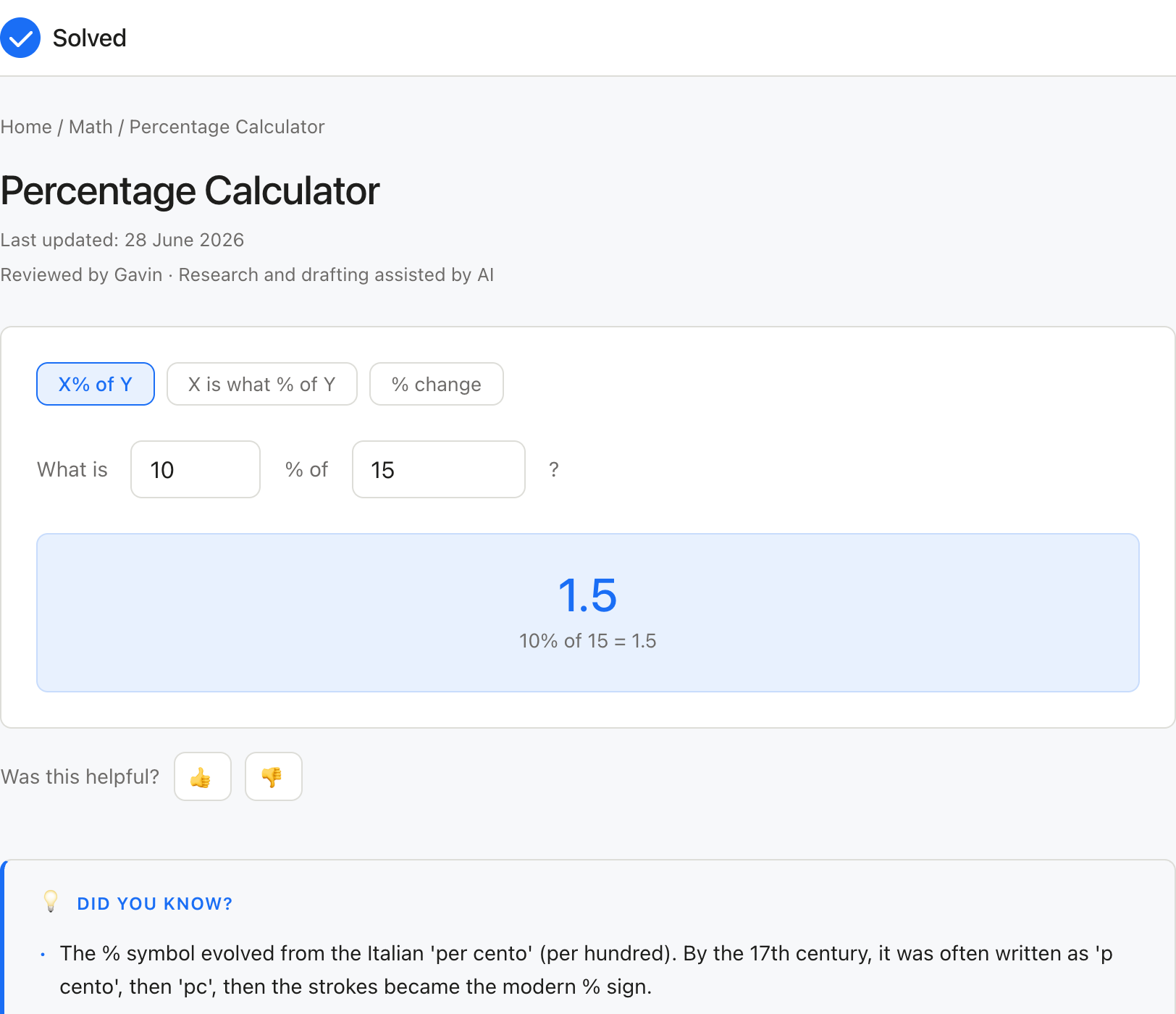
The capture below shows Percentage Calculator after the inputs were entered, with the result on screen. Enter the same values to reproduce it.
Captured from solved.tools on 10 September 2026.
Frequently Asked Questions
What is the difference between percentage change and percentage points? Percentage change measures the relative shift from a starting value. Percentage points measure the absolute arithmetic difference between two percentages. If interest rates rise from 2% to 3%, that is a 1 percentage point increase but a 50 percent change relative to the original rate.
How do I add and remove VAT from a price? To add 20% VAT: multiply the net price by 1.20. To remove 20% VAT from a gross price: divide the gross price by 1.20. Do not subtract 20% from the gross price; that gives the wrong answer because the percentage is calculated on a different base.
What does "percentage of what?" mean and why does it matter? Every percentage is a fraction of some base value, and the result changes dramatically depending on which base you use. A 10% discount on a 200-pound item saves 20 pounds; the same 10% on a 50-pound item saves only 5 pounds. Always clarify what the percentage is being applied to.
Can percentages exceed 100? Yes. A percentage greater than 100 means the part is larger than the whole you are comparing to. For example, if sales grow from 50 units to 130 units, that is a 160 percent increase. This is common in growth metrics and investment returns.
The three operations on one pair of numbers
Take the two prices already on this page, £180 and £135, and run all three of the calculator's operations on them. The answers are different because each one asks a different question of the same pair.
| Question | Working | Answer |
|---|---|---|
| What is 25 percent of £180? | (25 / 100) x 180 | £45.00 |
| What percentage is £135 of £180? | (135 / 180) x 100 | 75.00% |
| What is the change from £180 to £135? | ((135 minus 180) / 180) x 100 | minus 25.00% |
The £45 in the first row is the same £45 that appears as the discount in the page's own check, and the 75 percent in the second row says that the sale price is three quarters of the original. The third row is the operation most often confused with the first, and the two are not interchangeable: £45 is 25 percent of £180 in money, while the move from £180 to £135 is a 25 percent fall in the ratio of one price to the other.
Percentage change runs in two directions
A fall and the rise that undoes it are never the same size, because they are measured against different bases.
| Move | Change | Reverse move | Change |
|---|---|---|---|
| £180 to £135 | minus 25.00% | £135 to £180 | plus 33.33% |
| £120 to £96 | minus 20.00% | £96 to £120 | plus 25.00% |
| £200 to £250 | plus 25.00% | £250 to £200 | minus 20.00% |
| £80 to £100 | plus 25.00% | £100 to £80 | minus 20.00% |
The rule behind the table is short. To undo a fall of p percent you need a rise of p / (100 minus p) percent, and to undo a rise of p percent you need a fall of p / (100 plus p) percent. A 25 percent fall needs a 33.33 percent rise to recover, because 25 / 75 gives a third. A 25 percent rise needs only a 20 percent fall, because 25 / 125 gives a fifth. The page's own coat example is the same relationship read backwards: the £45 saved on £180 is 25 percent of the original, and the £45 needed to get back from £135 is 33.33 percent of the sale price.
Percentage points against percentage change
The page's FAQ uses a rate moving from 2 percent to 3 percent to separate the two measures, and the same pair of figures is worth tabulating further.
| Move | Change in percentage points | Percentage change |
|---|---|---|
| 2% to 3% | plus 1.00 | plus 50.00% |
| 2% to 2.5% | plus 0.50 | plus 25.00% |
| 5% to 4% | minus 1.00 | minus 20.00% |
| 150% to 200% | plus 50.00 | plus 33.33% |
The last row is the one that catches people out. A rate moving from 150 percent to 200 percent has moved 50 percentage points, and the relative change is 33.33 percent, not 50 percent. Both statements are correct and they answer different questions. Reporting a move in points and a move in percent in the same sentence without naming which is which is the most common error on the page's subject matter.
Adding and removing VAT at 20 percent
The page gives the method for both directions: multiply the net figure by 1.20 to add the tax, and divide the gross figure by 1.20 to take it back off. The second operation is where the arithmetic goes wrong most often, because subtracting 20 percent from a gross figure is not the same as dividing by 1.20.
| Gross price | Net by dividing by 1.20 | Net by taking 20 percent off | Difference | VAT by dividing | VAT as 20 percent of the gross | Difference |
|---|---|---|---|---|---|---|
| £120.00 | £100.00 | £96.00 | £4.00 | £20.00 | £24.00 | £4.00 |
| £250.00 | £208.33 | £200.00 | £8.33 | £41.67 | £50.00 | £8.33 |
| £299.99 | £249.99 | £239.99 | £10.00 | £50.00 | £60.00 | £10.00 |
The error runs one way. Taking 20 percent off the gross understates the net figure and overstates the tax inside it, because the 20 percent is being taken off a base that already includes the tax. On a £250 gross the gap is £8.33, small on one invoice and material across a year of them. The correct base for the 20 percent is the net figure, £208.33, and 20 percent of that is £41.67.
The reverse direction is simpler because the base is already the net figure. £249.99 of net sales becomes £299.99 including VAT, and the £50.00 of tax is 20 percent of the £249.99.
A discount ladder on the page's own price
Holding the original price at £180 and moving only the discount produces this ladder, with the page's own 25 percent row in the middle of it.
| Percentage off | Saving | Sale price |
|---|---|---|
| 5% | £9.00 | £171.00 |
| 10% | £18.00 | £162.00 |
| 15% | £27.00 | £153.00 |
| 20% | £36.00 | £144.00 |
| 25% | £45.00 | £135.00 |
| 30% | £54.00 | £126.00 |
| 40% | £72.00 | £108.00 |
Reading down the saving column, each extra 5 percentage points of discount costs the seller £9 on this price. That constant step is a property of the fixed base and not a general rule. Once the base changes, the same 5 percentage points is worth a different amount, which is the point the page's FAQ makes about asking percentage of what.
Successive percentages do not add
Two changes applied one after the other compound rather than sum, and the result is always further from the start than the arithmetic suggests.
| Starting figure | First move | After the first | Second move | After the second | If the moves simply added |
|---|---|---|---|---|---|
| £200 | plus 10% | £220.00 | plus 10% | £242.00 | £240.00 |
| £200 | plus 20% | £240.00 | plus 20% | £288.00 | £280.00 |
| £200 | minus 10% | £180.00 | minus 10% | £162.00 | £160.00 |
A rise followed by an equal fall does not return to the start either. £200 up 10 percent gives £220, and £220 down 10 percent gives £198, which is £2 below where it began. The order does not matter for the final figure, only the direction of the last move against the size of the base at that point.
Reading each result against its base
Every figure above takes its base from somewhere, and naming the base is what keeps the arithmetic honest.
- A percentage of a number uses the number itself as the base. The 10 percent row of the discount ladder uses £180.
- A percentage change uses the starting value as the base, never the finishing one. The fall from £180 to £135 divides the £45 by £180 and not by £135.
- A percentage point is an arithmetic difference between two percentages and needs no base at all.
- A reverse percentage divides by the multiplier. Where the gross figure is the input, the base is the net figure and the divisor is 1.20.
- Rounding is applied at the end. Rounding a percentage before multiplying it into a price introduces an error in the money figure that the calculator's own display will not show.
Two checks worth building into a habit
- Work the calculation backwards from the answer. If a 25 percent discount on £180 gives £135, then £135 divided by £180 should give 75 percent, and it does.
- Compare the size of the change against the size of the starting figure. A change that looks large as a percentage and small in money is a sign that the base was small, which is often the real answer to a dispute about a figure.
Also try these free tools: