401(k) Calculator
Last updated: 27 June 2026
Reviewed by Gavin Meiring, Lead research and primary author · Doctoral Candidate (Corporate Governance) · Research and drafting assisted by AI
- The 401(k) takes its name from section 401(k) of the US Internal Revenue Code, added by the Revenue Act of 1978 — the 'k' is just a subsection letter, not an acronym.
- Benefits consultant Ted Benna is known as the 'father of the 401(k)': reading the 1978 law in 1980, he realised employees could defer salary into retirement accounts, and he helped the Johnson Companies of Pennsylvania adopt the first plan in 1981.
- The provision was added to the 1978 tax law almost as an afterthought — it took IRS regulations in late 1981 before companies realised salary-deferral plans were legal, and 401(k)s exploded in popularity through the 1980s.
401(k) Calculator
A 401(k) calculator estimates how much your US employer-sponsored retirement account will grow over time based on your contributions, employer matching, investment returns, and time horizon. It is used by American workers planning for retirement who want to understand how their contributions today translate into retirement income. The 401(k) is the most common employer-sponsored retirement savings vehicle in the United States.
How to Use the 401(k) Calculator
- Enter your current 401(k) balance (zero if you are just starting).
- Input your annual salary and your contribution rate as a percentage of salary.
- Enter your employer's matching contribution (for example, 50% match up to 6% of salary).
- Set your expected annual investment return (a common assumption is 6% to 8% for a diversified portfolio).
- Enter your current age and your planned retirement age.
- The calculator projects your total 401(k) balance at retirement and an estimated monthly income it could support.
The Formula
The 401(k) future value calculation uses the compound growth formula for an annuity:
Future Value = Current Balance multiplied by (1 plus r) raised to the power of n plus [Annual Contribution multiplied by ((1 plus r) raised to the power of n minus 1) divided by r]
Where:
Current Balance = existing 401(k) value r = annual rate of return (as a decimal) n = number of years until retirement Annual Contribution = your contribution plus employer match (total annual amount added)
Employer match is calculated first: if your employer matches 50% of contributions up to 6% of salary, and you contribute 6%, you receive an additional 3% of salary from your employer.
Real-World Example
You are 30 years old, earn $70,000 per year, and contribute 6% of salary to your 401(k). Your employer matches 50% of your contribution up to 6% of salary. You have $5,000 already saved. Your expected annual return is 7%, and you plan to retire at 65.
Your annual contribution = 6% of $70,000 = $4,200 Employer match = 3% of $70,000 = $2,100 Total annual contribution = $6,300 Years to retirement = 35
Future value of existing $5,000: $5,000 multiplied by (1.07)^35 = $5,000 multiplied by 10.677 = $53,385
Future value of annual contributions: $6,300 multiplied by ((1.07)^35 minus 1) divided by 0.07 = $6,300 multiplied by (10.677 minus 1) divided by 0.07 = $6,300 multiplied by 138.24 = $870,912
Total projected 401(k) balance = $53,385 plus $870,912 = $924,297
Using the 4% safe withdrawal rate, this could support annual withdrawals of approximately $36,972 (or $3,081 per month) in retirement. Combined with Social Security benefits, this could provide a comfortable retirement income.
Maximising Your 401(k) Contributions
The 2024 employee contribution limit is $23,000 per year (or $30,500 if you are 50 or older, including the $7,500 catch-up contribution). Contributing at least enough to capture the full employer match is the highest-priority financial action for most workers. Failing to do so leaves free money on the table.
Traditional 401(k) contributions are made pre-tax, reducing your taxable income in the year of contribution. Taxes are deferred until withdrawal in retirement. A Roth 401(k) option allows after-tax contributions with tax-free growth and withdrawals, which is beneficial if you expect your tax rate to be higher in retirement.
Investment choices within a 401(k) are typically limited to the fund options offered by the employer's plan. Low-cost index funds tracking the S&P 500 or a total market index are generally preferred by financial advisers for long-term compounding, given their lower fees versus actively managed alternatives.
Required minimum distributions (RMDs) apply to traditional 401(k) accounts starting at age 73. You must begin withdrawing a minimum amount each year calculated by dividing your account balance by a life expectancy factor provided by the IRS.
Choosing the Right Investment Mix
The investment options inside a 401(k) plan are typically limited to a selected list of mutual funds chosen by the plan provider. Most modern 401(k) plans include a range of funds tracking broad indices, such as the S&P 500, total US stock market, total international stock market, and various bond indices. A common long-term allocation is a mix of stock and bond funds that gradually shifts more conservative as retirement approaches. A worker in their 30s with a 30+ year horizon can typically tolerate a higher stock allocation, while a worker within 10 years of retirement usually increases their bond exposure to reduce volatility near retirement.
Many target-date funds take the guesswork out of allocation by automatically reducing equity exposure as the target retirement year approaches. These are convenient for workers who do not want to actively manage their fund choices, though their underlying fee structure varies significantly between providers and should be evaluated against building a manual portfolio from low-cost index funds.
Common 401(k) Mistakes to Avoid
The most common mistake is failing to contribute at least enough to capture the full employer match. Leaving match money on the table is, in effect, taking a voluntary pay cut equal to the unclaimed percentage. The second most common mistake is borrowing from a 401(k) to cover non-emergency expenses, because the loan repayments come from post-tax income and any unpaid balance at separation is treated as a distribution, triggering taxes and penalties. The third is cashing out when changing jobs; rolling the balance into an IRA or new employer plan preserves tax-advantaged growth. Other pitfalls include paying high fees on underperforming funds, ignoring vesting schedules, and failing to revisit contributions after a salary increase.
Tax Considerations
Traditional 401(k) contributions reduce current-year taxable income, which is valuable when marginal tax rates are higher now than they will be in retirement. Roth 401(k) contributions are made with after-tax dollars, but qualified withdrawals in retirement are tax-free. The trade-off depends on your current versus expected retirement tax bracket. Younger workers in lower brackets often benefit from Roth contributions, while workers in their peak earning years often benefit from traditional pre-tax contributions. Diversifying across both account types can provide flexibility in retirement to manage taxable income year by year.
Withdrawals from a traditional 401(k) are taxed as ordinary income. Withdrawals from a Roth 401(k) are tax-free if the account has been open for at least five years and the participant is at least 59.5 years old. The 4% rule is a popular heuristic for sustainable retirement withdrawals, suggesting that a 4% annual withdrawal rate, adjusted for inflation, has historically supported a 30-year retirement from a balanced portfolio.
Reference Table: Contribution rate, employer match and balance at 65
A $75,000 salary with a 50% employer match up to 6% of pay, invested at 6% a year for 30 years. Contributing 6% captures the full match; the monthly income column applies a 4% withdrawal rate to the projected balance.
| Your rate | Annual contribution | Employer match | Balance at 65 | Monthly income at 4% |
|---|---|---|---|---|
| 3% | $2,250 | $1,125 | $282,520 | $942 |
| 6% | $4,500 | $2,250 | $565,040 | $1,883 |
| 10% | $7,500 | $2,250 | $816,168 | $2,721 |
| 15% | $11,250 | $2,250 | $1,130,079 | $3,767 |
Worked Example on Screen
The capture below shows 401(k) Calculator after the inputs were entered, with the result on screen. Enter the same values to reproduce it.
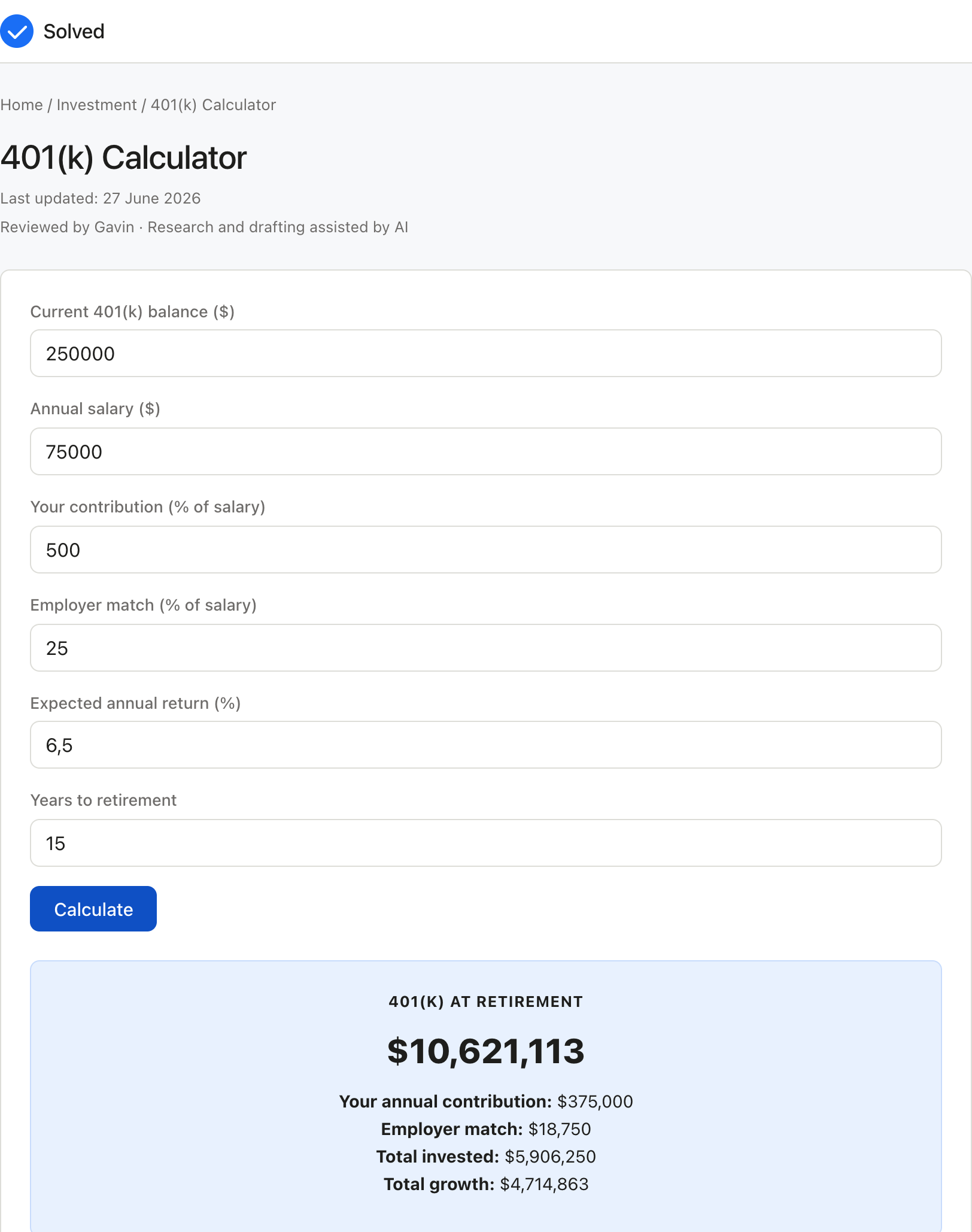
Captured from solved.tools on 10 September 2026.
Frequently Asked Questions
What happens to my 401(k) if I change jobs? When you leave an employer, you can leave the 401(k) with your former employer's plan, roll it over to your new employer's plan, roll it over to an individual retirement account (IRA), or cash it out. Cashing out triggers income tax and a 10% early withdrawal penalty if you are under 59.5. Rolling over to an IRA or new employer plan preserves tax-deferred growth and is generally the recommended option.
How much should I contribute to my 401(k)? At minimum, contribute enough to capture the full employer match. Beyond that, a common guideline is to save 15% of gross income for retirement across all accounts. If you start saving late, a higher rate is needed to catch up. Maximising contributions to the IRS annual limit is advisable once you have paid off high-interest debt and built an emergency fund.
What is vesting and how does it affect my employer match? Vesting refers to the process by which employer contributions become permanently yours over time. Some employers use immediate vesting (the match is yours immediately), while others use a graded or cliff vesting schedule (for example, 20% per year over 5 years, or 100% after 3 years). If you leave before being fully vested, you may forfeit a portion of the employer match. Always check your plan's vesting schedule before changing jobs.
Can I withdraw from my 401(k) before retirement? Early withdrawals before age 59.5 are subject to a 10% penalty plus income tax, making them expensive. Exceptions include certain hardship withdrawals, substantially equal periodic payments (SEPP or 72(t) distributions), separation from service after age 55, and disability. Loans from a 401(k) are available in many plans (typically up to 50% of the vested balance or $50,000, whichever is less), which avoids the penalty but must be repaid or trigger tax consequences.
Inputs and Their Effects
Each field on the 401(k) Calculator form plays a distinct part in the calculation.
- your current 401(k) balance (zero if you are just starting) - this value feeds the 401(k) Calculator directly and shows up in the result.
- your annual salary and your contribution rate as a percentage of salary - this value feeds the 401(k) Calculator directly and shows up in the result.
- your employer's matching contribution (for example, 50% match up to 6% of salary) - this value feeds the 401(k) Calculator directly and shows up in the result. Editing one field of the 401(k) Calculator changes the output in line with the formula, so a misplaced value is visible in the answer.
Common Mistakes to Avoid
The errors that come up most often with the 401(k) Calculator are easy to spot once you know them:
- Entering a value in the wrong unit for your current 401(k) balance (zero if you are just starting); the 401(k) Calculator answer is only right when the unit matches the label.
- Mixing conventions, such as percentages and decimals, where the 401(k) Calculator formula expects one form.
- Rounding the inputs before the 401(k) Calculator runs; keep the full values and let the tool round the final answer.
- Treating the 401(k) Calculator result as exact when the inputs themselves were estimates.
When to Use the 401(k) Calculator
Use the 401(k) Calculator whenever you need a quick, reliable answer that fits the tool's scope. Common situations for the 401(k) Calculator include homework and study, on-the-job quick checks, sanity-checking a more complex calculation, or exploring a scenario for personal interest. If the 401(k) Calculator answer will be used for a decision that has legal, medical, or financial consequences, treat the result as a starting point and verify it with a qualified professional.
How the Math Works
The calculation behind the 401(k) Calculator follows the standard form for this kind of problem: The 401(k) future value calculation uses the compound growth formula for an annuity: Future Value = Current Balance multiplied by (1 plus r) raised to the power of n plus [Annual Contribution multiplied by ((1 plus r) raised to the power of The 401(k) Calculator applies that relationship in the order the algebra prescribes, converting inputs to consistent units first where the formula needs them.
Practical Tips
A few habits keep the 401(k) Calculator results reliable:
- Confirm each input matches the label, especially your current 401(k) balance (zero if you are just starting) and your annual salary and your contribution rate as a percentage of salary if both are present.
- Work in one unit system throughout the 401(k) Calculator instead of converting mid-way by hand.
- Sanity-check the 401(k) Calculator output against a rough estimate before relying on it.
- Keep a note of the values you used so the 401(k) Calculator calculation can be reproduced later.
Worked Examples and Edge Cases
Beyond the worked examples earlier in this page, a few additional cases illustrate how the 401K Calculator behaves at the edges of its input range.
Boundary inputs. Entering the smallest or largest sensible value for a numeric input in the 401(k) Calculator should produce a result at the corresponding end of the output range, not a runaway value or a silently clipped result.
Equal inputs. When two inputs that should be different are set to the same value, the 401(k) Calculator result should be the well-defined value the formula produces for that degenerate case.
Non-numeric inputs. Text in a numeric field of the 401(k) Calculator is ignored by the parser and treated as zero.
can the 401K Calculator be used for professional or commercial purposes? yes, the 401K Calculator The 401(k) Calculator provides mathematically correct results that are suitable for professional, commercial, and educational use. the 401K Calculator formulas used are well-established and validated against reference standards.
**How often are the formulas behind the 401(k) Calculator updated? When standards change (e.g., new physical constants, revised tax brackets, updated standards), the 401(k) Calculator is updated to reflect the current authoritative source. Each calculator's references section, including the 401(k) Calculator, lists the specific sources used.tools/tools/roth-vs-traditional)