Mortgage Calculator
Last updated: 27 June 2026
Reviewed by Gavin Meiring, Lead research and primary author · Doctoral Candidate (Corporate Governance) · Research and drafting assisted by AI
- The word 'mortgage' comes from the Old French 'mort gage', meaning 'death pledge'. The pledge dies either when the debt is paid off, or when you default.
- The 30-year fixed-rate mortgage is uniquely American. In most countries, mortgage rates reset every 2–5 years. UK buyers typically fix for just 2 years at a time.
- In the UK, the average first-time buyer now spends over 30% of their take-home pay on mortgage repayments, the highest ratio since records began in the 1980s.
Mortgage Calculator
A mortgage calculator helps you work out your monthly repayments on a home loan based on the amount borrowed, interest rate, and term. It is used by first-time buyers, homeowners considering remortgaging, and property investors who want to compare borrowing costs before committing to a deal.
How to Use the Mortgage Calculator
- Enter the loan amount, which is the property price minus your deposit.
- Enter the annual interest rate quoted by your lender.
- Set the mortgage term in years (typically 25 or 30 years in the UK).
- Choose repayment type: capital and interest, or interest only.
- Click calculate to see your monthly payment and total cost over the term.
The Formula
For a standard capital and interest (repayment) mortgage, the monthly payment is calculated using the annuity formula:
M = P x (r(1 + r)^n) / ((1 + r)^n - 1)
Where M is the monthly payment, P is the principal (loan amount), r is the monthly interest rate (annual rate divided by 12), and n is the total number of monthly payments (years multiplied by 12). For interest-only mortgages, the monthly payment is simply P multiplied by r, since the principal is not reduced.
Real-World Example
You borrow £250,000 over 25 years at an annual interest rate of 4.5%.
- Monthly rate: 4.5% / 12 = 0.375%, or 0.00375
- Number of payments: 25 x 12 = 300
- Monthly payment: 250,000 x (0.00375 x (1.00375)^300) / ((1.00375)^300 - 1)
- Result: approximately £1,389 per month
- Total repaid over 25 years: approximately £416,700
- Total interest paid: approximately £166,700
This shows how much the interest adds over a long term, which is why overpaying when possible reduces the overall cost significantly.
Understanding Your Result
The monthly figure from a mortgage calculator is a guide, not a guaranteed offer. Your actual rate depends on your credit history, loan-to-value ratio, and the lender's current products. A lower LTV (more deposit) almost always secures a better rate. It is also worth calculating what happens if rates rise by 1 or 2 percentage points, since most UK deals revert to a standard variable rate after an initial fixed period. Use the calculator to stress-test your budget before applying.
Reference Table: Monthly repayment ladder for a $250,000 mortgage
The table shows the monthly principal-and-interest payment for a $250,000 loan at four rates and four terms. Every figure assumes no fees, no insurance and a fixed rate for the whole term. At 6% over 30 years the payment is $1,499 a month and the total repaid is $539,595, of which $289,595 is interest.
| Term | 4% APR | 5% APR | 6% APR | 7% APR |
|---|---|---|---|---|
| 15 years | $1,849 | $1,977 | $2,110 | $2,247 |
| 20 years | $1,515 | $1,650 | $1,791 | $1,938 |
| 25 years | $1,320 | $1,461 | $1,611 | $1,767 |
| 30 years | $1,194 | $1,342 | $1,499 | $1,663 |
Worked Example on Screen
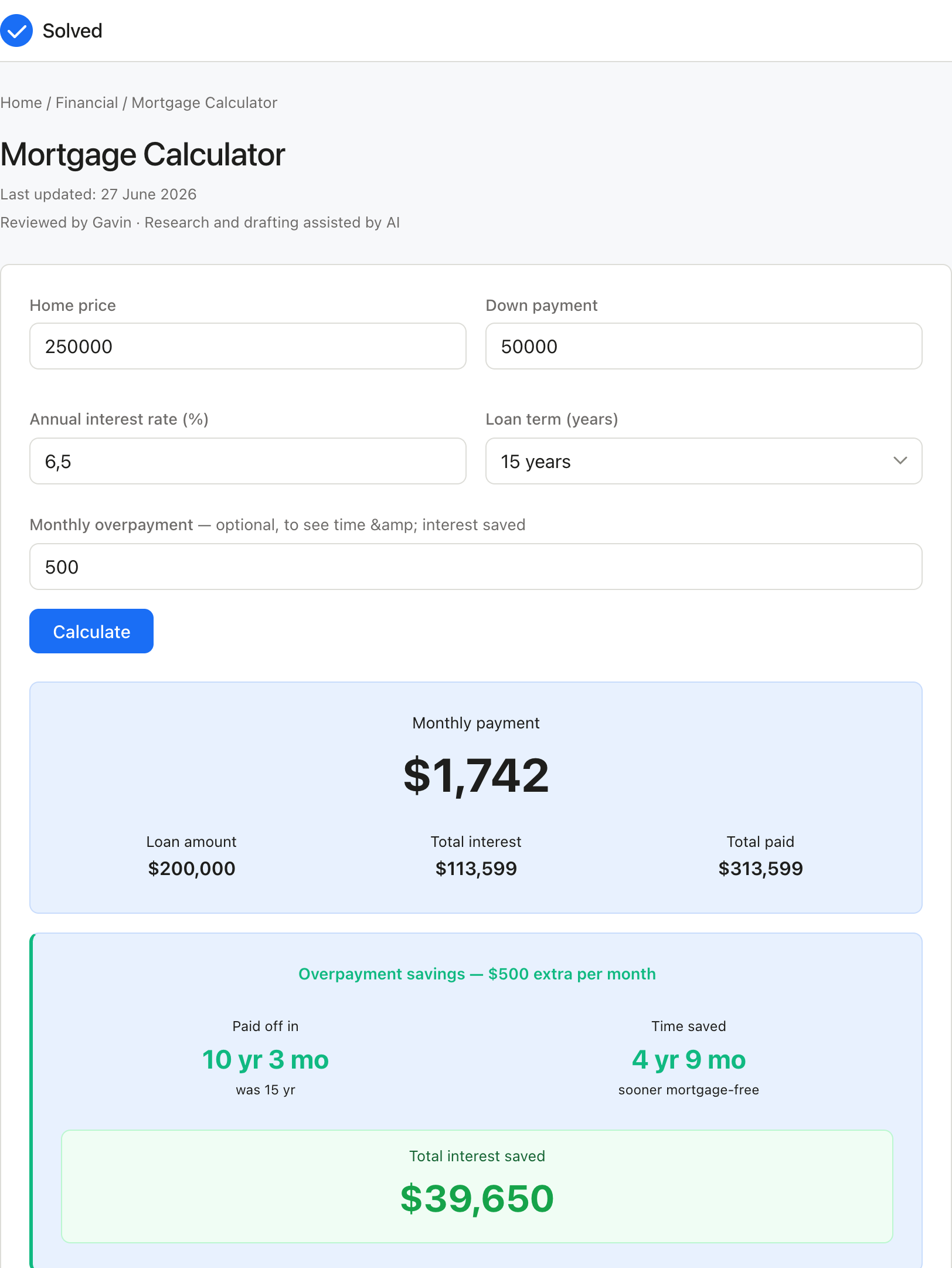
The capture below shows Mortgage Calculator after the inputs were entered, with the result on screen. Enter the same values to reproduce it.
Captured from solved.tools on 10 September 2026.
Frequently Asked Questions
What is the difference between a repayment and interest-only mortgage? With a repayment mortgage, each payment reduces the outstanding balance and pays interest, so you own the property outright at the end. With interest only, your payments cover just the interest; the original loan must be repaid separately at the end of the term, usually by selling the property or using savings.
How does the mortgage term affect my monthly payment? A longer term reduces your monthly payment but increases the total interest paid. Extending from 20 to 30 years on a £200,000 mortgage at 4% saves around £150 per month but costs tens of thousands more in interest over the life of the loan.
Can I use this calculator for a buy-to-let mortgage? Yes. Enter the loan amount, rate, and term as normal. Many landlords also compare the monthly payment against expected rental income to check the rental yield covers the mortgage comfortably, which most lenders require at a ratio of at least 125%.
What happens when my fixed-rate deal ends? Most fixed-rate mortgages revert to the lender's standard variable rate (SVR), which is usually higher. Use the calculator to check your payment at the SVR and factor that into your long-term budget planning. Remortgaging to a new deal before the SVR kicks in is the standard way to avoid the increase.
Understanding the Mortgage Calculator
The Mortgage Calculator is one of the most-requested tools in the mortgage category because it condenses a calculation that would otherwise require manual work, a spreadsheet, or a specialist program into a single input-and-output step. whether you are a student, a professional, or a curious learner, the Mortgage Calculator is designed to deliver a quick and trustworthy answer without forcing you to install anything or sign up for an account. Behind the scenes, the Mortgage Calculator applies well-established mathematical or scientific formulas to the values you provide. the aim of Mortgage Calculator is to remove the friction of hand calculation while still showing you the underlying method, so you can confidently interpret the result. Every calculation is performed locally in your browser, which means your inputs never leave your device.
When Should You Use the Mortgage Calculator?
Use the Mortgage Calculator whenever you need a quick, reliable answer that fits the tool's scope. Common situations for the Mortgage Calculator include homework problems, workplace tasks, financial planning, fitness or health tracking, and everyday curiosity. If the Mortgage Calculator answer will be used for a decision that has legal, medical, or financial consequences, treat the result as a starting point and verify it with a qualified professional. The Mortgage Calculator is free to use, requires no sign-up, and works on any device with a modern browser. You can run the Mortgage Calculator as many times as you like, change the inputs, and compare results side by side.
Common Inputs and How to Choose Them
Most Mortgage Calculator problems revolve around a small set of inputs.
- the loan amount, which is the property price minus your deposit is usually the first value to pin down for the Mortgage Calculator.
- the annual interest rate quoted by your lender sets the context the Mortgage Calculator needs for a sensible result.
- the mortgage term in years (typically 25 or 30 years in the UK) refines the Mortgage Calculator output where the data is available. Identifying the right values is the most important step for the Mortgage Calculator, because the answer is only as accurate as the data you put in. If a value is unknown, prefer a conservative estimate over a guess when using the Mortgage Calculator.
How to Interpret the Result
The numerical answer from the Mortgage Calculator alone is rarely the whole story. Read the units, the precision, and any warnings shown alongside the Mortgage Calculator result. Understanding the path from inputs to output in the Mortgage Calculator makes it easier to spot errors, communicate the result to others, and reuse the method for related problems in the future.
Worked Examples
A typical Mortgage Calculator run takes reasonable inputs, produces a sensible answer, and returns it in a single click. Example: You borrow £250,000 over 25 years at an annual interest rate of 4.5%. - Monthly rate: 4.5% / 12 = 0.375%, or 0.00375 - Number of payments: 25 x 12 = 300 - Monthly payment: 250,000 x (0.00375 x (1.00375)^300) / ((1.00375)^300 - 1) - Result: approximately £1,389 per month - Total repaid over 25 years: approximately £416,700 - Total interest paid: approximately £166,700 This shows how much the intere
Common Mistakes to Avoid
Common mistakes with the Mortgage Calculator:
- Mixing up units (for example, entering one unit when the Mortgage Calculator expects another).
- Forgetting to convert percentages to decimals or vice versa where the Mortgage Calculator formula requires it.
- Using a snapshot value that no longer reflects reality for the Mortgage Calculator, especially for time-sensitive inputs like prices, rates, or counts.
- Rounding intermediate steps too early and then carrying the rounded value forward in the Mortgage Calculator.
- Treating the Mortgage Calculator as a substitute for professional advice when the decision is high-stakes.
Limitations and Assumptions
No calculator is a perfect model of reality, and the Mortgage Calculator is no exception. The Mortgage Calculator makes simplifying assumptions to keep the math tractable: it ignores rare cases, applies default values where inputs are missing, and uses formulas that suit the typical situation rather than the exotic one. When your situation falls outside the typical case, the Mortgage Calculator result may drift further from the truth. If you need a more precise answer than the Mortgage Calculator provides, the next step is usually a specialist, a more detailed reference, or a domain-specific tool.
Related Tools and References
For more depth on the Mortgage Calculator topic, consult textbooks, academic papers, or reputable online resources. Reputable sources for the Mortgage Calculator include government statistics agencies, university extension services, and peer-reviewed journals. Wikipedia is a useful starting point for definitions and formulas behind the Mortgage Calculator, but always follow the citations to the original source before relying on a number. If you find that you need the same Mortgage Calculator calculation repeatedly, consider writing down the inputs and the result in a note so you can build a personal record over time.
Quick Reference
- Free to use: yes, no sign-up required.
- Privacy: all calculations run locally in your browser.
- Units: metric and imperial supported where applicable; check the input labels.
- Speed: instant, no page reload.
- Mobile friendly: yes, works on phones and tablets.
- Offline: once the page has loaded, the calculation continues to work without a network connection.
References - General-purpose math references such as Wolfram MathWorld and Khan Academy for foundational formulas.
- Wikipedia articles on the relevant topic, with citations to primary sources, cover the Mortgage Calculator background.
- Peer-reviewed journals and textbooks give the most rigorous treatments of the Mortgage Calculator method.Tools/tools/calculator) - Percentage Calculator - Unit Converter
Also try these free tools: