Unit Converter
Last updated: 27 June 2026
Reviewed by Gavin Meiring, Lead research and primary author · Doctoral Candidate (Corporate Governance) · Research and drafting assisted by AI
- The metric system was devised during the French Revolution with the ambitious goal of creating measurements based on natural constants. 'For all people, for all time' was the motto.
- The US is one of only three countries that haven't officially adopted the metric system. The other two are Myanmar and Liberia. Even the US military uses metric.
- The 1999 Mars Climate Orbiter was lost because one team used imperial units (pound-force seconds) and another used metric (newton seconds). The $327m spacecraft crashed into Mars.
Unit Converter
The unit converter handles hundreds of conversions across length, weight, temperature, speed, volume, area, energy, and more, giving you instant accurate results. It is designed for students, engineers, travellers, and anyone who regularly needs to switch between measurement systems. Select your category, choose your units, and enter a value to convert.
How to Use the Unit Converter
- Choose the measurement category from the dropdown menu, such as length, mass, or temperature.
- Select the unit you are converting from in the left field.
- Select the unit you are converting to in the right field.
- Type your value into the input box.
- Read the converted result, which updates instantly as you type.
The Formula
Most unit conversions use a multiplication factor:
Result = Input * Conversion Factor
For example, 1 kilometre = 1000 metres, so to convert 5 km to metres: 5 * 1000 = 5000 m.
Temperature conversions use additive offsets as well as multiplication. For Celsius to Fahrenheit:
F = (C * 9/5) + 32
For Kelvin to Celsius:
C = K - 273.15
All other conversions reduce to a single multiplication by the appropriate ratio between the two units.
Real-World Example
Convert 65 miles per hour to kilometres per hour.
- The conversion factor is 1 mile = 1.60934 km
- Multiply: 65 * 1.60934 = 104.61 km/h
A car travelling at 65 mph is doing approximately 104.6 km/h. This is essential knowledge for driving in countries that use metric speed limits, or when comparing performance figures between cars listed with different units.
Commonly Used Unit Conversions
Some conversions come up repeatedly in everyday life and work:
Length: 1 inch = 2.54 cm; 1 foot = 0.3048 m; 1 mile = 1.60934 km Weight: 1 pound = 0.45359 kg; 1 stone = 6.35029 kg; 1 ounce = 28.3495 g Volume: 1 US gallon = 3.78541 litres; 1 UK gallon = 4.54609 litres; 1 fluid ounce = 29.5735 ml Area: 1 acre = 4046.86 sq metres; 1 hectare = 10,000 sq metres; 1 sq foot = 0.0929 sq metres Energy: 1 calorie = 4.184 joules; 1 kilowatt-hour = 3,600,000 joules; 1 BTU = 1055.06 joules
Bookmarking or memorising a handful of these prevents calculation errors in daily situations.
Reference Table: Unit conversion matrix
Four base quantities against their most common equivalents. The factors come from the SI definitions and the 1959 international yard and pound agreement, so one inch is exactly 25.4 mm and one pound is exactly 0.45359237 kg.
| Quantity | Equivalent 1 | Equivalent 2 | Equivalent 3 | Equivalent 4 |
|---|---|---|---|---|
| 1 metre | 100 cm | 1,000 mm | 3.28084 ft | 39.3701 in |
| 1 kilogram | 1,000 g | 2.20462 lb | 35.274 oz | 0.157473 stone |
| 1 litre | 1,000 ml | 0.264172 US gal | 1.75975 UK pt | 4.22675 US cups |
| 1 kilometre | 1,000 m | 0.621371 mi | 1,093.61 yd | 3,280.84 ft |
Worked Example on Screen
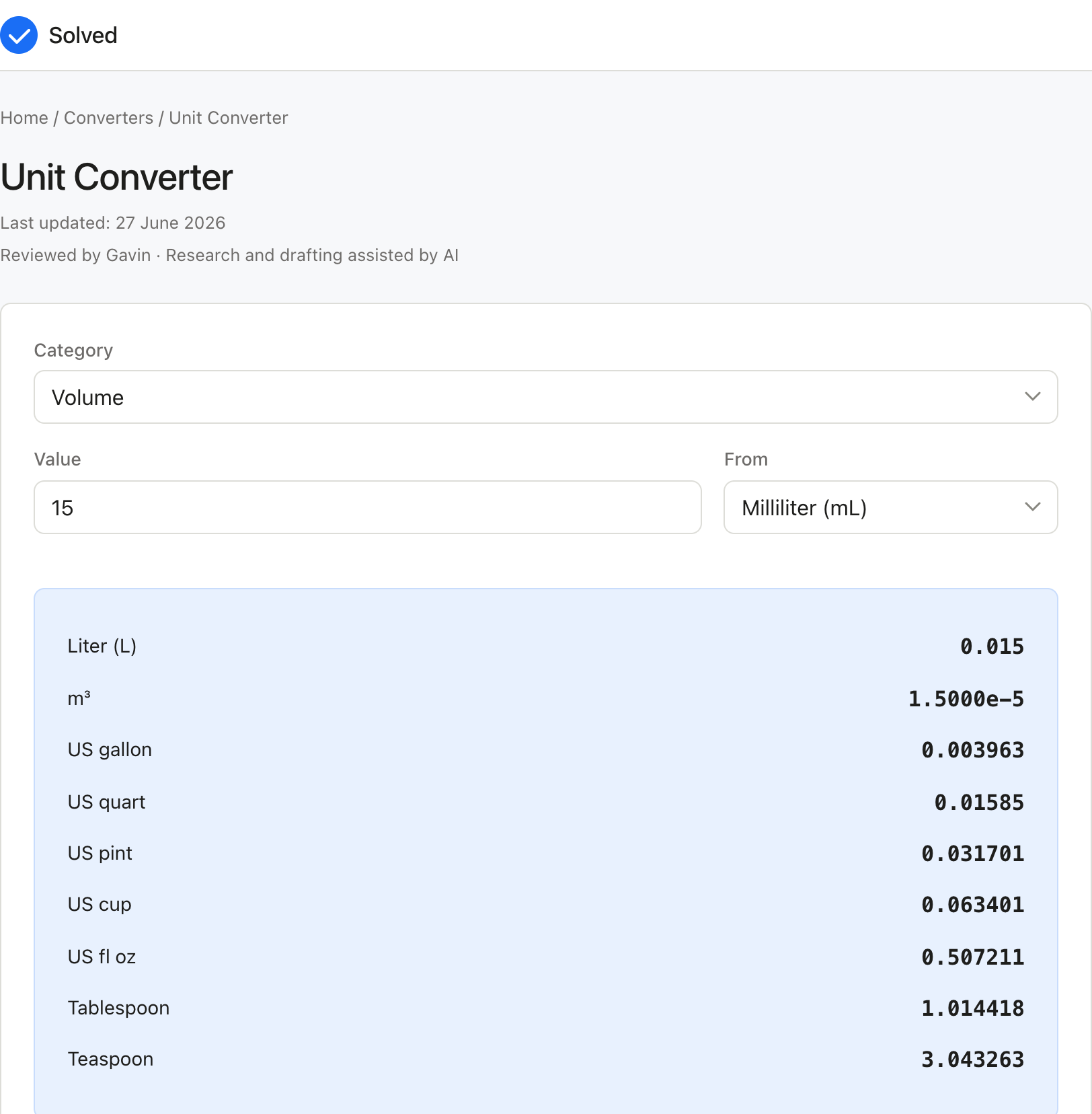
The capture below shows Unit Converter after the inputs were entered, with the result on screen. Enter the same values to reproduce it.
Captured from solved.tools on 10 September 2026.
Frequently Asked Questions
Why does the UK and US sometimes use the same unit name but different values? Several units share a name but differ between the US customary system and the Imperial system. The US gallon (3.785 litres) and the UK gallon (4.546 litres) are the most common example. Always check which system applies when performing conversions related to volume or fluid measure.
How accurate are unit converter results? Results are computed from standard conversion factors and are accurate to many decimal places. For most practical purposes, rounding to three or four significant figures is sufficient. High-precision scientific work may require more decimal places or system-specific exact definitions.
Can I convert between metric and imperial for cooking measurements? Yes. Cooking conversions include cups, tablespoons, teaspoons, fluid ounces, and millilitres. Note that US cups (240 ml) differ slightly from metric cups (250 ml) used in Australia and New Zealand, so always verify which standard your recipe uses.
Is there a quick way to estimate metric-to-imperial conversions mentally? Yes. A few rough rules help: 1 kg is about 2.2 lb; 1 km is about 0.6 miles; 1 litre is about 1.75 UK pints; 30 cm is about 1 foot; and to convert Celsius to Fahrenheit, double the Celsius value and add 30 (close enough for everyday estimates).
What the converter covers
The tool holds five categories and 42 units in total: 8 for area, 10 for volume, 7 for pressure, 8 for energy and 9 for data. There is no length, mass, temperature or speed category in the menu, so the kilometre, pound, Celsius and mile-per-hour material on this page describes conversions the converter does not perform. What it does perform it shows in full: one entry is converted into every other unit in its category at once, to six decimals, and the list updates as you type.
| Category | Units in the menu | Sample entry | What the converter prints for that entry |
|---|---|---|---|
| Area | 8 | 1 Acre | 4046.86 m², 0.004047 km², 0.404686 Hectare, 43560.057264 ft², 4840.006363 yd², 0.001562 mi², 40468600 cm² |
| Volume | 10 | 1 US gallon | 3.78541 L, 3785.41 mL, 0.003785 m³, 3.999998 US quart, 8.000004 US pint, 16.000008 US cup, 128.000068 US fl oz, 255.99927 Tablespoon, 767.999886 Teaspoon |
| Pressure | 7 | 1 Bar | 100000 Pa, 100 kPa, 0.1 MPa, 0.986923 atm, 14.503768 PSI, 750.063755 mmHg |
| Energy | 8 | 1 kWh | 3600000 J, 3600 kJ, 860420.650096 cal, 860.42065 kcal, 1000 Wh, 3412.12822 BTU, 2.2469e+25 eV |
| Data | 9 | 1 GB | 8000000000 Bit, 1000000000 Byte, 8000000 kb, 1000000 KB, 8000 Mb, 1000 MB, 8 Gb, 0.001 TB |
Those rows are the tool's own output for one entry in each category, reproduced from the component's arithmetic, not estimated.
Where the rounded factors show
Two details in the volume row repay a close read. One US gallon holds exactly four US quarts, and the converter prints 3.999998. A US gallon holds exactly eight US pints, and it prints 8.000004. Both come from the stored factors, which are rounded to six significant figures: the litre value 3.78541 and the quart value 0.946353 divide to 3.999998. The same cause gives 16.000008 cups and 128.000068 fluid ounces to the gallon, and the tablespoon and teaspoon rows drift further at 255.99927 and 767.999886. For a recipe or a fuel figure, read those rows as their whole numbers.
The area category shows the same effect against the exact definitions. The 1959 international yard and pound agreement fixes one inch at exactly 25.4 millimetres, so one square foot is exactly 0.09290304 square metres and one square yard is exactly 0.83612736 square metres. The converter stores 0.092903 and 0.836127.
| Factor in the converter | Exact value from the 1959 agreement | Effect on one entry |
|---|---|---|
| 1 ft² = 0.092903 m² | 0.09290304 m² | 1 Acre reads 43560.057264 ft² instead of exactly 43560 |
| 1 yd² = 0.836127 m² | 0.83612736 m² | 1 Acre reads 4840.006363 yd² instead of exactly 4840 |
| 1 Acre = 4046.86 m² | 4046.8564224 m² | 0.0036 square metres high, which is 0.00009 per cent |
| 1 mi² = 2.59e6 m² | 2589988.110336 m² | 1 Acre reads 0.001562 mi² |
One acre is exactly 4,840 square yards, so the exact area is 4,840 multiplied by 0.83612736, which is 4,046.8564224 square metres. The converter's 4,046.86 is that figure rounded up by 0.0036 square metres. The 43,560.057264 square feet it prints for an acre sits above the exact 43,560, and the printed yard figure sits above the exact 4,840, because the stored square-foot and square-yard factors are both low. Each printed figure is about 0.00013 per cent above its exact value.
Decimal prefixes in the data category
The data units use decimal SI prefixes rather than binary ones. One kilobyte in this converter is 1,000 bytes and one gigabyte is 1,000,000,000 bytes, so a 100 megabit per second connection shows 12.5 megabytes per second. Operating systems that report file sizes in binary multiples would call the same transfer 11.9209 mebibytes per second, because one mebibyte is 1,048,576 bytes. One gibibyte is 1,073,741,824 bytes, which is 7.374 per cent larger than the gigabyte the converter uses. Neither convention is wrong; the two disagree on the label, and a drive sold as 1 TB holds 1,000,000,000,000 bytes, which a binary report shows as 0.9095 TiB.
Reading the printed values
Values between 0.0001 and 1,000,000,000,000 print to six decimals with trailing zeros dropped, so 100000 Pa and 0.1 MPa appear as short as they are. Outside that range the tool switches to scientific notation with four decimals, which is why the electronvolt row for one kilowatt hour reads 2.2469e+25 rather than a string of 26 digits. The category menu resets the entry to 1 and the source unit to the first unit in the list whenever you change category, so a value typed in one category does not carry into the next.
The agreements behind the factors
The imperial and US factors rest on the 1959 international yard and pound agreement, which fixed the inch at 25.4 millimetres and the pound at 0.45359237 kilograms exactly, and on the definitions in the SI Brochure for the metric units and their decimal prefixes. The calorie in the energy row is the thermochemical calorie of exactly 4.184 joules; the international steam table calorie is a different figure at 4.1868 joules, so a nutrition table that uses the second definition will differ from this converter in the fourth significant figure. One standard atmosphere is 101,325 pascals by definition, and one bar is 100,000 pascals, which is why the pressure row prints 750.063755 mmHg for one bar rather than the 760 mmHg that one atmosphere gives.
Also try these free tools: