Temperature Converter
Last updated: 21 August 2026
Reviewed by Gavin Meiring, Lead research and primary author · Doctoral Candidate (Corporate Governance) · Research and drafting assisted by AI
Temperature Converter — °C ⇄ °F ⇄ K
Convert between Celsius, Fahrenheit, Kelvin (and Rankine) using the SI definitions. 0 °C = 273.15 K exactly; 1 °C = 1 K. The Fahrenheit scale uses 32 °F = 0 °C and 212 °F = 100 °C.
- The Fahrenheit scale set 0°F as the coldest temperature Daniel Fahrenheit could achieve in his lab using a brine solution of ice, water and salt, in 1724.
- Absolute zero (0 Kelvin, -273.15°C) is the lowest theoretically possible temperature. It's never been achieved — only approached to within billionths of a degree.
- °C and °F are equal at exactly -40°. Below that, Celsius numbers are less negative; above it, Fahrenheit numbers are higher. At 100°C/212°F — boiling point of water — they diverge dramatically.
Temperature Converter
Temperature is the most-used physical quantity in everyday life, and the three main scales, Celsius (°C), Fahrenheit (°F) and Kelvin (K), coexist in modern usage. The Celsius scale is the SI-derived scale used by most countries and in science; the Fahrenheit scale is used in the United States for weather, cooking and body temperature; the Kelvin scale is the SI base unit of thermodynamic temperature. The SI defines 0 °C = 273.15 K exactly (the triple point of water is 273.16 K, so 0.01 °C = 273.16 K). One degree Celsius equals one kelvin in size, so temperature differences convert directly: ΔT(K) = ΔT(°C).
The Fahrenheit scale is defined by two fixed points: 32 °F = 0 °C (the ice point, where water freezes) and 212 °F = 100 °C (the steam point, where water boils at 1 atm). A 180 °F span therefore equals a 100 °C span, so 1 °F = 5/9 °C and °F = °C × 9/5 + 32. Rankine is the absolute Fahrenheit scale (used in some US engineering): 0 °R = absolute zero = −459.67 °F.
This converter lets you type into any of the three input fields (°C, °F, K) and the others update automatically. It also displays the Rankine value. Presets cover cooking (180 °C, 350 °F), weather (room temperature 20 °C / 68 °F), body temperature (37 °C / 98.6 °F), water phase transitions (0 °C / 100 °C) and absolute zero (−273.15 °C / 0 K). The conversion is exact to the precision displayed, no rounding error accumulates.
How to Use
- Celsius (°C), enter any temperature in degrees Celsius (negative values allowed for sub-zero temperatures).
- Fahrenheit (°F), enter any temperature in degrees Fahrenheit. The other fields update automatically.
- Kelvin (K), enter any temperature in kelvins (must be ≥ 0 for physical temperatures).
- The result block shows the conversion from your Celsius input to Fahrenheit and Kelvin (since Celsius is the SI-derived scale), plus the Rankine equivalent.
- Use the presets for common temperatures: water freezing (0 °C), room temperature (20 °C), body temperature (37 °C), water boiling (100 °C), oven 180 °C (356 °F), oven 350 °F (≈176.67 °C), absolute zero (−273.15 °C / 0 K), and −40 (the only temperature where °C = °F).
The Formulae
The conversion rests on three exact definitions:
T(K)    = T(°C) + 273.15                              (CIPM/SI Brochure §2.3.1)
T(°C)   = T(K) − 273.15                              (exact)
T(°F)   = T(°C) × 9/5 + 32                           (Fahrenheit 1724)
T(°C)   = (T(°F) − 32) × 5/9                         (inverse)
T(K)    = (T(°F) − 32) × 5/9 + 273.15                 (Fahrenheit → Kelvin)
T(°R)   = T(°F) + 459.67                             (absolute Fahrenheit)
T(K)    = T(°R) × 5/9                                (Rankine → Kelvin)
T(°C)   = T(°R) × 5/9 − 273.15                       (Rankine → Celsius)
Key landmarks:
- Absolute zero: 0 K = −273.15 °C = −459.67 °F = 0 °R (by definition)
- Water triple point: 273.16 K = 0.01 °C = 32.018 °F (the only point where solid, liquid and gas coexist in pure water)
- Water freezing (1 atm): 273.15 K = 0 °C = 32 °F (by the original Celsius scale)
- Water boiling (1 atm): 373.15 K = 100 °C = 212 °F (by the original Celsius scale)
- Body temperature (normal): 310.15 K = 37 °C = 98.6 °F (the oral reading; can vary 36.1 to 37.2 °C)
- The crossover: −40 °C = −40 °F (the only temperature where the two scales read the same)
Worked Examples
Example 1, Water freezing point:
- T(°C) = 0; T(K) = 0 + 273.15 = 273.15 K; T(°F) = 0 × 9/5 + 32 = 32 °F
- All three values exact.
Example 2, Water boiling point (1 atm):
- T(°C) = 100; T(K) = 100 + 273.15 = 373.15 K; T(°F) = 100 × 9/5 + 32 = 212 °F
Example 3, Room temperature:
- T(°C) = 20; T(K) = 293.15 K; T(°F) = 20 × 9/5 + 32 = 68 °F
Example 4, Body temperature:
- T(°C) = 37; T(K) = 310.15 K; T(°F) = 37 × 9/5 + 32 = 98.6 °F
Example 5, The crossover (−40):
- T(°C) = −40; T(°F) = (−40) × 9/5 + 32 = −40 °F (the only temperature where °C = °F)
Example 6, Absolute zero:
- T(K) = 0 (by definition)
- T(°C) = 0 − 273.15 = −273.15 °C
- T(°F) = −273.15 × 9/5 + 32 = −459.67 °F
- T(°R) = −459.67 + 459.67 = 0 °R
Example 7, Moderate oven (180 °C, common European baking):
- T(°C) = 180; T(K) = 453.15 K; T(°F) = 180 × 9/5 + 32 = 356 °F
Example 8, US recipe conversion (350 °F):
- T(°F) = 350; T(°C) = (350 − 32) × 5/9 = 318 × 5/9 = 176.6666… °C ≈ 176.67 °C
- T(K) = 176.6666… + 273.15 = 449.8166… K
Example 9, Liquid nitrogen (−196 °C, common cryogenic):
- T(°C) = −196; T(K) = 77.15 K; T(°F) = −196 × 9/5 + 32 = −320.8 °F
Example 10, Sun's surface (~5,778 K):
- T(K) = 5778; T(°C) = 5778 − 273.15 = 5504.85 °C; T(°F) = 5504.85 × 9/5 + 32 = 9940.73 °F
Where It Shows Up
- Weather forecasting, most countries report in Celsius; the US reports in Fahrenheit. International travellers need to convert quickly. The conversion is mentally easy: °F = °C × 2 + 30 (rough approximation), or exactly °F = °C × 9/5 + 32.
- Cooking and baking, European recipes use °C (180 °C fan oven); US recipes use °F (350 °F). Converting correctly is essential, a 50 °F error ruins a soufflé.
- Body temperature and medical contexts, normal oral body temperature is 37 °C = 98.6 °F. Fever thresholds (38 °C / 100.4 °F) and hypothermia (35 °C / 95 °F) need accurate conversion in clinical settings.
- Oven and freezer temperatures, most refrigerators run at 4 °C / 40 °F (fresh food) or −18 °C / 0 °F (freezer). Industrial freezers go to −80 °C / −112 °F (lab samples).
- Climate science and meteorology, global temperature records are stored in °C; some US stations report in °F. Climate change discussions compare °C anomalies; a 2 °C warming target is 3.6 °F.
- Physics, chemistry and engineering, the kelvin is the SI base unit; all thermodynamic calculations use it. The Celsius scale is the everyday scale; Fahrenheit is the US everyday scale. Converting correctly is non-negotiable for any technical work.
- Aviation and aerospace, outside air temperature (OAT) is reported in °C by ICAO standard. Engine temperatures, material limits and aerodynamic properties are usually in °C or K.
- Astronomy, stellar and planetary temperatures are reported in K (or sometimes in eV via the Boltzmann constant). The Sun's surface is ~5,778 K; the cosmic microwave background is 2.725 K.
- Industrial processes, chemical reactors, metallurgy, semiconductor fabrication, pharmaceutical manufacturing and food processing all use specific temperature ranges with precise units. Errors are expensive and dangerous.
Common Mistakes
- Forgetting the +32 in the Fahrenheit formula, °F = °C × 9/5 (without +32) gives wrong answers. The 32 accounts for the offset between the Fahrenheit and Celsius zero points. Always include it.
- Multiplying by 5/9 when going °C → °F instead of 9/5, the formula is °F = °C × 9/5 + 32, NOT °F = °C × 5/9. The 9/5 is for °C → °F; the 5/9 is for °F → °C (with the − 32).
- Using 273 instead of 273.15 for the Celsius-to-Kelvin offset, the exact offset is 273.15, not 273 or 273.16. (273.16 is the triple-point temperature, which is exactly 0.01 °C above 273.15 K.) This matters for sub-degree precision work.
- Confusing °C and K, both scales have the same unit size, but their zero points differ. 0 °C = 273.15 K, not 0 K. A temperature difference of 1 °C equals a difference of 1 K, but absolute temperatures on the two scales differ by 273.15.
- Using "degrees Rankine" or "degrees Kelvin" in formal writing, the SI symbol is K (without "degrees"); Rankine is °R (with the degree sign). Modern style drops "degrees" for K but keeps it for °R. The 2019 SI revision formalised this.
- Approximating with 9/5 = 2 instead of 1.8, a 20% error in the conversion factor. This matters for any non-rough work.
- Negative temperatures in Kelvin, physical temperatures cannot be negative in K (0 K is absolute zero). A "−5 K" reading is unphysical and indicates a sensor error or a sign confusion.
- Confusing ITS-90 with thermodynamic temperature, the International Temperature Scale of 1990 (ITS-90) defines practical temperature scales for thermometry. ITS-90 values agree with thermodynamic temperature to within ~0.001 K above 1 K but can differ by more for very low temperatures. This converter uses the thermodynamic scale; for ultra-high-precision thermometry, consult ITS-90 tables.
Reference Table: Celsius, Fahrenheit and Kelvin
Seven reference temperatures across the three scales. The conversion is F = C times 9/5 plus 32, and K = C plus 273.15. Minus 40 is the one point where the Celsius and Fahrenheit scales meet.
| Celsius | Fahrenheit | Kelvin |
|---|---|---|
| -40 °C | -40 °F | 233.15 K |
| -18 °C | -0 °F | 255.15 K |
| 0 °C | 32 °F | 273.15 K |
| 10 °C | 50 °F | 283.15 K |
| 20 °C | 68 °F | 293.15 K |
| 37 °C | 99 °F | 310.15 K |
| 100 °C | 212 °F | 373.15 K |
Worked Example on Screen
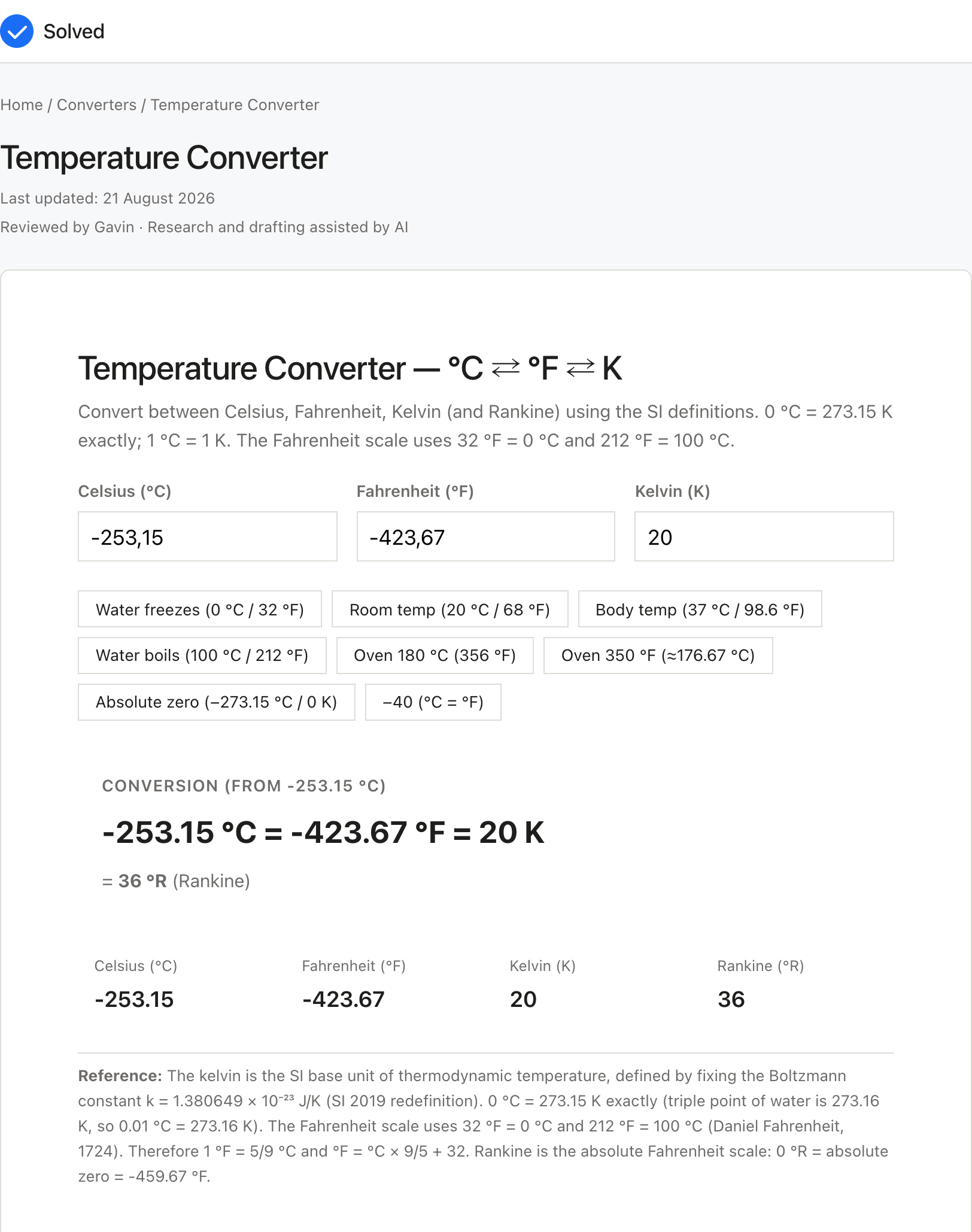
The capture below shows Temperature Converter after the inputs were entered, with the result on screen. Enter the same values to reproduce it.
Captured from solved.tools on 10 September 2026.
Frequently Asked Questions
What is 0 °C in Kelvin? 0 °C = 273.15 K exactly. This is fixed by the SI definition (CIPM/SI Brochure §2.3.1). The triple point of water is 273.16 K (which is 0.01 °C). Historically, before the 2019 SI redefinition, the kelvin was defined by the triple point of water; now it's defined by fixing the Boltzmann constant k = 1.380649 × 10⁻²³ J/K exactly, with the same numerical result.
How do you convert Celsius to Fahrenheit? °F = °C × 9/5 + 32. For example, 25 °C = 25 × 9/5 + 32 = 45 + 32 = 77 °F. The reverse: °C = (°F − 32) × 5/9.
Why does the formula use 9/5 and 5/9? The Fahrenheit scale has 180 degrees between the ice point (32 °F) and the steam point (212 °F), while Celsius has 100 degrees between the same two points (0 °C and 100 °C). So 180 °F = 100 °C, giving 1 °F = 100/180 = 5/9 °C and 1 °C = 180/100 = 9/5 °F.
What is absolute zero in Celsius and Fahrenheit? Absolute zero is 0 K = −273.15 °C = −459.67 °F exactly (by definition of the kelvin since 2019; before then, by definition of the Celsius scale at the ice point and the kelvin at the triple point). No physical temperature can be lower than absolute zero.
What temperature is the same in °C and °F? Only −40. −40 °C = −40 °F. This is the unique fixed point of the two scales (where the linear relationship crosses). For any other temperature, the two scales read different values.
What is 100 °C in Fahrenheit? 100 °C = 212 °F (the boiling point of water at 1 atm). This was one of the original Fahrenheit anchor points.
What is normal body temperature in Celsius and Fahrenheit? 37.0 °C = 98.6 °F (the conventional "normal" oral body temperature, established by Carl Wunderlich's 19th-century measurements). Modern measurements suggest 36.1 to 37.2 °C as the typical range for healthy adults. The exact value varies by measurement site (oral, axillary, tympanic, rectal).
What is the difference between Celsius and centigrade? "Centigrade" was the original name for the scale (from Latin "centum" + "gradus", meaning "100 steps"), used from 1743 (when Anders Celsius proposed it, inverted, with 0 at the steam point and 100 at the ice point; flipped by Carl Linnaeus in 1745 or Jean-Pierre Christin in 1743). The scale was renamed "Celsius" in 1948 by the 9th General Conference on Weights and Measures to avoid confusion with the "centesimal" angular gradian. The two names refer to the same scale.
Is Rankine still used? Yes, in some US engineering contexts (especially thermodynamic calculations and aerospace). 1 °R = 1 °F (same unit size), but the zero point is absolute zero instead of the Fahrenheit zero. Conversion: T(°R) = T(°F) + 459.67.
Why did the SI redefine the kelvin in 2019? The 2019 SI redefinition fixed the Boltzmann constant k = 1.380649 × 10⁻²³ J/K exactly, replacing the old definition (which set the triple point of water at exactly 273.16 K). The numerical value of 273.15 K for 0 °C is unchanged. The new definition is more fundamental (it's based on a constant of nature rather than a specific material) and supports lower-temperature thermometry with better precision.
Is this calculator suitable for professional or commercial use? yes, the Temperature Converter, Celsius, Fahrenheit, Kelvin, Rankine The Temperature Converter provides mathematically correct results that are suitable for professional, commercial, and educational use. The formulas used are well-established and validated against the SI definition.
**Celsius, Fahrenheit, Kelvin, Rankine, How often are the formulas behind the Temperature Converter updated? When standards change (e.g., the 2019 SI redefinition of the kelvin), this calculator is updated to reflect the current authoritative source. Celsius, Fahrenheit, Kelvin, Rankine, Celsius, Fahrenheit, Kelvin, Rankine, Each calculator's references section, including the Temperature Converter, lists the specific sources used.
References
- Celsius, Fahrenheit, Kelvin, Rankine, BIPM SI Brochure (9th edition, 2019), §2.3.1, defines the kelvin by fixing the Boltzmann constant k = 1.380649 × 10⁻²³ J/K exactly. Celsius, Fahrenheit, Kelvin, Rankine, Bureau International des Poids et Mesures, Sèvres.
- Celsius, Fahrenheit, Kelvin, Rankine, NIST Special Publication 811 (2008), Appendix B.6, Recommended conversion factors for thermodynamic temperature, including the exact 0 °C = 273.15 K offset.
- International Temperature Scale of 1990 (ITS-90), defines practical temperature scales for thermometry, adopted by the CIPM in 1989 and updated for the 2019 SI redefinition.
- Preston-Thomas, H. (1990), "The International Temperature Scale of 1990 (ITS-90)", Metrologia 27, 3 to 10, the foundational reference for ITS-90.
- Celsius, A. (1742), original observation paper on the centigrade scale; Linnaeus, C. (1745) or Christin, J.-P. (1743), inversion of the scale to the modern 0/100 convention (sources differ on priority).
- Fahrenheit, D. G. (1724), original proposal of the Fahrenheit scale using a mercury thermometer and a brine-ice-salt mixture for the zero point.
- Taylor, B. N. and Thompson, A. (eds.), NIST Special Publication 811 (2008 edition), the canonical US reference for unit conversions.
Also try these free tools:
- Celsius to Fahrenheit Converter, same factor, opposite-direction-only
- Boiling Point Calculator, adjusts for altitude
- Wind Chill Calculator, uses °F (US) or °C (international)
- Heat Index Calculator, apparent temperature for humidity