Weight Converter
Last updated: 27 June 2026
Reviewed by Gavin Meiring, Lead research and primary author · Doctoral Candidate (Corporate Governance) · Research and drafting assisted by AI
- The kilogram was the last SI base unit to be defined by a physical object — a platinum-iridium cylinder kept in Paris. In 2019, it was redefined in terms of Planck's constant.
- A cubic metre of water weighs exactly 1,000 kg — by design. The metric system was engineered so that water's density ties together units of length, volume, and mass.
- The heaviest animal ever recorded was a blue whale at 190 tonnes (190,000 kg). The lightest living vertebrate is the Paedophryne amauensis frog at 0.0001g.
Weight Converter
The weight converter converts between kilograms, pounds, stone, grams, ounces, tonnes, and more, with instant results. It is used by travellers, athletes, dietitians, chefs, and anyone who needs to move between metric and imperial weight measurements. Enter your value and choose your units to convert immediately.
How to Use the Weight Converter
- Enter the weight or mass value you want to convert.
- Select the unit you are converting from, such as kilograms or stone.
- Select the unit you are converting to.
- Click Convert or read the updated result instantly.
- For body weight expressed in stone and pounds, use the combined stone-pounds input if available.
The Formula
All weight conversions use the kilogram as a base unit and apply a fixed conversion factor:
Result = Input * (Value of input unit in kg) / (Value of output unit in kg)
Key conversion factors: 1 pound (lb) = 0.453592 kg 1 stone = 6.350293 kg (14 pounds) 1 ounce (oz) = 0.028350 kg 1 US ton (short ton) = 907.185 kg 1 UK tonne (metric ton) = 1000 kg 1 gram = 0.001 kg
Real-World Example
Convert 11 stone 4 pounds to kilograms (a typical adult body weight in UK notation).
- Convert stone to pounds: 11 * 14 = 154 pounds
- Add the extra pounds: 154 + 4 = 158 pounds total
- Convert to kg: 158 * 0.453592 = 71.67 kg
A person weighing 11 stone 4 pounds weighs approximately 71.7 kg. British people commonly describe body weight in stone and pounds, while medical professionals in the UK increasingly record it in kilograms.
Weight vs. Mass
In everyday use, "weight" and "mass" are used interchangeably, but scientifically they differ. Mass is the amount of matter in an object, measured in kilograms. Weight is the force exerted on that mass by gravity, measured in newtons. A 70 kg person on the Moon has the same mass but weighs about one-sixth as much because lunar gravity is weaker. For all practical purposes on Earth, converting between kilograms and pounds gives you equivalent "weights." The distinction matters mainly in physics, engineering, and aerospace contexts.
Reference Table: Mass and weight conversion factors
The pound is exactly 0.45359237 kg under the 1959 international agreement, so the ounce is exactly 28.349523125 g. The stone is 14 pounds and the tonne is 1,000 kg. Use these factors rather than mental rounding when the result feeds a shipping or dosage calculation.
| Unit | Grams | Imperial | Metric |
|---|---|---|---|
| 1 ounce | 28.3495 g | 0.0625 lb | 0.0283495 kg |
| 1 pound | 453.592 g | 16 oz | 0.453592 kg |
| 1 stone | 6,350.29 g | 14 lb | 6.35029 kg |
| 1 kilogram | 1,000 g | 2.20462 lb | 0.157473 stone |
| 1 tonne | 1,000,000 g | 2,204.62 lb | 1,000 kg |
Worked Example on Screen
The capture below shows Weight Converter after the inputs were entered, with the result on screen. Enter the same values to reproduce it.
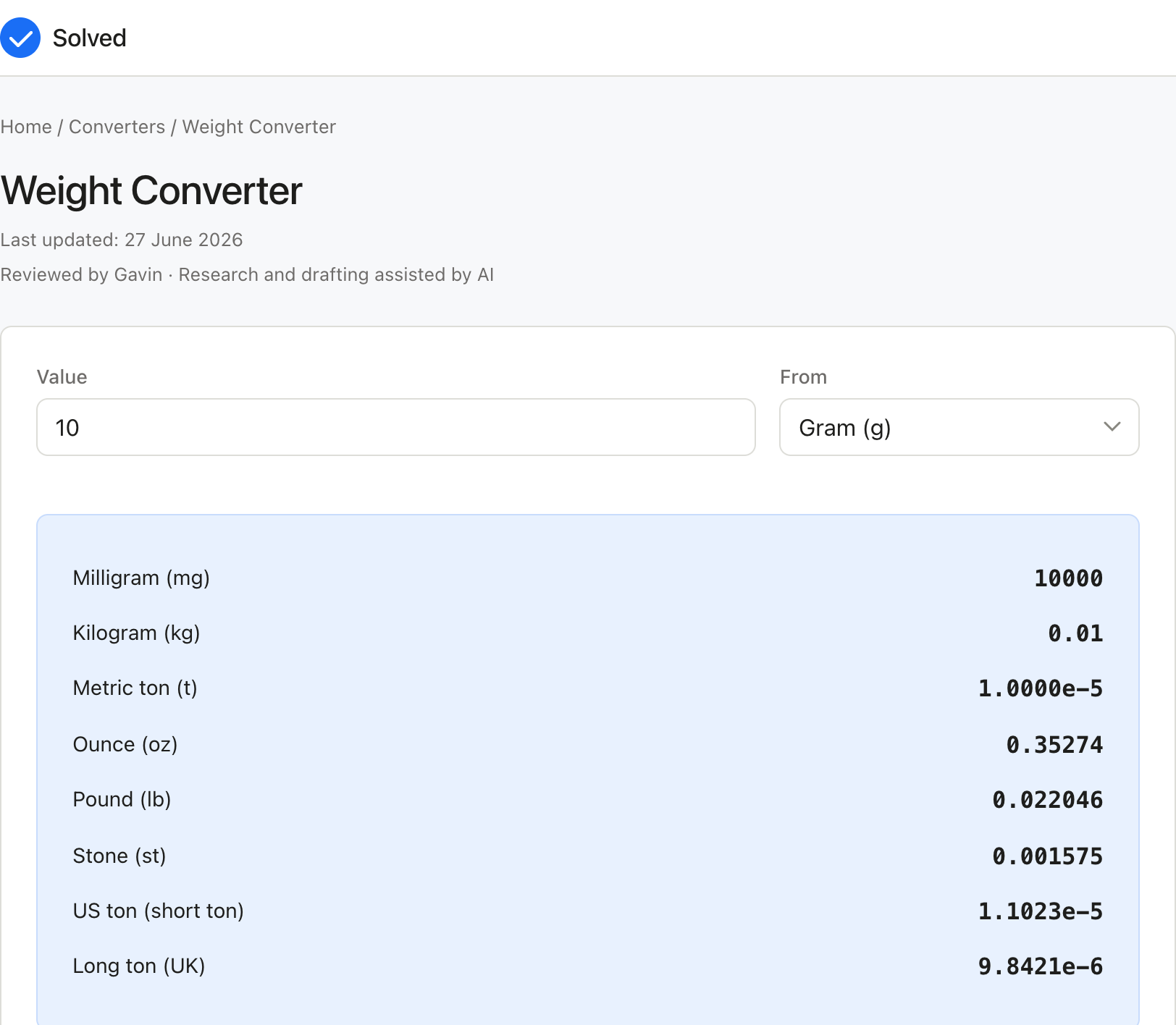
Captured from solved.tools on 10 September 2026.
Frequently Asked Questions
How many pounds are in a stone? Exactly 14 pounds. The stone is a traditional British unit no longer used in most contexts except body weight, where it remains common in everyday conversation in the UK and Ireland. It is not used in the US, Australia, or most other English-speaking countries.
What is the difference between a short ton, a long ton, and a metric tonne? A US short ton is 2000 pounds (907.185 kg). A UK long ton is 2240 pounds (1016.047 kg). A metric tonne is 1000 kg (2204.62 pounds). Always clarify which "ton" a source uses, particularly in commercial shipping, agriculture, and commodities.
Is a kilogram the same as a kilogram-force? No. A kilogram (kg) is a unit of mass. A kilogram-force (kgf) is a unit of force equal to the weight of a 1 kg mass under standard gravity (9.80665 m/s^2), which equals 9.80665 newtons. The distinction matters in engineering but is usually irrelevant for everyday weight conversions.
How do I convert a recipe from US cups and ounces to grams? Cups measure volume, not mass, so the conversion depends on the density of the ingredient. For example, 1 cup of water is about 237 g, but 1 cup of flour is about 125 g. Use a dedicated cooking measurement converter for reliable results with specific ingredients.
What the tool prints for two inputs
The form takes one value and one source unit and prints the value in every other unit it holds. Both tables below are the tool's own output, with the source unit left out.
One kilogram entered:
| Unit | Result |
|---|---|
| Milligram | 1000000 |
| Gram | 1000 |
| Metric ton | 0.001 |
| Ounce | 35.273966 |
| Pound | 2.204624 |
| Stone | 0.157473 |
| US ton | 0.001102 |
| Long ton | 0.000984 |
158 pounds entered, which is 11 stone 4 pounds:
| Unit | Result |
|---|---|
| Milligram | 71667536 |
| Gram | 71667.536 |
| Kilogram | 71.667536 |
| Metric ton | 0.071668 |
| Ounce | 2527.998217 |
| Stone | 11.285705 |
| US ton | 0.079 |
| Long ton | 0.070536 |
The ounce figure in the second table deserves a second look. 158 pounds is 2,528 ounces exactly, because a pound is sixteen ounces. The tool prints 2,527.998217, which is 0.001783 ounces short, or about 51 milligrams. The cause sits in the stored factors rather than in the division: the pound is held as 453.592 grams and the ounce as 28.34952 grams, and sixteen of those ounces come to 453.59232 grams, a little more than the stored pound. Divide the stored pound into its own stored ounces and the count falls a fraction short of sixteen.
The exact factors against the ones the tool stores
| Unit | Tool's stored figure | Exact figure | Difference |
|---|---|---|---|
| Ounce | 28.34952 g | 28.349523125 g | 0.000003125 g low |
| Pound | 453.592 g | 453.59237 g | 0.00037 g low |
| Stone | 6350.293 g | 6350.29318 g | 0.00018 g low |
| US short ton | 907185 g | 907184.74 g | 0.26 g high |
| UK long ton | 1016047 g | 1016046.9088 g | 0.0912 g high |
The exact figures all follow from one agreement. Representatives of Australia, Canada, New Zealand, South Africa, the United Kingdom and the United States signed the international yard and pound agreement on 1 July 1959, which fixed the international pound at exactly 0.45359237 kilograms and the yard at exactly 0.9144 metres. The ounce is one sixteenth of that pound, the stone is fourteen pounds, the short ton is 2,000 pounds and the long ton is 2,240 pounds, so all five figures above come from the one definition.
The paragraph above the reference table gives the pound as exactly 0.45359237 kg and the ounce as exactly 28.349523125 g, and the table beneath it lists 453.592 g and 28.3495 g. Both statements sit on the page and they part in the seventh significant figure.
Stone and pounds, which the tool prints as a decimal
A UK reader writing body weight uses two units together, and the tool gives one decimal stone figure. The conversion between the two forms is arithmetic:
- 158 pounds: 158 divided by 14 is 11 with a remainder of 4, so 11 stone 4 pounds.
- 80 kilograms: 80 divided by 0.45359237 is 176.36981 pounds, and 176.36981 divided by 14 is 12 with a remainder of 8.36981, so 12 stone 8.37 pounds.
- 11 stone 4 pounds back to kilograms: (11 times 14 plus 4) times 0.45359237 gives 71.667594 kg.
The tool's own figure for the same 11 stone 4 pounds is 71.667536 kg, and the gap of 0.000058 kg is the stored pound factor again. Neither figure matters at the scale of a bathroom scale. Both matter if the number feeds a delivery charge or a dose, which is why the reference table above says to use the exact factors for those cases.
What the form holds and what the steps describe
The form holds one number field, one source unit selector and a result list. There is no destination selector, because the tool prints every other unit at once, so step 3 in the instructions above has nothing to select. Step 5 mentions a combined stone and pounds input, and no such field exists on the form.
The formatter rounds every result to six decimal places and switches to exponential notation below 0.0001 or above 10,000,000,000. A very small input therefore prints in the other style: enter 0.0001 milligrams and the kilogram line comes out as 1.0000e-10, which reads as 10 to the minus 10 kilograms. The unit list holds nine entries, in the order milligram, gram, kilogram, metric ton, ounce, pound, stone, US short ton and UK long ton.
Mass against weight in the tool
Every unit on the list is a unit of mass. The form converts mass to mass and no result carries a force term, so the distinction the section above draws between mass and weight does not change any figure the tool prints. A kilogram-force is a unit of force equal to one kilogram times standard gravity, and it is not on the list.
Where the imperial factors are fixed in law
The pound and the yard have been fixed internationally since 1 July 1959, when six countries agreed on a common international yard of 0.9144 metres and a common pound of 0.45359237 kilograms. NIST Special Publication 811, "Guide for the Use of the International System of Units (SI)", carries the accepted conversion factors and the exact relationships between the units of mass used in the two tables above.
Also try these free tools: