APR Calculator
Last updated: 27 June 2026
Reviewed by Gavin Meiring, Lead research and primary author · Doctoral Candidate (Corporate Governance) · Research and drafting assisted by AI
- APR was designed to be a standardised comparison tool, but lenders still find ways to obscure costs through arrangement fees, broker fees, and insurance add-ons.
- A payday loan charging $15 per $100 borrowed for two weeks has an APR of around 400%. Legal in many US states. The UK capped payday loan APRs at 1,509% in 2015.
- Credit card APR and mortgage APR are not comparable — credit card APR compounds monthly on an outstanding balance, while mortgage APR includes upfront fees spread over the term.
APR Calculator
An APR calculator works out the Annual Percentage Rate of a loan, which is the true annual cost of borrowing expressed as a percentage, including both the interest rate and any mandatory fees. It is used by borrowers comparing loan offers, checking whether an advertised rate reflects the real cost, and understanding what they will actually pay over the life of a loan.
How to Use the APR Calculator
- Enter the loan amount (principal).
- Enter the nominal interest rate offered by the lender.
- Enter any fees included in the loan cost (arrangement fees, administration charges, broker fees).
- Enter the loan term in months.
- Click calculate to see the APR, monthly payment, and total cost of credit.
The Formula
APR is the annualised internal rate of return of the loan cash flows, defined by the equation:
A = Sum of (Ak / (1 + APR/100)^(tk/365))
Where A is the amount advanced (loan minus any upfront fees paid separately), Ak is each repayment amount, and tk is the time in days from the date of the loan advance to the date of repayment k. In practice, for a standard monthly repayment loan, APR is calculated by finding the rate r that satisfies:
P = Sum of (M / (1 + r)^k) for k = 1 to n
Where P is the net proceeds after fees, M is the monthly payment, and n is the number of payments.
Real-World Example
Loan amount: £5,000 over 24 months. Nominal interest rate: 6% per year. Arrangement fee: £150, taken from the money advanced.
- Monthly payment on £5,000 at 6%: £221.60
- The fee leaves £4,850 actually received
- To find the APR, solve for r in: £4,850 = Sum of £221.60 / (1 + r)^k for k = 1 to 24
- Result: the monthly rate is 0.75%, so the APR is 9.01%, well above the 6% nominal rate
This illustrates why the APR is always at least as high as the nominal rate, and why fees can significantly raise the effective cost even when the interest rate looks attractive.
Why the APR Matters When Comparing Loans
The nominal interest rate alone does not tell you what a loan actually costs. A lender charging 5% interest with a £500 arrangement fee on a short loan may be more expensive than one charging 6% with no fee. APR levels the playing field by converting all costs into a single annual percentage, making direct comparison possible. UK law requires lenders to display the representative APR in their advertising. However, note that "representative" means at least 51% of successful applicants receive that rate; your personal rate may be higher. When comparing, focus on the total amount repayable, not just the APR, as APR comparisons are most meaningful between loans of the same term and amount.
Reference Table: How fees lift the APR above the nominal rate
A $20,000 loan over five years at a nominal 8%, with an origination fee deducted up front. The payment does not change with the fee, but the true cost does: the APR rises as the fee grows. A $1,000 fee turns an 8% nominal rate into an effective rate near 10%.
| Up-front fee | Monthly payment | Effective APR |
|---|---|---|
| $0 | $406 | 8.00% |
| $250 | $406 | 8.53% |
| $500 | $406 | 9.08% |
| $1,000 | $406 | 10.20% |
Worked Example on Screen
The capture below shows APR Calculator after the inputs were entered, with the result on screen. Enter the same values to reproduce it.
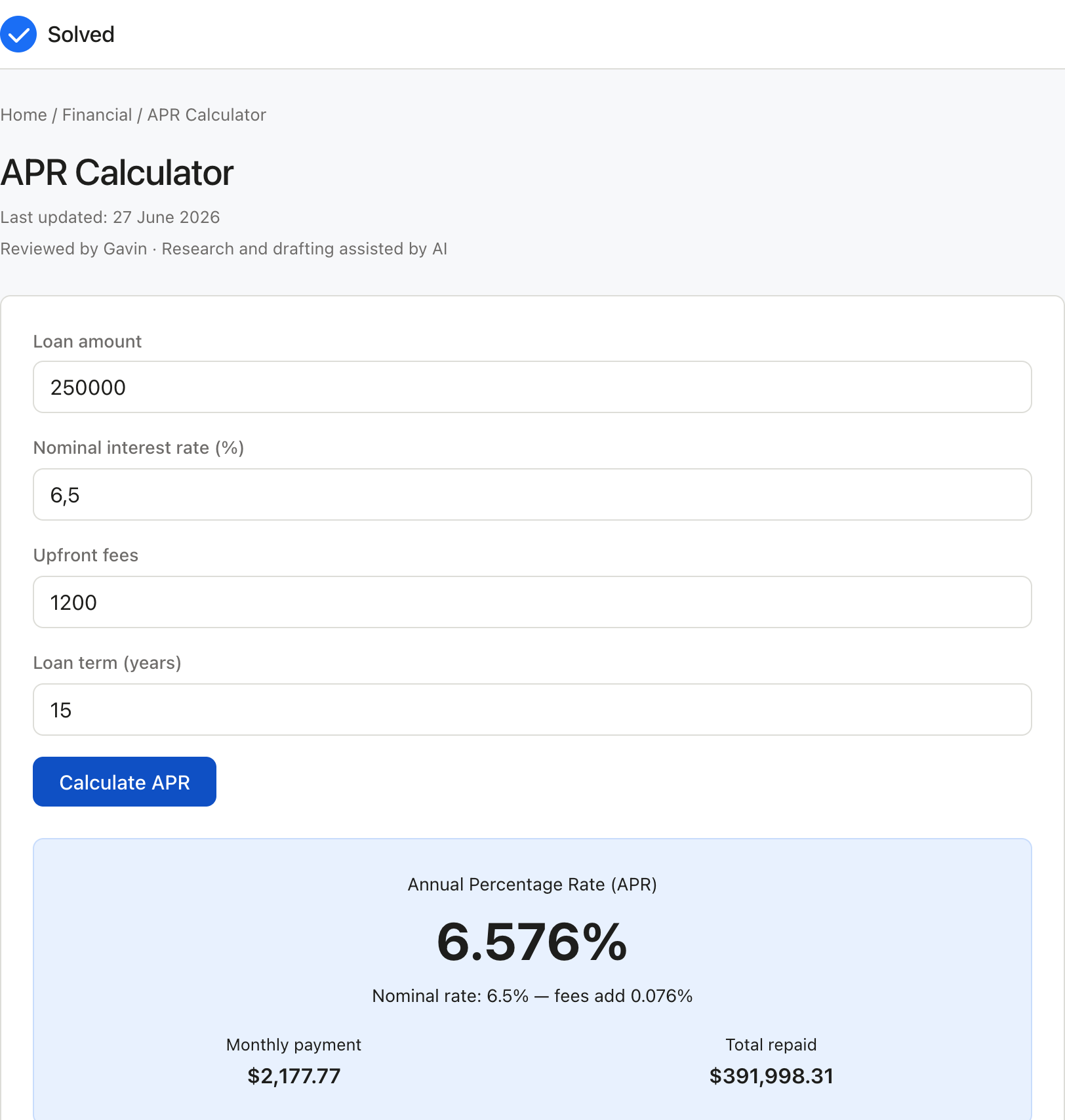
Captured from solved.tools on 10 September 2026.
What Each Fee Level Costs in APR
The example above uses a £150 fee. The table holds the loan and the payment constant and moves only the fee, so the cost of the fee is isolated.
| Arrangement fee | Monthly payment | APR | Total cost of credit |
|---|---|---|---|
| £0 | £221.60 | 6.00% | £318.47 |
| £75 | £221.60 | 7.49% | £393.47 |
| £150 | £221.60 | 9.01% | £468.47 |
| £250 | £221.60 | 11.10% | £568.47 |
| £400 | £221.60 | 14.34% | £718.47 |
£5,000 over 24 months at a nominal 6%, fee deducted from the money advanced. The APR is the calculator's figure: twelve times the monthly rate that makes the 24 payments worth the net advance today.
A £400 fee on a £5,000 two-year loan lifts the APR from 6.00% to 14.34%, and the total cost of credit from £318.47 to £718.47, without touching the headline rate. That is the case for reading the APR rather than the advertised rate when two offers differ only in their fees. Match the term and the payment structure first, then compare.
What the APR Figure Assumes
The calculator fixes the payment from the nominal rate applied to the full amount borrowed. The fee does not change the payment; it reduces the money actually received. The APR is then the rate that equates the stream of payments with the net advance, reported as twelve times the monthly rate, which is the convention used on loan documentation.
Check four things before you rely on the figure. The fee is assumed to be paid up front rather than added to the balance, the rate is assumed fixed for the whole term, the term is entered in whole years, and no insurance or optional product is bundled into the payment. A fee added to the balance behaves differently: the principal is larger, every payment rises, and the APR calculation has to start from the bigger number.
Frequently Asked Questions
What is the difference between APR and AER? APR (Annual Percentage Rate) applies to borrowing and represents the cost of credit. AER (Annual Equivalent Rate) applies to savings and investments and represents the return on deposited funds, standardised for compounding frequency. They are both standardised annual rates designed to allow fair comparison, but they refer to different products. You will see APR on loan adverts and AER on savings accounts.
Can the APR change during a loan? For fixed-rate loans, the APR is set for the full term. For variable-rate loans (such as credit cards or tracker mortgages), the APR changes when the underlying rate changes. Card issuers must give advance notice of rate changes. purpose of comparison, use the initial APR, but be aware that a variable-rate product's future cost is uncertain.
Why is the APR on a payday loan so high? Payday loans are short-term products. Because APR is an annualised figure, even a small fee on a 30-day loan produces an extremely high APR. For example, a £25 fee on a £500 one-month loan is 5% for 30 days, which annualises to over 60% APR. This does not mean the actual cost for 30 days is 60%; it means that if you borrowed at that rate for a full year, you would pay 60% in costs. Always look at the total amount repayable alongside APR for very short-term borrowing.
Is a lower APR always better? A lower APR is generally better when comparing loans of the same amount and term. However, a lower APR on a longer term can result in more total interest paid than a higher APR on a shorter term. Always check the total amount repayable, not just the APR, when making a final decision.
Also try these free tools related to APR Calculator: - Loan Calculator
Extended Reference Notes
The notes below cover the broader context that informs how to use the APR Calculator well.
Typical Input Ranges
Most real-world uses of the APR Calculator fall into a middle band where the result is stable and useful. Very small inputs to the APR Calculator often round to zero or near-zero, and very large inputs amplify every rounding error in the calculation. The middle band, where the APR Calculator inputs are ordinary sizes, is where the tool is most reliable.
Assumptions Behind the Formula
The APR Calculator assumes the inputs stay fixed across the period or scenario being modelled. Rates move, values change, and fees appear, so treat the APR Calculator output as a clean reference and layer in the frictions your own situation adds.
Common Edge Cases
Three situations change the APR Calculator answer in ways the formula does not surface: boundary values near zero, rounding cascades across many steps, and unit mismatches between fields. When any of these apply, sanity-check the APR Calculator result against an independent estimate.
When to Revisit the Calculation
The APR Calculator output is only as current as its inputs, so re-run the calculation whenever a key value changes materially. A quarterly re-check of the APR Calculator suits personal planning; monthly suits active business or investment decisions.
Relationship to Other Tools
The APR Calculator shares inputs and outputs with the other tools in its category. If the same numbers feed several tools, capture them once and run each tool so the comparison stays consistent with the APR Calculator.
Practical Checklist Before Relying on the Result
Before acting on the APR Calculator output, run a short mental checklist: inputs in the right units, direction of the result matching intuition, and magnitude plausible. Each check takes seconds and catches the most common classes of APR Calculator error before they reach a decision.
Putting the Result to Work
A single APR Calculator run usually narrows the range of plausible answers rather than settling the question. Compare the APR Calculator result against a benchmark or a previous run, and ask what would have to change for the answer to flip a decision.
Sensitivity to Inputs
Some inputs move the APR Calculator result more than others; changing each by a small amount shows which ones matter. Spend the effort on the high-impact APR Calculator inputs and treat the low-impact ones as approximate.
A Note on Stale Inputs
A calculation is only as fresh as the inputs that feed it, so note the date the APR Calculator inputs were last refreshed. A six-month-old APR Calculator result can be as wrong as a wrong calculation when the underlying values have moved on.