Currency Converter
Last updated: 28 June 2026
Reviewed by Gavin Meiring, Lead research and primary author · Doctoral Candidate (Corporate Governance) · Research and drafting assisted by AI
- The word 'currency' comes from the Latin 'currere', meaning 'to run' — a nod to the coins and notes that literally circulate from hand to hand.
- The foreign exchange market is the largest financial market on Earth, with more than $7 trillion changing hands every day — far exceeding the daily turnover of all the world's stock markets combined.
- The pound sterling is often called the world's oldest currency still in use, tracing its origins back over 1,200 years to the silver pennies struck by Anglo-Saxon kings.
Currency Converter
A currency converter calculates how much one currency is worth in another using the current exchange rate. It is used by travellers, online shoppers, importers, exporters, and anyone sending money abroad who needs to know the value of a currency in real terms before making a transaction.
How to Use the Currency Converter
- Enter the amount you want to convert.
- Select the currency you are converting from.
- Select the currency you are converting to.
- Click convert to see the equivalent amount at the current exchange rate.
- Check the rate shown; the tool uses mid-market rates, which differ from the rates banks and exchange services charge customers.
The Formula
Currency conversion uses a simple ratio:
Converted Amount = Original Amount x Exchange Rate
Where the exchange rate is expressed as "units of target currency per unit of source currency". For example, if the GBP/USD rate is 1.27, then £1 = $1.27, and £500 = £500 x 1.27 = $635.
To convert back from USD to GBP, divide by the rate or use the inverse rate (1 / 1.27 = 0.787), so $635 / 1.27 = £500.
Real-World Example
You are travelling to the United States and want to exchange £800 for US dollars. The mid-market rate is GBP/USD 1.2650.
- Converted amount at mid-market rate: £800 x 1.2650 = $1,012
- Your bank charges a 2.5% fee: £800 x 0.025 = £20 fee
- Effective exchange: (£800 - £20) x 1.2650 = $986.70
- Or equivalently, the bank's effective rate: 1.2650 x 0.975 = 1.2334
The gap between the mid-market rate and the rate you actually receive is the spread or fee. This gap varies widely between providers, from under 0.5% at specialist travel money companies to 5% or more at airport bureaux de change.
Getting the Best Exchange Rate
The mid-market rate (also called the interbank rate) is the rate at which banks trade currency with each other. Retail customers never receive the mid-market rate; the difference between what you receive and the mid-market rate is effectively the fee. To get the best deal: avoid airport and hotel exchange desks, which typically charge the highest margins; use specialist providers such as Wise, Revolut, or a high-street travel money service for cash; and for international bank transfers, compare specialist transfer services against your bank, as fees vary significantly. For regular currency needs, a multi-currency account can reduce conversion costs considerably.
Reference Table: Worked conversions at illustrative rates
A conversion table at fixed example rates: 0.92 euro, 0.79 pound and 18.40 rand to the dollar. The live rate changes constantly, so use the calculator for the current figure and treat this table as a worked example of the method.
| US dollars | Euros at 0.92 | Pounds at 0.79 | Rand at 18.40 |
|---|---|---|---|
| $50 | €46.00 | £39.50 | R920.00 |
| $100 | €92.00 | £79.00 | R1,840.00 |
| $500 | €460.00 | £395.00 | R9,200.00 |
| $1,000 | €920.00 | £790.00 | R18,400.00 |
| $5,000 | €4600.00 | £3950.00 | R92,000.00 |
Worked Example on Screen
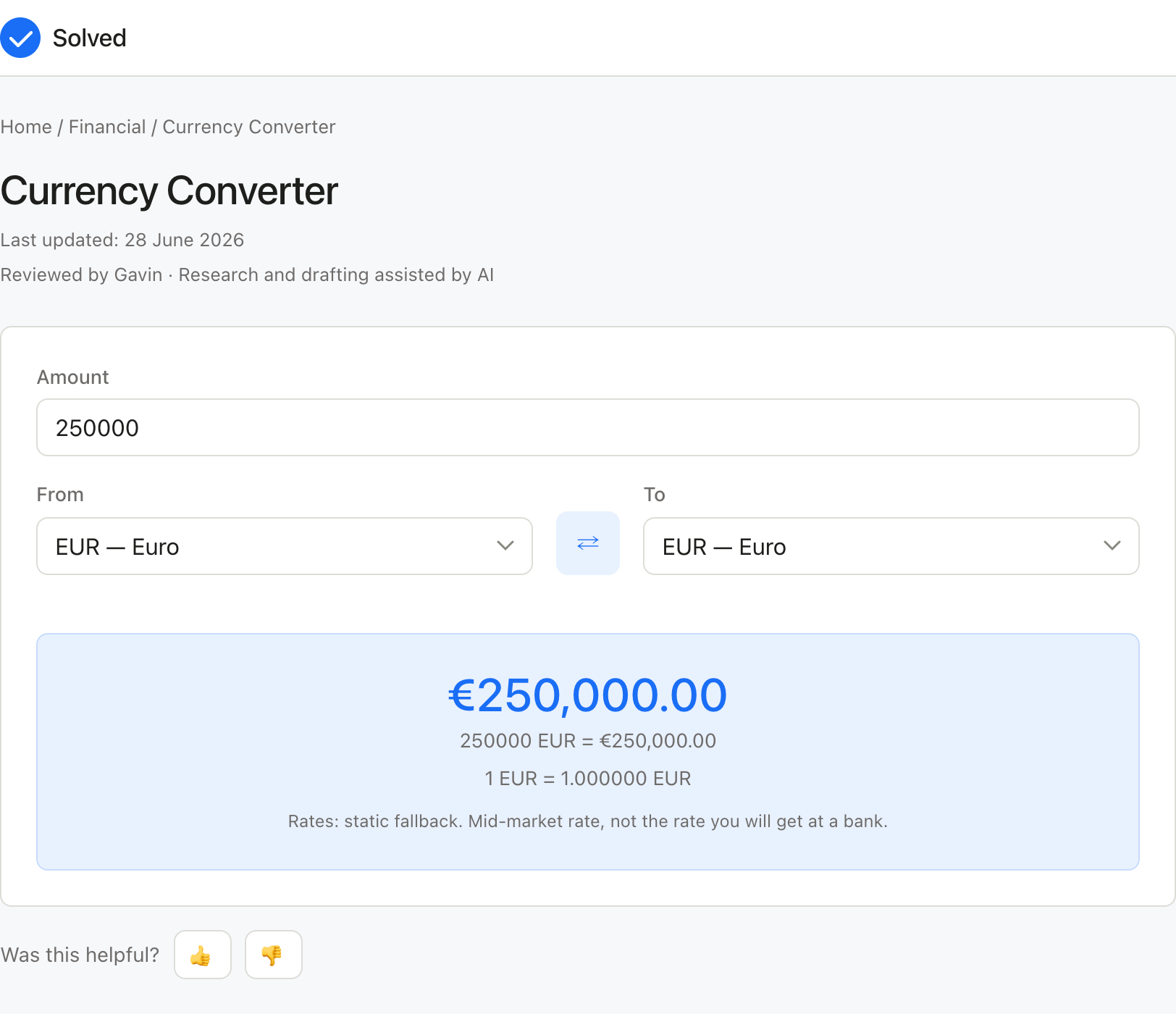
The capture below shows Currency Converter after the inputs were entered, with the result on screen. Enter the same values to reproduce it.
Captured from solved.tools on 10 September 2026.
Frequently Asked Questions
Why does the exchange rate differ between providers? Every provider adds a margin to the mid-market rate to make a profit. Banks typically add 2 to 4%, airport bureaux de change add 5 to 10%, while specialist online services may add less than 1%. Some services charge a flat fee instead of or in addition to a margin. Always calculate the total amount received, not just the quoted rate, to compare providers accurately.
What is the difference between the buy rate and sell rate? When you exchange currency at a bureau de change, they buy your home currency at a lower rate (the buy rate) and sell foreign currency at a higher rate (the sell rate). The gap between these two rates is the spread, which is the provider's profit. The mid-market rate sits between the two. When looking at a rate board, the rate that benefits you depends on which direction you are converting.
Should I pay in local currency or my home currency when abroad? Always pay in local currency. When a card terminal abroad asks if you want to pay in your home currency (called Dynamic Currency Conversion or DCC), decline. DCC rates are set by the merchant and are almost always worse than your card provider's rate, sometimes by 3 to 5%. Paying in local currency lets your bank or card provider apply their conversion rate, which is typically more favourable.
Does the exchange rate change throughout the day? Yes. Foreign exchange markets operate 24 hours a day, five days a week, and rates change continuously based on economic data, central bank decisions, geopolitical events, and market sentiment. For small transactions, intraday movements are usually minor. For large transfers, timing the conversion or using a forward contract through a specialist provider can lock in a rate if you expect conditions to worsen.
What a provider actually costs on a real transfer
The quoted rate is the wrong number to compare. What reaches the other side is the amount received, and that figure folds the rate, the margin and any flat fee into one value.
Take a 1,000 pound transfer at a mid-market rate of 1.2650 dollars to the pound. The five rows below apply a margin to that rate, which is how most retail providers charge.
| Provider | Margin | Cost in pounds | Dollars received |
|---|---|---|---|
| Mid-market rate, no margin | 0 percent | 0.00 | 1,265.00 |
| Specialist transfer service | 0.5 percent | 5.00 | 1,258.67 |
| Online bank | 1.5 percent | 15.00 | 1,246.02 |
| High street bank | 2.5 percent | 25.00 | 1,233.38 |
| Airport bureau de change | 5 percent | 50.00 | 1,201.75 |
The spread between the best and worst row is 63.25 dollars on a 1,000 pound transfer, or 5 percent of the amount sent. A provider that advertises "no commission" and applies a 2.5 percent margin is charging 25 pounds and calling it something else. Comparing the received amount catches that. Comparing the advertised fee does not.
Worked example: converting through a second currency
Converting through an intermediate currency costs you a second spread. Take a 1,000 pound transfer to South Africa with these illustrative rates: pounds to dollars at 1.2650, dollars to rand at 18.15, and a direct pound to rand quote at 23.10.
- Convert to dollars: 1,000 multiplied by 1.2650 gives 1,265.00 dollars.
- Convert to rand: 1,265.00 multiplied by 18.15 gives 22,959.75 rand.
- Compare with the direct route: 1,000 multiplied by 23.10 gives 23,100.00 rand.
- The difference is 140.25 rand, which is 0.61 percent of the direct amount.
The implied cross rate through the dollar is 1.2650 multiplied by 18.15, which is 22.9597 rand to the pound, against a quoted 23.10. The 0.14 rand gap between the two is the cost of the extra hop, and it stays hidden unless you multiply the two legs out and compare the total with the direct quote.
The arithmetic runs the other way as a check. Back conversion uses the inverse rate: at 1.27 dollars to the pound, 635 dollars divided by 1.27 returns 500.00 pounds. Division by the rate and multiplication by the reciprocal agree, which is worth confirming whenever a tool reports a rate and an inverse rate side by side.
Reading the reference table on this page
The table of conversions at fixed rates uses 0.92 euro, 0.79 pound and 18.40 rand to the dollar. It is a method demonstration, and the numbers in it multiply out exactly:
| Check | Arithmetic | Result |
|---|---|---|
| 50 dollars in euros | 50 multiplied by 0.92 | 46.00 |
| 50 dollars in pounds | 50 multiplied by 0.79 | 39.50 |
| 50 dollars in rand | 50 multiplied by 18.40 | 920.00 |
| 5,000 dollars in euros | 5,000 multiplied by 0.92 | 4,600.00 |
| 5,000 dollars in rand | 5,000 multiplied by 18.40 | 92,000.00 |
Treat the table as a worked example of the ratio and nothing more. A fixed rate in a table is a snapshot, and the rate moves continuously during the trading week.
Where the rates come from, and what they are not
Central bank reference rates are the most widely used public benchmark. The European Central Bank publishes euro foreign exchange reference rates for 29 currencies on each working day, usually at around 16:00 CET and not on TARGET closing days. The bank builds them from a concertation procedure between European central banks that normally runs at about 14:10 CET, and the published table describes them as averages of buying and selling rates rather than rates at which trades actually settled.
The ECB states the limitation itself: the reference rates are published for information purposes only, and using them for transaction purposes is strongly discouraged. A reference rate is a benchmark for measurement and accounting. It is not a quote anyone will trade with you at.
That distinction explains the whole comparison above. The mid-market or interbank rate sits at the centre of the market, and every provider quotes either side of it rather than at it. When you see a converter showing a rate and a bank showing a different one, you are looking at the same underlying benchmark with a margin applied in one case and not the other.
Rounding and precision when the amount is large
Two rounding decisions change the answer you act on.
The first is the number of decimal places. Major currencies quote to two decimals, and smaller units quote differently: the Japanese yen has no minor unit in practice, and the South African rand quotes to two. A converter that displays two decimals for every currency is rounding some of them at a coarser step than the market uses. On a 100,000 rand transfer, each 0.005 rand of rounding is 500 rand of displayed value.
The second is whether the fee comes out before or after conversion. Charging 2.5 percent before conversion and 2.5 percent after gives different totals, because the base the percentage applies to has changed. A high street bank charging 25 pounds on a 1,000 pound transfer and a provider charging 2.5 percent on the converted dollar amount are not charging the same fee. Run both orders through the calculator and keep the larger figure as your planning number.
For anything you intend to report or file, record the rate, the timestamp and the fee basis alongside the result. A conversion without those three pieces of context cannot be reproduced later, and reproducing it is usually the point.
Also try these free tools: