Inflation Calculator
Last updated: 27 June 2026
Reviewed by Gavin Meiring, Lead research and primary author · Doctoral Candidate (Corporate Governance) · Research and drafting assisted by AI
- At the Bank of England's 2% inflation target, prices double every 36 years. At 10% inflation, they double every 7.2 years.
- During Germany's hyperinflation of 1923, prices doubled every 3.7 days at the peak. Workers were paid twice a day so they could spend their wages before they became worthless.
- A pint of milk in the UK cost about 3p in 1970. Today it costs around 65p — a rise of over 2,000% — while average wages have risen around 3,000%.
Inflation Calculator
An inflation calculator shows how the purchasing power of money changes over time and how much a sum from the past is worth in today's money (or vice versa). It is used by consumers, investors, and financial planners to understand the real value of money and to adjust savings targets, wages, and investment returns for inflation.
How to Use the Inflation Calculator
- Enter the starting amount you want to adjust.
- Enter the starting year and the ending year.
- Enter the average annual inflation rate, or use the default historical average for your country.
- Click calculate to see the inflation-adjusted value.
- Use the result to compare purchasing power across different years or to set savings goals in real terms.
The Formula
The inflation-adjusted future value uses the compound growth formula applied to price levels:
Adjusted Value = Original Amount x (1 + inflation rate)^number of years
To find what a past amount is worth today, divide the original by the compounded price increase:
Real Value Today = Historical Amount / (1 + average inflation rate)^years elapsed
Where the inflation rate is expressed as a decimal (e.g., 3% = 0.03) and years is the number of years between the two dates.
Real-World Example
You want to know what £10,000 saved in 2010 would need to be worth today (2025) to have the same purchasing power, assuming average UK inflation of 3.5% per year.
- Years elapsed: 15
- Adjustment factor: (1 + 0.035)^15 = approximately 1.675
- Equivalent value today: £10,000 x 1.675 = approximately £16,750
This means £10,000 in 2010 had the purchasing power of roughly £16,750 in 2025. A savings account that returned less than 3.5% annually over this period would have actually lost real value, even if the nominal balance grew.
Why Inflation Matters for Financial Planning
Inflation quietly erodes purchasing power over time. A retirement fund that looks substantial today may buy significantly less in 20 or 30 years. For example, at 3% annual inflation, prices roughly double every 24 years. This is why financial planners advise targeting returns that exceed inflation rather than simply preserving the nominal value of savings. When setting a retirement income target, always express it in today's money and then apply an inflation adjustment to find the future nominal figure you need to accumulate. Investments in equities, index-linked bonds, and property have historically outpaced inflation over long periods, while cash savings often struggle to keep pace during high-inflation periods.
Reference Table: What $1,000 buys later
The purchasing power of $1,000 after 5, 10 and 20 years at three inflation rates. At 3% a year, $1,000 buys what $744.09 buys today after a decade. Stated the other way, a basket costing $1,000 now costs $1,343.92 in ten years.
| Inflation | After 5 years | After 10 years | After 20 years |
|---|---|---|---|
| 2% | $905.73 | $820.35 | $672.97 |
| 3% | $862.61 | $744.09 | $553.68 |
| 4% | $821.93 | $675.56 | $456.39 |
Worked Example on Screen
The capture below shows Inflation Calculator after the inputs were entered, with the result on screen. Enter the same values to reproduce it.
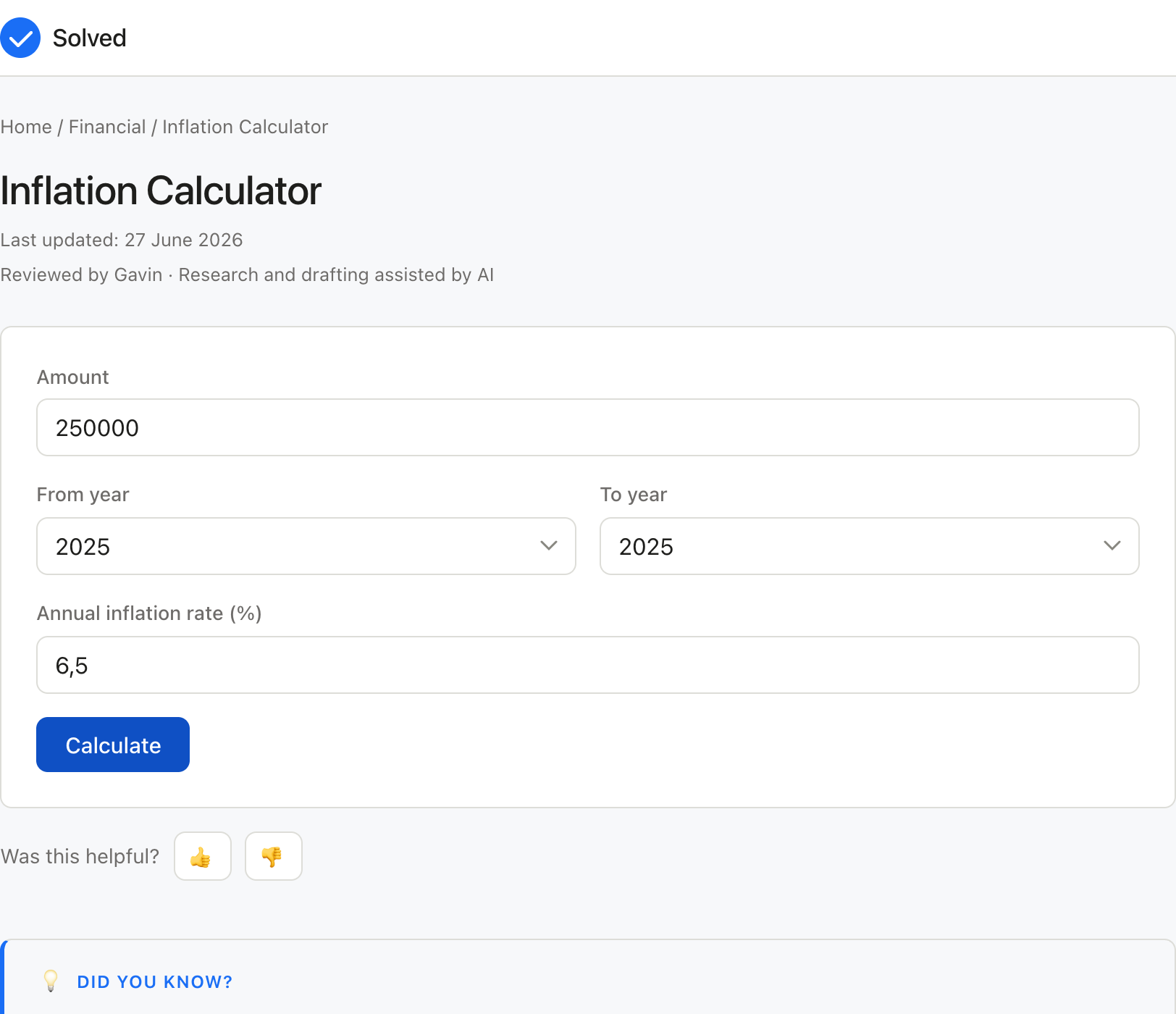
Captured from solved.tools on 10 September 2026.
Frequently Asked Questions
What inflation rate should I use for long-term planning? The Bank of England targets 2% annual inflation. Historically, UK inflation has averaged around 2.5 to 3.5% over the past few decades, with periods of much higher inflation (the 2022 peak reached over 11%). For conservative long-term planning, many advisers use 2.5 to 3% as a reasonable assumption; for a more cautious plan, use 3.5%.
How does inflation affect investment returns? The real return on an investment is the nominal return minus inflation. If your investment earns 6% per year and inflation is 3%, your real return is approximately 3%. This is the figure that matters for actual purchasing power. Always compare investment returns against inflation, not just the headline percentage.
What is the difference between CPI and RPI in the UK? The Consumer Prices Index (CPI) is the UK government's official inflation measure and is used for most economic statistics and for uprating benefits. The Retail Prices Index (RPI) is an older measure that includes housing costs such as mortgage interest payments and is typically higher than CPI. Some debt products and index-linked gilts still use RPI.
Can inflation ever be good? Moderate inflation (around 2%) is generally considered healthy for an economy as it encourages spending and investment rather than hoarding cash. Very low inflation or deflation can lead to reduced economic activity. High inflation is harmful as it reduces real wages, erodes savings, and creates uncertainty for businesses and households.
Understanding the Inflation Calculator
The Inflation Calculator is one of the most-requested tools in the inflation category because it condenses a calculation that would otherwise require manual work, a spreadsheet, or a specialist program into a single input-and-output step. whether you are a student, a professional, or a curious learner, the Inflation Calculator is designed to deliver a quick and trustworthy answer without forcing you to install anything or sign up for an account. Behind the scenes, the Inflation Calculator applies well-established mathematical or scientific formulas to the values you provide. the aim of Inflation Calculator is to remove the friction of hand calculation while still showing you the underlying method, so you can confidently interpret the result. Every calculation is performed locally in your browser, which means your inputs never leave your device.
When Should You Use the Inflation Calculator?
Use the Inflation Calculator whenever you need a quick, reliable answer that fits the tool's scope. Common situations for the Inflation Calculator include homework problems, workplace tasks, financial planning, fitness or health tracking, and everyday curiosity. If the Inflation Calculator answer will be used for a decision that has legal, medical, or financial consequences, treat the result as a starting point and verify it with a qualified professional. The Inflation Calculator is free to use, requires no sign-up, and works on any device with a modern browser. You can run the Inflation Calculator as many times as you like, change the inputs, and compare results side by side.
Common Inputs and How to Choose Them
Most Inflation Calculator problems revolve around a small set of inputs.
- the starting amount you want to adjust is usually the first value to pin down for the Inflation Calculator.
- the starting year and the ending year sets the context the Inflation Calculator needs for a sensible result.
- the average annual inflation rate, or use the default historical average for your country refines the Inflation Calculator output where the data is available. Identifying the right values is the most important step for the Inflation Calculator, because the answer is only as accurate as the data you put in. If a value is unknown, prefer a conservative estimate over a guess when using the Inflation Calculator.
How to Interpret the Result
The numerical answer from the Inflation Calculator alone is rarely the whole story. Read the units, the precision, and any warnings shown alongside the Inflation Calculator result. Understanding the path from inputs to output in the Inflation Calculator makes it easier to spot errors, communicate the result to others, and reuse the method for related problems in the future.
Worked Examples
A typical Inflation Calculator run takes reasonable inputs, produces a sensible answer, and returns it in a single click. Example: You want to know what £10,000 saved in 2010 would need to be worth today (2025) to have the same purchasing power, assuming average UK inflation of 3.5% per year. - Years elapsed: 15 - Adjustment factor: (1 + 0.035)^15 = approximately 1.675 - Equivalent value today: £10,000 x 1.675 = approximately £16,750 This means £10,000 in 2010 had the purchasing power of roughly £16,750 in 2025. A savings acc
Common Mistakes to Avoid
Common mistakes with the Inflation Calculator:
- Mixing up units (for example, entering one unit when the Inflation Calculator expects another).
- Forgetting to convert percentages to decimals or vice versa where the Inflation Calculator formula requires it.
- Using a snapshot value that no longer reflects reality for the Inflation Calculator, especially for time-sensitive inputs like prices, rates, or counts.
- Rounding intermediate steps too early and then carrying the rounded value forward in the Inflation Calculator.
- Treating the Inflation Calculator as a substitute for professional advice when the decision is high-stakes.
Limitations and Assumptions
No calculator is a perfect model of reality, and the Inflation Calculator is no exception. The Inflation Calculator makes simplifying assumptions to keep the math tractable: it ignores rare cases, applies default values where inputs are missing, and uses formulas that suit the typical situation rather than the exotic one. When your situation falls outside the typical case, the Inflation Calculator result may drift further from the truth. If you need a more precise answer than the Inflation Calculator provides, the next step is usually a specialist, a more detailed reference, or a domain-specific tool.
Related Tools and References
For more depth on the Inflation Calculator topic, consult textbooks, academic papers, or reputable online resources. Reputable sources for the Inflation Calculator include government statistics agencies, university extension services, and peer-reviewed journals. Wikipedia is a useful starting point for definitions and formulas behind the Inflation Calculator, but always follow the citations to the original source before relying on a number. If you find that you need the same Inflation Calculator calculation repeatedly, consider writing down the inputs and the result in a note so you can build a personal record over time.
Quick Reference
- Free to use: yes, no sign-up required.
- Privacy: all calculations run locally in your browser.
- Units: metric and imperial supported where applicable; check the input labels.
- Speed: instant, no page reload.
- Mobile friendly: yes, works on phones and tablets.
- Offline: once the page has loaded, the calculation continues to work without a network connection.
References - General-purpose math references such as Wolfram MathWorld and Khan Academy for foundational formulas.
- Wikipedia articles on the relevant topic, with citations to primary sources, cover the Inflation Calculator background.
- Peer-reviewed journals and textbooks give the most rigorous treatments of the Inflation Calculator method.Tools/tools/calculator) - Percentage Calculator - Unit Converter
Also try these free tools: