Compound Interest Calculator
Last updated: 27 June 2026
Reviewed by Gavin Meiring, Lead research and primary author · Doctoral Candidate (Corporate Governance) · Research and drafting assisted by AI
- Albert Einstein allegedly called compound interest 'the eighth wonder of the world'. Historians can't confirm he said it — but the maths speaks for itself.
- Warren Buffett made over 95% of his net worth after his 65th birthday, almost entirely due to compound growth accumulating over decades.
- The Rule of 72: divide 72 by your annual interest rate to find how many years it takes to double your money. At 6%, that's 12 years. At 1% (most savings accounts), it's 72 years.
Compound Interest Calculator
A compound interest calculator shows how an investment or savings balance grows when interest is earned not just on the original amount but also on previously accumulated interest. It is used by savers, investors, and anyone planning long-term financial goals who wants to see the real impact of time and rate on their money.
How to Use the Compound Interest Calculator
- Enter your starting balance or initial deposit.
- Enter the annual interest rate or expected return.
- Set the compounding frequency: annually, quarterly, monthly, or daily.
- Enter the number of years you plan to save or invest.
- Optionally, add a regular monthly contribution to see how additional deposits accelerate growth.
The Formula
The compound interest formula is:
A = P x (1 + r/n)^(n x t)
Where A is the final amount, P is the principal (starting balance), r is the annual interest rate as a decimal, n is the number of times interest compounds per year, and t is the number of years. For regular contributions, each deposit is also compounded from the time it is added, so the total is the sum of the compounded principal and the future value of the contribution series.
Real-World Example
You invest £5,000 at an annual rate of 5%, compounded monthly, for 10 years with no additional contributions.
- r/n = 0.05 / 12 = 0.004167
- n x t = 12 x 10 = 120
- A = 5,000 x (1 + 0.004167)^120
- A = 5,000 x 1.6470 = approximately £8,235
You started with £5,000 and gained £3,235 purely from compound interest, without adding a single extra pound. Over 20 years at the same rate, the balance would grow to approximately £13,600.
Why Compounding Frequency Matters
The more frequently interest is compounded, the more you earn. The difference between annual and daily compounding on a large balance over many years is meaningful. On £10,000 at 5% over 20 years, annual compounding produces approximately £26,533, while daily compounding produces approximately £27,181. The gap widens as the balance and time period grow. Most savings accounts in the UK compound monthly or daily, while many investment accounts treat returns as annual. Always check the compounding frequency when comparing products, as it affects your real return.
Reference Table: Growth of a $10,000 lump sum
The table compounds a single $10,000 deposit at five rates over four periods, with interest added once a year and nothing withdrawn. Money doubles in roughly 72 divided by the annual rate, so 6% takes about 12 years.
| Annual rate | 5 years | 10 years | 20 years | 30 years |
|---|---|---|---|---|
| 4% | $12,167 | $14,802 | $21,911 | $32,434 |
| 5% | $12,763 | $16,289 | $26,533 | $43,219 |
| 6% | $13,382 | $17,908 | $32,071 | $57,435 |
| 7% | $14,026 | $19,672 | $38,697 | $76,123 |
| 8% | $14,693 | $21,589 | $46,610 | $100,627 |
Worked Example on Screen
The capture below shows Compound Interest Calculator after the inputs were entered, with the result on screen. Enter the same values to reproduce it.
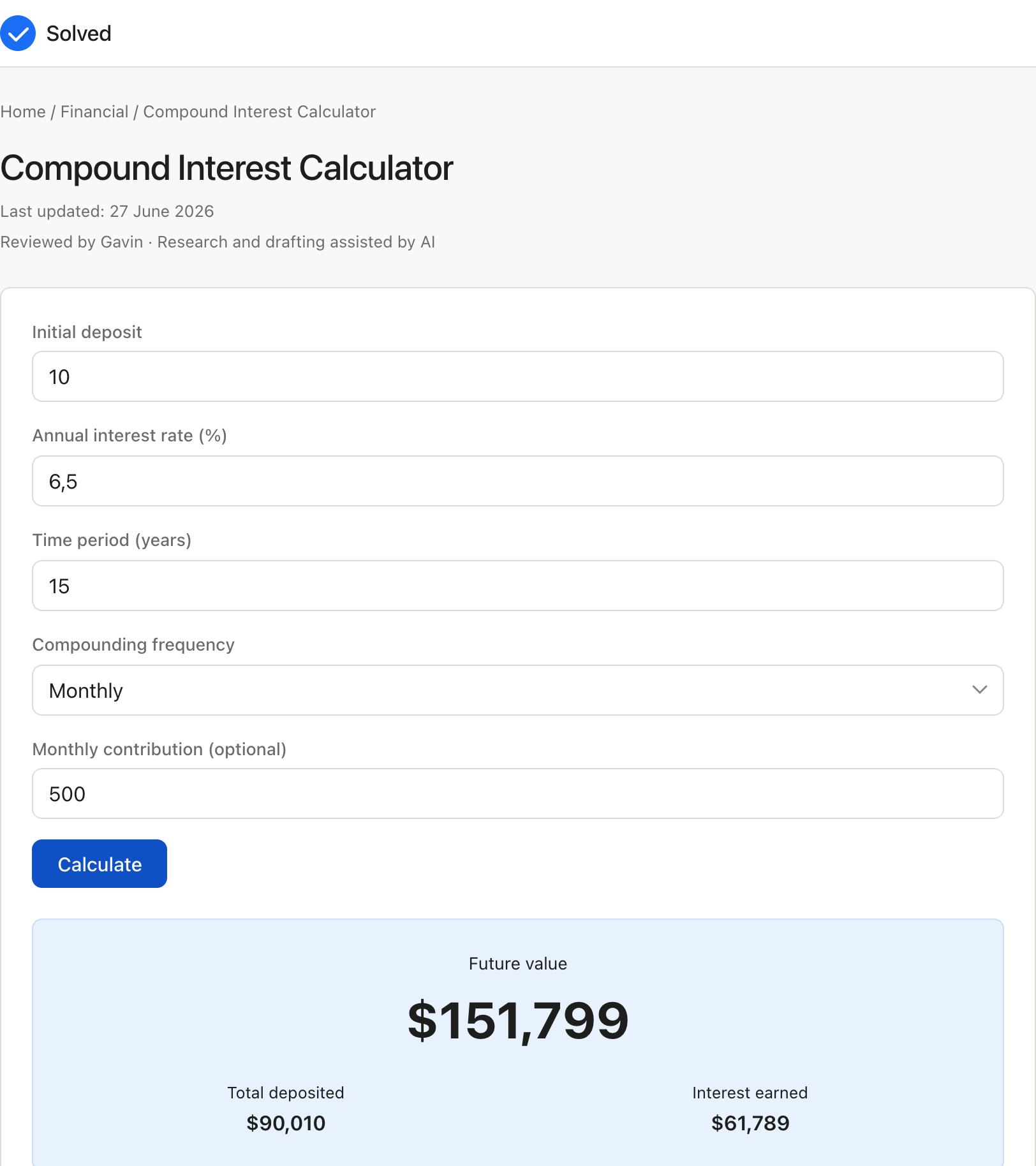
Captured from solved.tools on 10 September 2026.
Frequently Asked Questions
What is the difference between compound and simple interest? Simple interest is calculated only on the original principal. Compound interest is calculated on the principal plus all previously earned interest. Over long periods, compound interest produces significantly higher returns. A £10,000 investment at 5% simple interest for 20 years earns £10,000 in interest. The same sum at 5% compound interest (annually) earns approximately £16,533.
Does compound interest work against me on debt? Yes. When you carry a credit card balance or loan, interest compounds on the outstanding amount, including previous interest charges. This is why high-interest debt grows quickly if minimum payments are made. Paying more than the minimum reduces the principal faster and cuts the total interest owed.
What is the Rule of 72? The Rule of 72 is a quick way to estimate how long it takes to double your money. Divide 72 by the annual interest rate. At 6%, your money doubles in approximately 12 years. At 8%, it doubles in roughly 9 years. It is a useful mental shortcut before running the full compound interest calculation.
How does inflation affect compound growth? Compound interest calculators typically show nominal growth, not real growth. If your savings earn 4% annually but inflation is running at 3%, your real return is only around 1%. For long-term planning, subtract the expected inflation rate from your interest rate to see the purchasing power gain, not just the number in your account.
Also try these free tools:
Inputs and Their Effects
Each field on the Compound Interest Calculator form plays a distinct part in the calculation.
- your starting balance or initial deposit - this value feeds the Compound Interest Calculator directly and shows up in the result.
- the annual interest rate or expected return - this value feeds the Compound Interest Calculator directly and shows up in the result.
- the compounding frequency: annually, quarterly, monthly, or daily - this value feeds the Compound Interest Calculator directly and shows up in the result. Editing one field of the Compound Interest Calculator changes the output in line with the formula, so a misplaced value is visible in the answer.
Common Mistakes to Avoid
A common mistake is to confuse nominal rates with effective rates, or annual rates with rates per period. The two figures look similar but produce different answers when applied to a real-world scenario. Another frequent error is to overlook fees and charges. Origination fees, service charges, and similar costs are often excluded from headline rate calculations but materially affect the true cost or return. Be careful with sign conventions when working with cash flows. Inflows and outflows must follow the same convention throughout the calculation, otherwise the result will look correct but be unusable for decision-making. Do not assume historical performance implies future results. Past returns, even reliable ones, are not a guarantee of what is to come. Finally, watch the rounding. Financial calculations usually carry more precision than they display, and rounding at each intermediate step can introduce small but cumulative errors over long horizons.
When to Use This Tool
Use the Compound Interest Calculator when you have the inputs to hand and want a single, reliable answer quickly. The Compound Interest Calculator fits a well-defined question where the inputs are known and the output is a number you can act on. If the problem needs scenario modelling across many changing variables, a spreadsheet or a dedicated planning tool gives you more room than the Compound Interest Calculator to compare outcomes side by side.
How the Math Works
The calculation behind the Compound Interest Calculator follows the standard form for this kind of problem: The compound interest formula is: A = P x (1 + r/n)^(n x t) Where A is the final amount, P is the principal (starting balance), r is the annual interest rate as a decimal, n is the number of times interest compounds per year, and t is the n The Compound Interest Calculator applies that relationship in the order the algebra prescribes, converting inputs to consistent units first where the formula needs them.
Practical Tips
A few habits keep the Compound Interest Calculator results reliable:
- Confirm each input matches the label, especially your starting balance or initial deposit and the annual interest rate or expected return if both are present.
- Work in one unit system throughout the Compound Interest Calculator instead of converting mid-way by hand.
- Sanity-check the Compound Interest Calculator output against a rough estimate before relying on it.
- Keep a note of the values you used so the Compound Interest Calculator calculation can be reproduced later.
Troubleshooting Unexpected Results
When the Compound Interest Calculator result does not match expectation, run through the usual suspects in order:
- Check the unit on your starting balance or initial deposit first; a unit mismatch is the most common cause of a surprising Compound Interest Calculator answer.
- Check the sign of each input; a negative where the Compound Interest Calculator expects a positive flips the result.
- Check the magnitude; a Compound Interest Calculator answer many orders of magnitude off is almost always a unit or decimal error.
- Re-run a simple round-number case by hand to confirm the Compound Interest Calculator is wired up correctly.
Related Concepts and Where This Fits
The Compound Interest Calculator fits alongside the other tools in its category, and the choice between them usually comes down to which inputs you already have. If the same numbers feed several tools, run them in one pass so the assumptions stay consistent across the comparison, which is where the Compound Interest Calculator earns its place.