Savings Calculator
Last updated: 27 June 2026
Reviewed by Gavin Meiring, Lead research and primary author · Doctoral Candidate (Corporate Governance) · Research and drafting assisted by AI
- The median American household has less than $8,000 saved — roughly two months of average expenses. In the UK, 12 million adults have less than $100 in savings.
- Japan historically had one of the world's highest savings rates at 15–20% of income. That rate has fallen sharply since the 1990s as the population aged.
- The 50/30/20 budgeting rule — 50% needs, 30% wants, 20% savings — was popularised by US Senator Elizabeth Warren in her 2005 book 'All Your Worth'.
Savings Calculator
A savings calculator shows how a savings balance grows over time based on your starting amount, regular deposits, and interest rate. It is used by people building an emergency fund, saving for a specific goal, or comparing savings accounts to find the best place for their money.
How to Use the Savings Calculator
- Enter your current savings balance or starting deposit.
- Enter the amount you plan to add each month.
- Enter the annual interest rate offered by your savings account.
- Set the time period in months or years.
- Review the projected final balance and the split between your contributions and interest earned.
The Formula
Savings growth with regular deposits uses the future value formula:
FV = P x (1 + r)^n + C x (((1 + r)^n - 1) / r)
Where FV is the final balance, P is the starting balance, r is the monthly interest rate (annual rate divided by 12), n is the number of months, and C is the monthly deposit. If you make no regular deposits, the second part of the formula is zero and only the first applies.
Real-World Example
You open a savings account with £1,000, add £150 per month, at an annual rate of 4.5% (monthly rate 0.375%), over 3 years (36 months).
- FV of starting balance: 1,000 x (1.00375)^36 = approximately £1,144
- FV of monthly deposits: 150 x (((1.00375)^36 - 1) / 0.00375) = approximately £5,898
- Total balance: approximately £7,042
- Total contributed: £1,000 + (£150 x 36) = £6,400
- Interest earned: approximately £642
Choosing the Right Savings Account
Not all savings accounts work the same way. Easy-access accounts let you withdraw at any time but typically offer lower rates. Fixed-rate bonds lock your money away for a set period (6 months to 5 years) in exchange for a higher rate. Cash ISAs shelter your interest from income tax, which matters most for higher-rate taxpayers or those with large balances. Notice accounts sit between the two: you access funds after a notice period (usually 30 to 95 days) and receive a better rate than easy access. The right account depends on whether you might need the money before the term ends. Use the calculator to compare what each account type would earn over your chosen period.
Reference Table: Regular savings balance over time
Balances from fixed monthly deposits at 3% and 5% a year, compounded monthly. Deposits are made at the end of each month. Saving $250 a month for ten years at 5% reaches $38,821, of which $30,000 is your own money.
| Monthly deposit | 3% over 5 years | 3% over 10 years | 5% over 10 years | 5% over 20 years |
|---|---|---|---|---|
| $100 | $6,465 | $13,974 | $15,528 | $41,103 |
| $250 | $16,162 | $34,935 | $38,821 | $102,758 |
| $500 | $32,323 | $69,871 | $77,641 | $205,517 |
| $1,000 | $64,647 | $139,741 | $155,282 | $411,034 |
Worked Example on Screen
The capture below shows Savings Calculator after the inputs were entered, with the result on screen. Enter the same values to reproduce it.
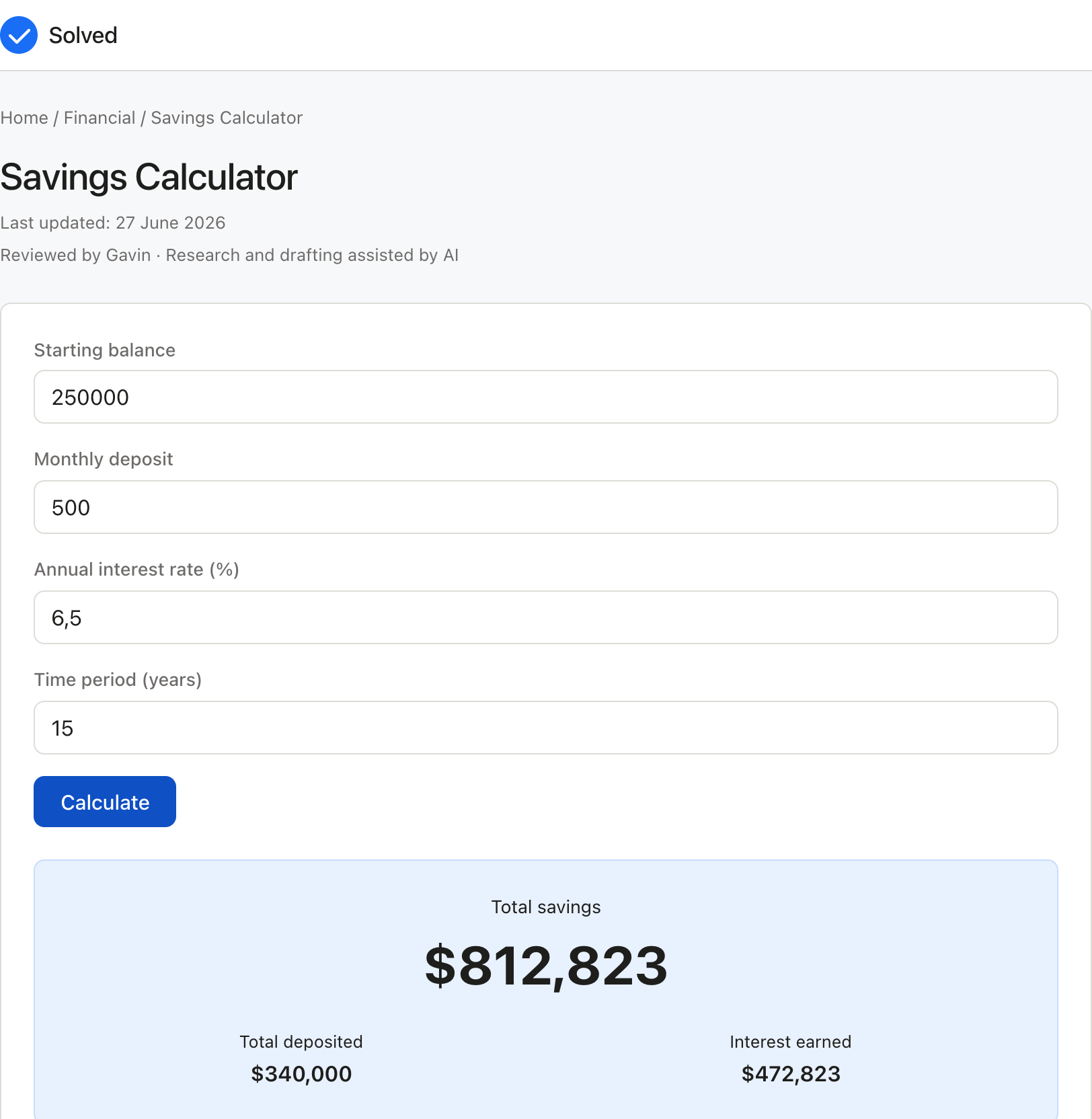
Captured from solved.tools on 10 September 2026.
Frequently Asked Questions
How often does interest compound on a savings account? Most UK savings accounts compound interest monthly or annually. Monthly compounding produces slightly more interest than annual compounding at the same rate. When comparing accounts, look at the AER (Annual Equivalent Rate), which standardises the effect of compounding frequency so you can compare products directly.
Is the interest on savings accounts taxable? In the UK, most people receive a Personal Savings Allowance: £1,000 for basic-rate taxpayers and £500 for higher-rate taxpayers. Interest above that threshold is taxable. Cash ISAs are exempt from tax entirely, making them valuable for people with significant savings or those in a higher tax bracket.
Should I pay off debt before saving? If your debt carries a higher interest rate than your savings account pays, paying off the debt first saves more money overall. The exception is an emergency fund; most financial advisers recommend holding 3 to 6 months of expenses in accessible savings regardless of any debt, to avoid being forced to borrow again in a crisis.
What is the best strategy for reaching a savings goal? Set a clear target amount and deadline, then use the calculator to work backwards to the required monthly contribution. Automate the deposit so it leaves your account on payday. Review the plan every 6 months and increase contributions when your income rises. Consistency matters more than the amount you start with.
Deposit protection above the old limit
A savings balance is a claim on a bank, and the protection behind that claim has a ceiling. In the UK the Financial Services Compensation Scheme pays out if a bank, building society or credit union fails, and the limit per person rose from 85,000 to 120,000 with effect from 1 December 2025. The temporary high balance limit for life events such as a house sale rose to 1.4 million over the same change, according to the scheme's published notice.
The limit works per banking licence rather than per account, and that catches people out. A current account, a cash ISA and two savings accounts at the same bank count together, so the total is what gets measured against the ceiling. Two brands owned by one licence are one bank for this purpose.
Two savers with a joint account are covered separately, so a couple holding 240,000 in a joint account sits exactly at two limits. Where a balance runs above the ceiling, the usual response is to hold the excess at a second institution, and to check that the second institution does not share a licence with the first.
The limit is a reason to map balances rather than a reason to move money. A saver with 30,000 in one account is nowhere near it. A saver who has built a large balance across several accounts at one bank, or who sold a property and is holding the proceeds, is the person the limit is for.
Monthly and annual compounding on the same rate
Two accounts advertising 5% can pay different amounts, because the advertised rate and the method of crediting interest are separate things. Take 10,000 at a nominal 5% and compare annual compounding against monthly.
| Period | Compounded annually | Compounded monthly | Difference |
|---|---|---|---|
| 1 year | 10,500.00 | 10,511.62 | 11.62 |
| 3 years | 11,576.25 | 11,614.72 | 38.47 |
At 4% over five years on 25,000, the same comparison gives 30,416.32 against 30,524.91, a gap of 108.59. The monthly column is higher in every case because interest starts earning interest sooner.
The compounding frequency is why the AER exists. An account quoting 5.00% AER and paying interest monthly credits about 0.4074% a month, and the twelve credits compound to 5.00%. That monthly credit is a gross annual rate of about 4.89%, not 5.00%, so an account advertised as 5.00% AER and an account advertised as 5.00% gross are not the same product. The AER is the figure to compare, because it is the one that standardises the frequency.
| Advertised rate | Frequency | Gross annual rate | Monthly credit |
|---|---|---|---|
| 5.00% AER | monthly | 4.8889% | 0.4074% |
| 4.00% AER | monthly | 3.9285% | 0.3274% |
Where the savings rate is not the AER
The formula on this page takes one rate and holds it fixed for the whole period. Real accounts move. A variable rate can change within weeks of the account opening, and a fixed rate applies only for the term. Neither behaviour is in the formula, and both change the answer.
Three further assumptions sit behind every projection here. Deposits go in at the end of each month, so a deposit made on the first of the month would earn one extra month of interest. No fees, no withdrawal penalties and no tax appear in the calculation. The balance compounds without interruption, which assumes the saver never takes money out.
Tax is the assumption most likely to bite. Interest is taxable income, and the UK personal savings allowance covers 1,000 of interest for a basic-rate taxpayer and 500 for a higher-rate taxpayer. Interest inside a cash ISA is exempt. A projection built on a taxable account and compared against an ISA figure without adjusting for tax will flatter the ISA by the tax on the interest.
A projection is a schedule, not a forecast. If the rate holds, the balance follows the formula to the pound. If the rate moves once, the projection is wrong from that month onwards, and re-running it with the new rate is the only way to see the change.
Checking the worked example against the formula
Run the example above through the formula exactly and the balance comes out lower than the page prints in three places. The starting 1,000 compounds to 1,144.25 at a monthly rate of 0.00375 over 36 months, which matches the printed 1,144. The deposits are where the printed figures stop reproducing.
| Step | Working | Amount |
|---|---|---|
| Starting balance after 36 months | 1,000 x (1.00375) to the power 36 | 1,144.25 |
| Deposits after 36 months | 150 x ((1.00375) to the power 36 minus 1) / 0.00375 | 5,769.91 |
| Total balance | 1,144.25 plus 5,769.91 | 6,914.16 |
| Contributions | 1,000 plus 150 x 36 | 6,400.00 |
| Interest | 6,914.16 minus 6,400.00 | 514.16 |
The page prints approximately 5,898 for the deposits, 7,042 for the total and 642 for the interest. Those three do not follow from the inputs the page states, which are 1,000, 150 a month, 4.5% a year and 36 months. The figures in the table above come from the page's own formula, so a reader who works it through reaches 5,769.91, 6,914.16 and 514.16.
One convention explains part of the gap and not the rest. Deposits made at the start of each month rather than the end would grow to 5,791.55, which is 21.64 higher than the end-of-month figure. The printed 5,898 stays about 106 above that.
Also try these free tools: