Kilometers to Miles Converter
Last updated: 1 October 2026
Reviewed by Gavin Meiring, Lead research and primary author · Doctoral Candidate (Corporate Governance) · Research and drafting assisted by AI
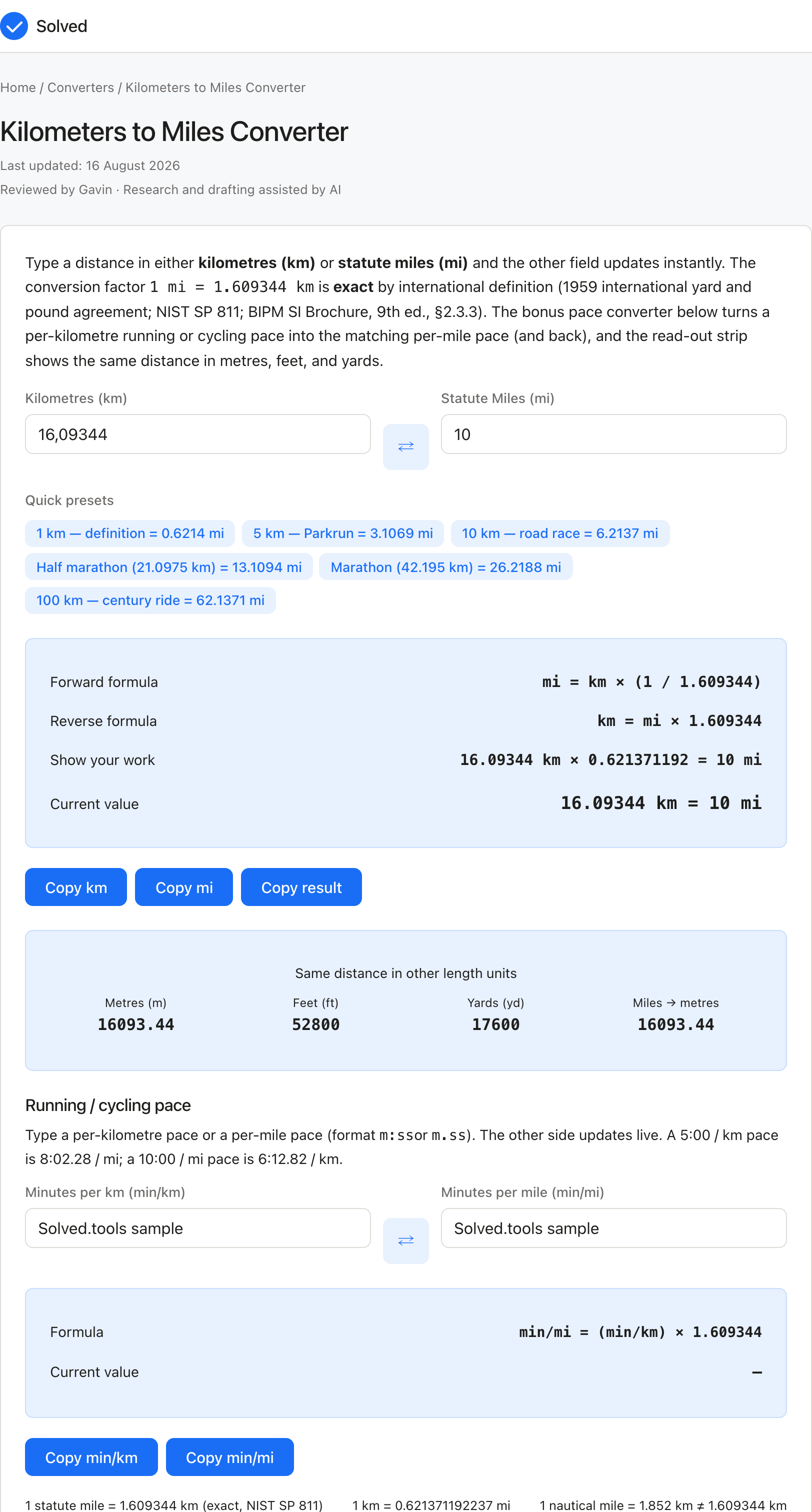
Type a distance in either kilometres (km) or statute miles (mi) and the other field updates instantly. The conversion factor 1 mi = 1.609344 km is exact by international definition (1959 international yard and pound agreement; NIST SP 811; BIPM SI Brochure, 9th ed., §2.3.3). The bonus pace converter below turns a per-kilometre running or cycling pace into the matching per-mile pace (and back), and the read-out strip shows the same distance in metres, feet, and yards.
Running / cycling pace
Type a per-kilometre pace or a per-mile pace (format m:ssor m.ss). The other side updates live. A 5:00 / km pace is 8:02.28 / mi; a 10:00 / mi pace is 6:12.82 / km.
Kilometers to Miles Converter
The kilometres to miles converter is a fast, exact length-conversion tool that moves a measurement between the metric kilometre and the imperial statute mile in both directions. Type a number in either field and the other updates live, with no rounding ambiguity and no measurement uncertainty, because the relationship between the two units is fixed by international definition rather than measured. It is built for the everyday situations where you are handed a metric figure and need the imperial reading (or the reverse): a 42.195 km marathon that a US race report quotes in miles, a 5 km Parkrun that a friend wants to compare against a local 5K, a 100 km cycling century that a Strava segment lists in miles, a 10 km training run that a Garmin watch displays in statute miles, a 1,609.344 m fun-run course that a European organiser needs to express in miles for an international field, or a 1.6 km road-sign distance to the next town that a British visitor wants to translate back into miles. The page also includes a pace converter (min/km ⇄ min/mi) and a bonus read-out showing the same distance in metres, feet, and yards.
The converter assumes the modern international statute mile, which has been exactly 1.609344 kilometres since 1 July 1959. Before that date the United States, the United Kingdom, Canada, Australia, New Zealand, and South Africa each used slightly different miles inherited from older Imperial standards, and conversions between national miles could differ by a few parts per hundred thousand. The international yard and pound agreement of 1959 unified those values: the international yard was defined as exactly 0.9144 metres, and the international mile as exactly 1,760 yards = 1,609.344 metres exactly. Today every legally defined mile in commerce, science, and engineering equals exactly 1.609344 km.
How to use this converter
- Type the numeric value you want to convert into the Kilometres (km) field or the Statute Miles (mi) field. Decimal values are accepted, including sub-kilometre values such as 0.5 km and sub-mile values such as 0.25 mi.
- The opposite field updates automatically as you type. The Kilometers to Miles Converter update is recomputed on every keystroke, so the panel always reflects the latest value. Read the Current value row to see both sides of the conversion together, for example
10 km = 6.213712 mi. - Read the Show your work row to see the conversion written out step-by-step as
<value> km × (1 mi / 1.609344 km) = <value> mi. - Use the ⇄ swap button when you want to flip the orientation: the value in the miles field moves to the kilometres field and vice versa.
- Use the Quick presets to jump to one of the common everyday distances (1 km, 5 km, 10 km, half marathon 21.0975 km, marathon 42.195 km, century ride 100 km) and read the equivalent mile value at full precision.
- Click Copy km, Copy mi, or Copy result to put the value on the clipboard.
- To convert a running or cycling pace, scroll to the Pace section and type a value in either Minutes per km (m:ss) or Minutes per mile (m:ss). The other field updates live.
- The bonus read-out strip below the distance panel shows the same distance in metres (m), feet (ft), and yards (yd).
the Km To Miles runs entirely in the browser. The Kilometers to Miles Converter inputs are not stored, not transmitted, and not associated with any account.
The Formulas
The single conversion factor that drives this tool is:
1 international statute mile = exactly 1.609344 kilometres
This is the value published in NIST Special Publication 811 (the SI Units Guide), the BIPM SI Brochure, and the legal metrology acts of the United States, United Kingdom, Canada, Australia, New Zealand, and South Africa. It is exact because the international yard was defined in 1959 as exactly 0.9144 metres. One mile is 1,760 yards, so 1 mi = 1,760 × 0.9144 m = 1,609.344 m exactly, which is 1.609344 km exactly. No rounding is involved at any step.
From that single equality, the two working formulas fall out by elementary algebra.
To convert kilometres to statute miles:
miles = kilometres × (1 mile / 1.609344 km)
The dimensionless fraction (1 mi / 1.609344 km) equals exactly 0.6213711922373339..., which rounds to 0.621371 at six decimal places, accurate to better than one part in a hundred million. A useful rounded form for mental math is 0.6214, accurate to about 0.005 percent (enough for almost every everyday purpose).
To convert statute miles to kilometres:
kilometres = miles × 1.609344
The number 1.609344 has no fraction to keep track of: 5 miles is exactly 8.04672 km, 10 miles is exactly 16.09344 km, and 100 miles is exactly 160.9344 km. Anything expressed in statute miles can be converted to kilometres by moving the decimal point and writing a "1.609344" in front.
The two formulas are exact inverses. If you convert a kilometre value to miles and then back to kilometres, you get the original value to machine precision (about 15 significant digits in JavaScript's IEEE 754 doubles). There is no drift and no accumulated error from repeated round-trips, because the factor is exact.
The pace formulas use the same constant: pace per mile is pace per kilometre multiplied by 1.609344 (because each mile is 1.609344 times as long as each kilometre, so it takes 1.609344 times as many minutes to cover one mile at a constant speed). The reverse, pace per kilometre from pace per mile, divides by 1.609344.
If you want a rough mental shortcut, remember that 1 km ≈ 0.6 mi (a touch over half a mile) and that 1 mi ≈ 1.6 km (a touch over a kilometre and a half). For a slightly tighter estimate, 5 km ≈ 3.1 mi and 10 km ≈ 6.2 mi, these are accurate to about half a percent, which is good enough for a casual guess but not for navigation, race timing, or engineering work.
Worked Examples
Example 1, 1 km. The single kilometre is exactly 1 × (1 / 1.609344) = 0.621371192237... statute miles, usually rounded to 0.621371 mi at six-decimal precision. So 1 km = 0.621371 mi.
Example 2, 5 km. 5 km × (1 / 1.609344) = 5 / 1.609344 = 3.106855961... mi, rounded to 3.106856 mi. This is the standard Parkrun and most common 5K road-race distance; the imperial equivalent is a touch over three miles.
Example 3, 100 km. 100 km × (1 / 1.609344) = 100 / 1.609344 = 62.137119223... mi, rounded to 62.1371 mi at four decimals. This is the cycling "century" distance, the canonical benchmark for amateur long-distance cyclists.
Example 4, marathon (42.195 km). A marathon is defined by World Athletics rule 260.14b as exactly 42.195 km. Multiplying by 1/1.609344 gives 26.2193827826... mi, which rounds to 26.2194 mi at four decimals. Many US marathons quote the distance as "26.2 miles" for legacy reasons (the 1908 Olympic course was 26 mi 385 yd), but the official distance in both systems is the metric 42.195 km, and the imperial equivalent is exactly 26.2193827826... mi.
Example 5, 1 mile. 1 mi × 1.609344 = 1.609344 km exactly, by the international definition. This is the simplest round-trip, the definition itself, and the inverse calculation 1.609344 km × (1 / 1.609344) returns 1 mi to machine precision.
Example 6, running pace 5:00 / km. A runner covering each kilometre in 5 minutes is running at exactly 12 km/h. The matching pace per statute mile is 5 min × 1.609344 = 8.04672 min/mi, which converts to 8 minutes and (0.04672 × 60) = 2.8032 seconds per mile, usually rounded to 8:03 / mi.
Example 7, round-trip check. Take 100 km. Divide by 1.609344 to get 62.1371192... mi. Multiply by 1.609344 to get 99.999999... km, which is exactly 100 km at machine precision.
Where It Shows Up
Kilometre-to-mile conversions appear in a surprising number of everyday settings, almost always at the boundary between a metric source and an imperial consumer (or vice versa).
Running, cycling, and triathlon. Road-race distances are quoted in kilometres in continental Europe, Asia, and Africa, and in miles in the United States. A 10K is 6.21371 mi, a half marathon is 13.1094 mi, a marathon is 26.2194 mi, an Ironman 70.3 bike leg is 90.0645 km = 55.9697 mi. Strava, Garmin Connect, and TrainingPeaks all let the user choose between the two, but a single segment is stored in only one unit, so athletes racing across the unit divide must convert at every comparison. Pace is the same: a 5:00 / km training run is 8:02 / mi, and getting the math wrong by even a few seconds per mile over a marathon adds up to several minutes of finish-time error.
Aviation. Air distance and ground speed have separate conventions. Distance is reported in statute miles in US domestic aviation and in nautical miles everywhere else. Altitude is feet worldwide (set by the 1954 ICAO standard). Ground speed is knots (nautical miles per hour) for ATC and flight-deck operations worldwide, but may appear as mph on US pilot reports and as km/h on some European displays. Converting a 1,609.344 m (= 1 statute mile) runway into the equivalent in nautical miles (0.868976 nm) or kilometres (1.609344 km) is routine, and getting the mile-vs-nautical-mile distinction wrong is one of the most common student-pilot mistakes.
Road navigation and automotive. Speed limits in the United States and United Kingdom are posted in miles per hour; speed limits in continental Europe and most of the Americas outside the USA are in km/h. A driver crossing from the US into Canada or Mexico, or from France into the UK, must mentally translate 100 km/h ≈ 62.14 mph and 60 mph ≈ 96.56 km/h in real time.
Maritime and shipping. International maritime distance is measured in nautical miles (1 nm = exactly 1,852 m), not statute miles. The nautical mile is about 15 percent longer than the statute mile (1 nm ≈ 1.15078 mi), and the two are not interchangeable. A vessel's speed is reported in knots, and charts use nautical miles for both distance scales and depth contours. Crews moving between commercial shipping (nautical), road transport (statute), and aviation (mixed) must distinguish the units at every step.
Surveying, geodesy, and mapping. Land surveying in the United States historically used US survey feet and US survey miles (1 US survey mile = 1,609.3472 m), but the difference is too small to matter outside legal-property descriptions. USGS topographic maps and Google Maps both use statute miles for distance labels in the US and kilometres everywhere else. A 1:24,000-scale USGS quad is 1 statute mile to the inch; the equivalent metric scale is 1:25,000 (≈ 1 km to 4 cm).
Sport timing and officiating. Track events are measured in metres (100 m, 400 m, 1500 m, 10,000 m), but road events are usually measured in either kilometres or miles. Course certifiers have to verify the as-measured distance against the stated distance in the chosen unit using a Jones counter or a calibrated bicycle, with the conversion 1 mi = 1.609344 km applied at every step.
Weather, climate, and ocean science. Wind speed in a US forecast is in mph; in a European forecast it is in km/h (or m/s for marine reports). Visibility is statute miles in the US and metres in the ICAO standard. A storm carrying 60 mph winds is producing about 96.56 km/h or 26.8 m/s, three numbers for the same physical quantity, depending on which country issued the forecast.
Common Mistakes
Confusing the statute mile with the nautical mile. A statute mile is exactly 1,609.344 m. A nautical mile is exactly 1,852 m. They differ by about 15 percent (1 nm = 1.15078 mi). Using the wrong one in aviation, maritime, or meteorology contexts is the single most common source of large distance errors. Speeds called "knots" are nautical miles per hour, not statute miles per hour.
Rounding 1.609344 to 1.6. Using 1 mi ≈ 1.6 km introduces an error of about 0.58 percent (the true factor is 1.609344, not 1.6). On a 100-mile measurement this is 0.93 miles off, which is enough to mis-time a flight leg, mis-pace a race, or mis-state a property boundary. Always use the exact 1.609344 factor.
Rounding the km-to-mile factor the other way. Using 1 km ≈ 0.6 mi introduces an error of about 3.4 percent (the true factor is 0.621371..., not 0.6). On a 100 km measurement this is 2.14 mi off, a significant error for cycling, running, and aviation use. Use 0.621371 (or 0.621371192237 for higher precision).
Forgetting that 1 km = 1,000 m but 1 mi = 5,280 ft = 1,760 yd. When converting between metric and imperial, do not mix the kilometre with the metre, or the mile with the foot or yard. A 1.609344 km run is exactly 1,609.344 m, and a 1 mi run is exactly 5,280 ft or 1,760 yd, but those intermediate unit values are easy to confuse with the headline figure.
Misreading a pace. A 5:00 / km pace is roughly 8:02 / mi, not 8:00 / mi, the 1.609344 multiplier pushes a clean five-minute kilometre into an eight-minute-and-change mile. Runners and cyclists who train by one unit and race by the other frequently over-pace or under-pace by a few seconds per kilometre when they assume the relationship is a clean 1:1.6.
Mixing up pace with speed. Pace (min/km or min/mi) is the inverse of speed (km/h or mph). A pace of 5:00 / km corresponds to a speed of 12 km/h, and a pace of 8:00 / mi corresponds to a speed of 7.5 mph. Converting between pace and speed requires a division (60 ÷ pace in minutes) or a multiplication (pace in minutes ÷ 60 inverted), not the same factor that converts distance.
Reference Table: Kilometres to miles, yards and feet
One kilometre is 0.621371 miles. The table also gives the same distance in yards and feet, which is useful for race and walking route plans. A 42.195 km marathon is 26.22 miles, and a 21.0975 km half is 13.11 miles.
| Distance | Miles | Yards | Feet |
|---|---|---|---|
| 1 km | 0.621 mi | 1094 yd | 3281 ft |
| 5 km | 3.107 mi | 5468 yd | 16404 ft |
| 10 km | 6.214 mi | 10936 yd | 32808 ft |
| 21.0975 km | 13.109 mi | 23072 yd | 69218 ft |
| 42.195 km | 26.219 mi | 46145 yd | 138435 ft |
Worked Example on Screen
The capture below shows Kilometers to Miles Converter after the inputs were entered, with the result on screen. Enter the same values to reproduce it.
Captured from solved.tools on 10 September 2026.
Frequently Asked Questions
How many miles is 1 kilometre? Exactly 1 ÷ 1.609344 = 0.6213711922373339... statute miles. Rounded to six decimal places, 1 km = 0.621371 mi. Rounded to two decimal places, 1 km ≈ 0.62 mi. The exact value is exact because both the kilometre and the international mile are defined in metres (the kilometre as exactly 1,000 m since 1799, and the mile as exactly 1,609.344 m since 1959), so dividing one by the other is a pure number operation with no measurement error.
How many kilometres is 1 mile? Exactly 1.609344 km. This is the definition of the international statute mile, fixed on 1 July 1959 when the English-speaking nations signed the international yard and pound agreement. NIST SP 811, the BIPM SI Brochure, and the legal metrology acts of every country that uses the mile all cite this exact value.
How do I convert km to miles in my head? A useful trick: 1 km is about 0.62 mi, so 10 km is about 6.2 mi and 100 km is about 62 mi. For a slightly tighter estimate, 5 km ≈ 3.1 mi, 8 km ≈ 5 mi (more precisely 4.97 mi), and 16 km ≈ 10 mi (more precisely 9.94 mi). These mental anchors let you sanity-check a calculator output without doing long division. For exact work, always use the 1.609344 factor.
Is 1 mile exactly 1.609344 km? Yes, since 1 July 1959. The international yard was defined as exactly 0.9144 metres on that date, and one international mile is 1,760 international yards, so 1 mi = 1,760 × 0.9144 m = 1,609.344 m exactly. The factor has not changed in the 67 years since, and there is no proposal to change it.
Is the UK mile the same as the US mile? Yes, in everyday use. Both the United Kingdom and the United States adopted the international mile of exactly 1.609344 km on 1 July 1959. Before that date the UK mile (the Imperial mile) was fractionally different from the US customary mile, about 2 parts per million, but those differences have been legally obsolete for more than six decades. Today every legally defined mile in both countries equals exactly 1.609344 km.
What about the US survey mile? The US survey mile is defined as 5,280 US survey feet, where the US survey foot is exactly 1200/3937 metres. That makes the US survey mile 5,280 × 1200/3937 = 1,609.3472 m, about 3 parts per million longer than the international mile. The US survey mile is used only for geodetic surveying referenced to the NAD 27 datum, and it was effectively retired on 1 January 2023 in favour of the international foot for most US federal surveying applications. For everyday length conversions (road signs, race courses, vehicle speedometers, navigation), the international mile of 1.609344 km is the correct value to use.
Is a nautical mile the same as a statute mile? No. A nautical mile is exactly 1,852 metres (about 15 percent longer than a statute mile). A speed of "knots" is nautical miles per hour, not statute miles per hour. Mixing them up is one of the most common mistakes in aviation, maritime, and meteorology, a 10-knot wind is 11.5078 mph, not 10 mph, and a 100-nm flight leg is 115.078 statute miles, not 100.
How many minutes per mile is a 5:00 / km pace? A 5:00 / km pace equals 5 × 1.609344 = 8.04672 minutes per mile, which converts to 8 minutes and (0.04672 × 60) = 2.8032 seconds per mile, or about 8:02.8 / mi. The rounded value 8:03 / mi is what most running calculators display.
q: can the Km To Miles be used for professional or commercial purposes? A: Yes. The conversion factor 1 mi = 1.609344 km is exact by international definition (1959 international yard and pound agreement), with no measurement uncertainty, so the calculator is suitable for race timing, flight planning, navigation, surveying, engineering, and any other professional or commercial application that requires an exact unit conversion.
How often are the Km To Miles formulas updated? A: The conversion factor 1 international mile = 1.609344 km was fixed on 1 July 1959 and has not been revised since. There is no proposal to change it. The definitions of the metre and the yard are themselves fixed by the SI (since the 2019 SI redefinition, the metre is defined by fixing the speed of light in vacuum c = 299,792,458 m/s exactly), so the relationship between the kilometre and the international statute mile is permanent and exact.
References
- NIST Special Publication 811 (2008 edition, with current online amendments): Guide for the Use of the International System of Units (SI). Annex B lists 1 mi = 1.609344 km exactly as the conversion factor for the international statute mile.
- BIPM SI Brochure (9th edition, 2019): The International System of Units (SI). Section 2.3.3 on non-SI units accepted for use with the SI cites the international yard (0.9144 m), foot (0.3048 m), and mile (1,609.344 m) as exact.
- 1959 international yard and pound agreement between the United States, the United Kingdom, Canada, Australia, New Zealand, and South Africa, which fixed the international yard at exactly 0.9144 metres on 1 July 1959.
- United States Code, Title 15, § 206 (Uniform Standards for Weights and Measures), and the Federal Register notices that adopted the international foot and mile for US federal use after 1 July 1959.
- ISO 80000-1:2009 / ISO 80000-3:2006 (Quantities and units, Space and time), which lists the international mile as a non-SI unit accepted for use with the SI.
- IEEE/ASTM SI 10-2016 (American National Standard for Metric Practice), which confirms 1 mi = 1.609344 km exactly and warns against the older US survey mile in non-survey applications.
- International Hydrographic Organization (IHO) S-32 (Hydrographic Dictionary, special publication No. 32), and ICAO Annex 5 (Units of Measurement, 5th edition, 2010), which together define the international nautical mile as exactly 1,852 metres, distinct from the statute mile and not interchangeable.
- World Athletics (formerly IAAF) Competition and Technical Rules 2024, rule 260.14b, which defines the marathon distance as exactly 42.195 km, a useful sanity-check value when verifying long-course calibrations.