Pace Calculator
Last updated: 27 June 2026
Reviewed by Gavin Meiring, Lead research and primary author · Doctoral Candidate (Corporate Governance) · Research and drafting assisted by AI
- The first sub-4-minute mile was run by Roger Bannister on 6 May 1954, at 3:59.4. Within 46 days, the record was broken again — proving it was a psychological barrier as much as a physical one.
- Eliud Kipchoge's sub-2-hour marathon (1:59:40 in 2019) works out to a pace of 2:50 per kilometre — every kilometre, for 42km.
- Elite marathon runners burn roughly 2,600 calories over the race. At 26.2 miles, that's about 100 calories per mile — similar for all runners, regardless of speed.
Pace Calculator
A pace calculator tells you how fast you need to run to finish a race in your target time, or how long a run will take at your current pace. It is used by runners, triathletes, and coaches to plan training sessions and race strategy.
How to Use the Pace Calculator
- Choose what you want to calculate: pace, finish time, or distance.
- Enter the two known values. For example, enter distance and finish time to find pace.
- Select your units, either kilometres or miles.
- Click Calculate to see your result.
- Use the splits table to see projected times at each kilometre or mile marker.
The Formula
Pace is calculated as total time divided by total distance. Pace (min/km or min/mile) = Time (in minutes) divided by Distance. To find finish time, multiply pace by distance. To find distance, divide time by pace. When converting between min/km and min/mile, multiply min/km by 1.60934 to get min/mile, or divide min/mile by 1.60934 to get min/km.
Real-World Example
A runner completes a 10 km race in 52 minutes and 30 seconds (52.5 minutes). Pace = 52.5 divided by 10 = 5.25 min/km, which is 5 minutes and 15 seconds per kilometre. To convert to min/mile: 5.25 multiplied by 1.60934 = 8.45 min/mile, or 8 minutes and 27 seconds per mile.
Common Race Distances and Benchmark Paces
For a sub-60-minute 10 km, you need a pace faster than 6:00 min/km. A sub-2-hour half marathon requires a pace faster than 5:41 min/km (9:08 min/mile). Breaking 4 hours in a marathon means running faster than 5:41 min/km. Knowing your goal pace before race day lets you train at the right intensity and avoid going out too fast.
Pace Conversion Table
The table below converts common paces between minutes per kilometre, minutes per mile, and speed in kilometres per hour. All values are exact conversions of the min/km figure using the 1.60934 factor.
| min/km | min/mile | km/h |
|---|---|---|
| 4:00 | 6:26 | 15.00 |
| 4:30 | 7:15 | 13.33 |
| 5:00 | 8:03 | 12.00 |
| 5:30 | 8:51 | 10.91 |
| 6:00 | 9:39 | 10.00 |
| 6:30 | 10:28 | 9.23 |
| 7:00 | 11:16 | 8.57 |
| 7:30 | 12:04 | 8.00 |
| 8:00 | 12:52 | 7.50 |
The most common running paces sit between 4:00 and 7:00 min/km. A 5:00 min/km runner covers 12 km in an hour; a 6:00 min/km runner covers 10 km. Walkers usually sit between 9:00 and 12:00 min/km depending on stride and fitness.
Race Target Paces
Planning a race starts with a target time and works back to the pace you must hold. The table below converts common goals into average paces. These are averages, not every-kilometre requirements; real races have hills, turns, and crowds.
| Goal | Distance | Required pace |
|---|---|---|
| Sub-20:00 5 km | 5 km | faster than 4:00 min/km |
| Sub-25:00 5 km | 5 km | faster than 5:00 min/km |
| Sub-60:00 10 km | 10 km | faster than 6:00 min/km |
| Sub-2:00 half marathon | 21.1 km | faster than 5:41 min/km |
| Sub-3:00 marathon | 42.2 km | faster than 4:16 min/km |
| Sub-3:30 marathon | 42.2 km | faster than 4:59 min/km |
| Sub-4:00 marathon | 42.2 km | faster than 5:41 min/km |
A sub-3:00 marathon is a demanding goal: 4:16 min/km for 42 km is a pace most club runners hold for only a fraction of that distance. Sub-4:00 is a common first-marathon target and still requires disciplined training.
Pacing in Training
Pace is not only a race-day tool; it is the backbone of training sessions. Easy runs are run at a conversational pace, roughly 7:00 to 8:30 min/km for most recreational runners. Tempo runs sit at a pace you can hold for about an hour, often called threshold pace. Interval sessions alternate fast repeats at 5 km pace or faster with slow recovery jogs. The pace calculator turns each of these into a concrete number: set the distance of the interval, enter the target time, and read the pace you need to hold for each repeat. Training by pace rather than feel makes sessions repeatable and lets you measure improvement from week to week.
Heart Rate and Pace
Pace and heart rate are two views of the same effort. Pace is the external measure, heart rate the internal one. On flat ground they track each other closely, but heat, fatigue, and hills break the link: on a hot day the same pace produces a higher heart rate, and on a hill the heart rate rises before the pace slows. The practical rule is to use pace for flat, familiar routes and heart rate for anything else. When the two disagree, heart rate is usually the more honest measure of how hard the body is actually working.
Common Pace Calculation Errors
The mistakes people make with pace calculations are consistent. Mixing units is the most common: entering a distance in kilometres but a target time based on miles, or reading a min/km result as min/mile. The second error is rounding too early. A pace of 5.25 min/km is 5 minutes 15 seconds, but rounding 5.25 down to 5.2 produces 5 minutes 12 seconds, which looks close but compounds over a full race. The third is forgetting that a marathon is 42.2 km, not 42. A pace that produces a 3:59:45 finish at 42.0 km becomes a 4:01:30 finish at the true distance. The calculator handles all three if the inputs are entered consistently.
Using the Splits Table
The splits table is the most practical output of the calculator. It lists the projected time at every kilometre or mile marker for your chosen pace. In a race, you compare your watch at each marker against the table: ahead of schedule means you started fast, behind means you started slow. The common advice is to run the first third of a race at or slightly slower than goal pace, because the effort of catching up is easier than the cost of fading. The table turns that advice into numbers you can check every kilometre.
Adjusting Pace for Conditions
Race-day conditions change what a target pace means. Heat slows most runners: as a rule of thumb, performance drops noticeably above roughly 15 degrees Celsius, and hot, humid days can add 10 to 30 seconds per kilometre to the effort of holding a given pace. Headwinds raise the cost of every step, tailwinds lower it. Hills are the biggest factor: climbing adds roughly 8 percent of effort per 100 metres of elevation gain, which is why hilly courses produce slower times even for fit runners. The practical adjustment is to treat the target pace as a starting point and use perceived effort as the tie-breaker when conditions depart from what you trained in.
Common Questions About Race Strategy
The single most common pacing mistake is going out too fast. Adrenaline and crowd energy push runners through the first kilometres well ahead of goal pace, and the deficit is paid back with interest later. The splits table is the antidote: it shows where you should be at each marker, and the discipline is to stay behind that line for the first third of the race. The second most common mistake is changing pace every kilometre based on how you feel in the moment. Better to hold a steady pace and adjust once at the halfway point based on the split comparison. The calculator supports both strategies by making the goal pace explicit.
Reference Table: Race times at four running paces
Finish times for 5 km, 10 km, a half marathon and a marathon at four even paces, with the equivalent speed in the last column. A 6:00 per kilometre pace gives a half marathon of about 127 minutes and a marathon of about 253 minutes, assuming the pace holds.
| Pace | 5 km | 10 km | Half marathon | Marathon | Speed |
|---|---|---|---|---|---|
| 4:00 per km | 20 min | 40 min | 84 min | 169 min | 15.00 km/h |
| 5:00 per km | 25 min | 50 min | 105 min | 211 min | 12.00 km/h |
| 6:00 per km | 30 min | 60 min | 127 min | 253 min | 10.00 km/h |
| 7:00 per km | 35 min | 70 min | 148 min | 295 min | 8.57 km/h |
Worked Example on Screen
The capture below shows Pace Calculator after the inputs were entered, with the result on screen. Enter the same values to reproduce it.
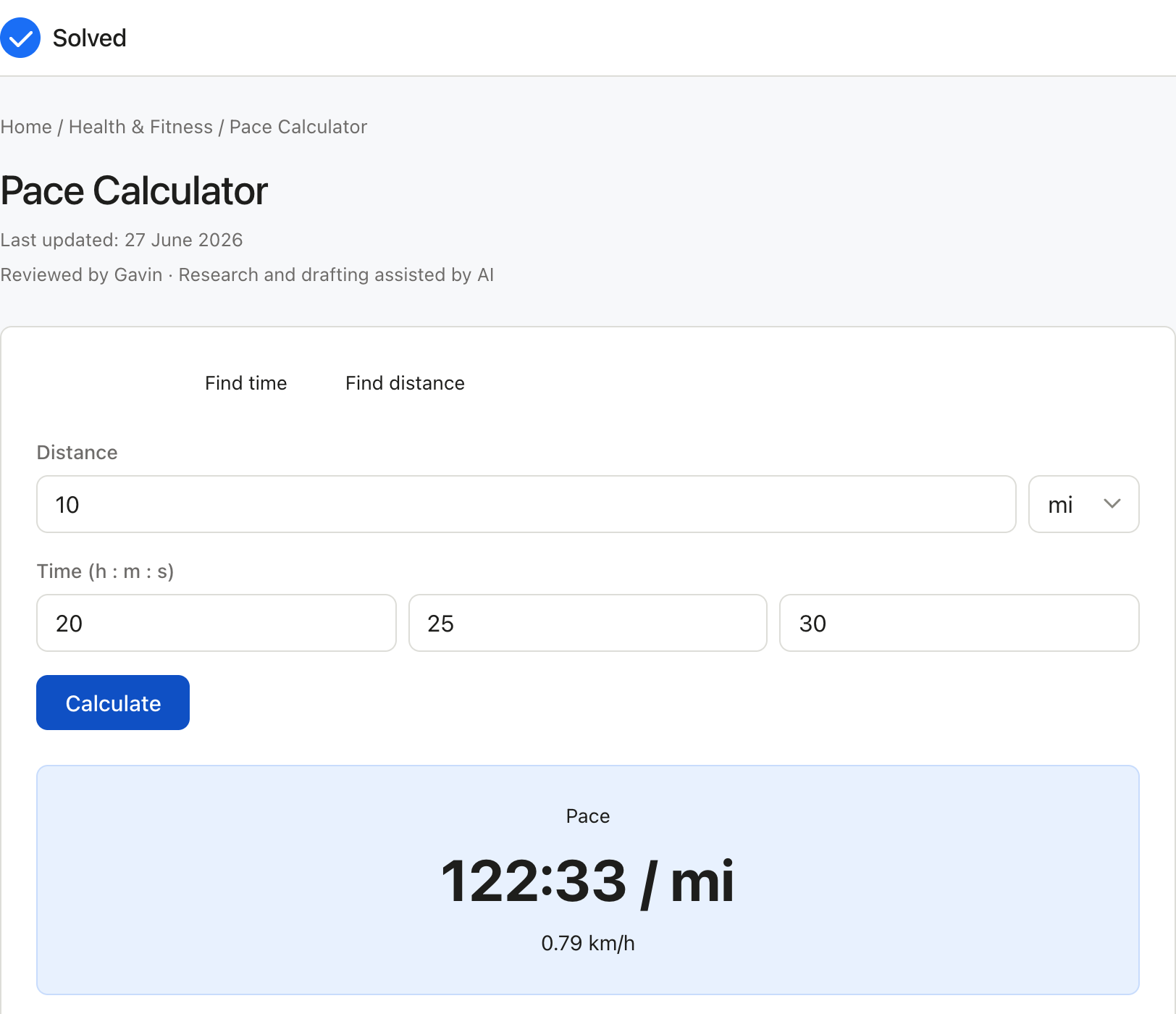
Captured from solved.tools on 10 September 2026.
Frequently Asked Questions
What is a good pace for a beginner runner? A comfortable conversational pace for most beginners falls between 7:00 and 8:30 min/km (11 to 14 min/mile). The best pace is one where you can hold a conversation without gasping.
How does elevation affect pace? Climbing roughly 100 metres of elevation adds approximately 8 percent to your effective pace. Many GPS watches now offer grade-adjusted pace to give a more accurate effort reading on hilly terrain.
What is negative splitting? Negative splitting means running the second half of a race faster than the first half. It is widely regarded as the most effective racing strategy because it avoids burning out in the early kilometres.
How do I convert pace to speed in km/h? Divide 60 by your pace in min/km to get speed in km/h. A pace of 5:00 min/km equals 60 divided by 5, which is 12 km/h.
What pace do I need for a sub-3:30 marathon? Divide 210 minutes by the marathon distance of 42.2 km. The result is 4.98 min/km, or 4:59 per kilometre. A sub-3-hour marathon needs 180 divided by 42.2 = 4.27 min/km, or 4:16 per kilometre.
Is pace the same as speed? No. Pace is time per unit of distance (minutes per kilometre), while speed is distance per unit of time (kilometres per hour). They are reciprocals: pace = 60 / speed in km/h. Runners use pace because it maps directly to race distances; drivers use speed.
How do I calculate a finish time from my pace? Multiply your pace in minutes per kilometre by the distance. A 5:30 min/km pace over 10 km gives 5.5 x 10 = 55 minutes. For a half marathon at the same pace, 5.5 x 21.1 = 116 minutes, or 1 hour 56 minutes.
What is a realistic pace improvement over a season? Improvement depends on training volume, consistency, and starting level. A new runner can expect faster gains than an experienced one. The useful habit is to re-test your pace every 4 to 6 weeks on the same route and adjust your goal times from the measured trend, not from a one-off best effort.
Also try these free tools: