Calories Burned Calculator
Last updated: 27 June 2026
Reviewed by Gavin Meiring, Lead research and primary author · Doctoral Candidate (Corporate Governance) · Research and drafting assisted by AI
- Walking burns roughly 80–100 calories per mile, regardless of your speed. Speed affects how long the mile takes, not how many calories you burn per mile.
- Swimming is often cited as the 'best' exercise for calorie burn — but because water dissipates heat, your body doesn't warm up as much, and many people eat more afterwards.
- Non-Exercise Activity Thermogenesis (NEAT) — fidgeting, standing, moving around — can account for up to 350 extra calories burned per day. Lean people tend to fidget more.
Calories Burned Calculator
A calories burned calculator estimates how much energy you expend during physical activity. It is used by athletes, fitness enthusiasts, and anyone tracking their energy balance for weight management or sports nutrition.
How to Use the Calories Burned Calculator
- Enter your body weight in kilograms or pounds.
- Select your activity type from the list, such as running, cycling, or swimming.
- Enter the duration of the activity in minutes.
- Optionally enter your intensity level or average heart rate if prompted.
- Click Calculate to see your estimated calorie expenditure.
The Formula
The standard formula uses MET values (Metabolic Equivalent of Task). Calories burned = MET multiplied by body weight in kilograms multiplied by duration in hours. MET is a measure of exercise intensity relative to rest: sitting has a MET of 1, brisk walking around 3.5, and running at 10 km/h around 10. A 70 kg person running for 1 hour at MET 10 burns approximately 700 kilocalories.
Real-World Example
A 75 kg person goes for a 45-minute moderate cycle ride. Cycling at moderate effort has a MET of approximately 8. Calories = 8 multiplied by 75 multiplied by (45 divided by 60) = 8 times 75 times 0.75 = 450 kilocalories. This represents the gross calorie burn including the calories that would have been burned at rest during that time.
Activity MET Reference Values
Walking at 5 km/h has a MET of around 3.5. Running at 8 km/h is approximately 8.3. Swimming laps at moderate effort is about 7. Cycling at 20 km/h is around 8. HIIT training sits between 8 and 14 depending on intensity. Yoga is approximately 3. These values are population averages; individual results vary with fitness level, age, and body composition.
Reference Table: Calories burned in 30 minutes at 70 kg
Estimates from the MET values published in the Compendium of Physical Activities. One MET is the resting metabolic rate, taken here as 3.5 ml of oxygen per kilogram per minute. For a 70 kg adult, calories equal MET multiplied by 3.5, multiplied by body weight in kilograms, divided by 200, per minute of activity.
| Activity | MET value | 30 minutes at 70 kg |
|---|---|---|
| Walking, 5 km/h | 3.5 | 129 kcal |
| Cycling, leisure | 6.8 | 250 kcal |
| Jogging, 8 km/h | 8.3 | 305 kcal |
| Swimming, laps | 7.0 | 257 kcal |
| Rowing machine, moderate | 7.0 | 257 kcal |
| Weight training, vigorous | 6.0 | 220 kcal |
Worked Example on Screen
The capture below shows Calories Burned Calculator after the inputs were entered, with the result on screen. Enter the same values to reproduce it.
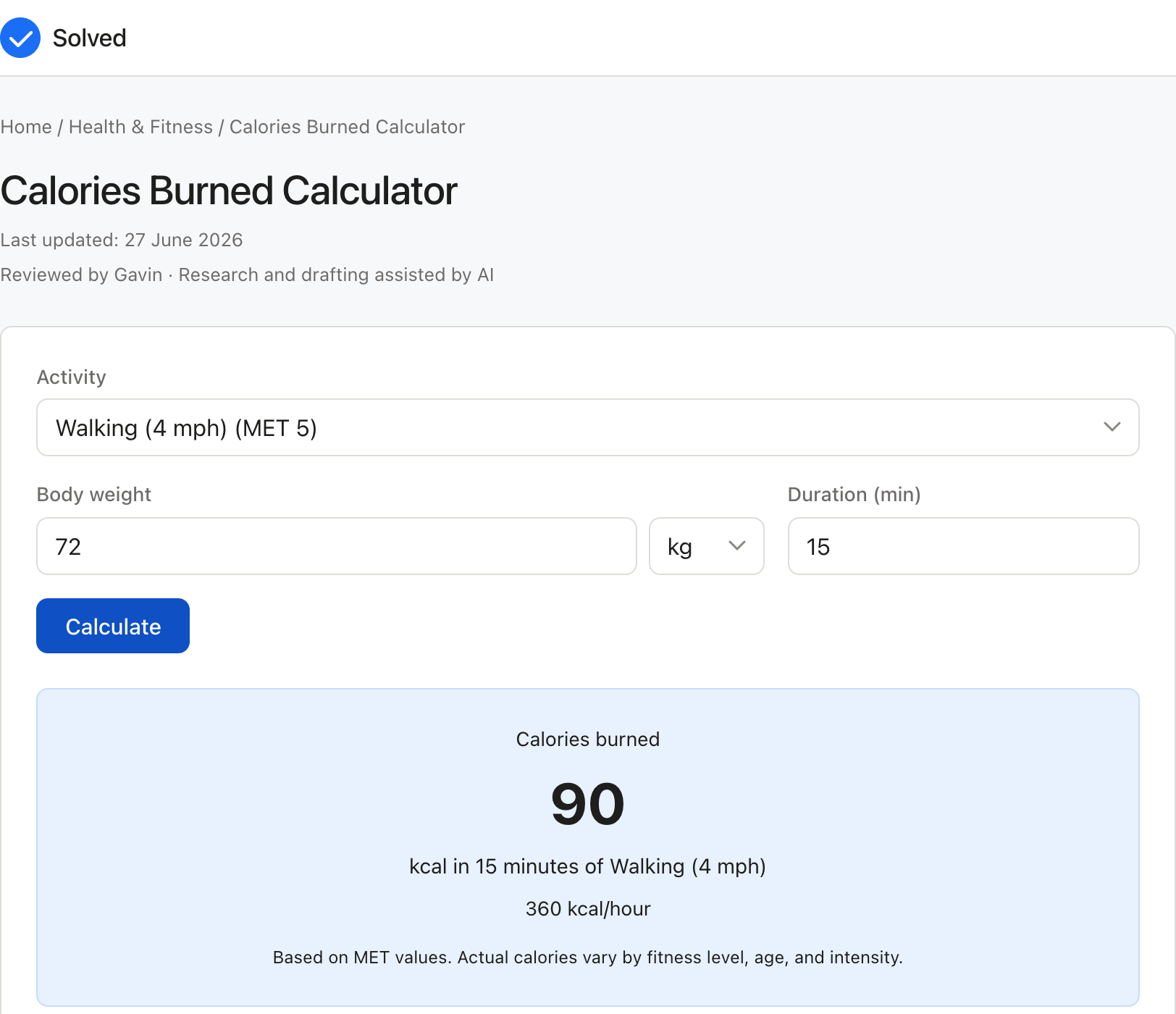
Captured from solved.tools on 10 September 2026.
Frequently Asked Questions
Are calorie burn estimates accurate? They are approximations, typically accurate to within 10 to 20 percent. Factors such as fitness level, muscle mass, heat, and individual metabolism affect actual expenditure. Wearable devices improve accuracy by incorporating heart rate data.
Should I eat back the calories I burn exercising? It depends on your goal. If you are trying to lose weight, eating back only a portion of exercise calories (around 50 percent) prevents over-compensation while still fuelling recovery. Athletes in heavy training usually need to replace most exercise calories.
What is the difference between net and gross calories burned? Gross calories include everything burned during the activity. Net calories subtract the calories you would have burned at rest during that time. Most nutrition apps use net calories to avoid double-counting with your base metabolic rate.
Does muscle mass affect how many calories I burn? Yes. Muscle tissue burns more energy at rest and during activity than fat tissue. People with greater muscle mass burn more calories for the same exercise at the same body weight.
Net against gross, worked with the same 70 kg adult
The 450 kilocalorie figure in the example above is a gross number: it counts every kilocalorie burned during the 45 minutes, including the ones the same person would have burned sitting still. Subtracting the resting share gives the net figure, which is the one that belongs in an energy balance calculation.
One MET, the resting rate used by the formula, works out at about 1.05 kilocalories per kilogram per hour. That figure comes from the same 3.5 millilitres of oxygen per kilogram per minute convention that produced the 200 divisor in the formula. For a 70 kg adult it is 73.5 kilocalories an hour, or 36.75 kilocalories over a 30 minute period.
| Activity, 30 minutes at 70 kg | MET | Gross kcal | Resting kcal | Net kcal | Net as a share of gross |
|---|---|---|---|---|---|
| Walking, 5 km/h | 3.5 | 129 | 36.75 | 92 | 71 percent |
| Cycling, leisure | 6.8 | 250 | 36.75 | 213 | 85 percent |
| Jogging, 8 km/h | 8.3 | 305 | 36.75 | 268 | 88 percent |
| Rowing machine, moderate | 7.0 | 257 | 36.75 | 220 | 86 percent |
The difference matters most at low intensity. Thirty minutes of walking looks like 129 kilocalories on the gross measure and 92 on the net measure, a gap of 29 percent. At jogging pace the gap narrows to 12 percent, because the activity energy dwarfs the resting energy. If a fitness tracker reports a gross figure and you log it against a food diary that already includes your basal metabolic rate, you count that resting energy twice.
How the answer moves with weight and duration
The formula is linear in both body weight and time, so doubling either doubles the result. That makes the sensitivity easy to read from a table rather than a graph.
| Body weight | 20 minutes | 30 minutes | 45 minutes | 60 minutes |
|---|---|---|---|---|
| 55 kg | 160 | 240 | 360 | 479 |
| 70 kg | 203 | 305 | 458 | 610 |
| 85 kg | 247 | 370 | 556 | 741 |
| 100 kg | 291 | 436 | 654 | 872 |
Values are kilocalories for jogging at 8 km/h, MET 8.3, computed as MET multiplied by 3.5, multiplied by body weight in kilograms, divided by 200, then multiplied by the minutes. At 100 kg the same 60 minute run is worth 43 percent more than it is at 70 kg. That is the arithmetic consequence of carrying more mass through the same distance, and it is why calorie estimates cannot be shared between people of different weights.
Reading across a row instead gives the marginal value of extra time: at 70 kg the tenth minute beyond 20 adds roughly 10 kilocalories, and the figure holds steady because the relationship has no curvature.
Turning kilocalories into the units on a food label
European food labels state energy in kilojoules, often with kilocalories in brackets. One kilocalorie is 4.184 kilojoules.
| Calories burned | Kilojoules | Megajoules |
|---|---|---|
| 129 | 540 | 0.54 |
| 250 | 1,046 | 1.05 |
| 305 | 1,276 | 1.28 |
| 450 | 1,883 | 1.88 |
| 700 | 2,929 | 2.93 |
A 305 kilocalorie run covers a little under half of the 2,000 kilocalorie daily reference intake used on European labels. The figure of 3,500 kilocalories per pound of body fat, or 7,700 per kilogram, comes from a 1958 paper by Max Wishnofsky in the American Journal of Clinical Nutrition, volume 6, issue 5, pages 542 to 546. It was derived from the energy density of adipose tissue and from weight-change data in a small number of very low calorie diet studies, and later work has shown it to be a rough planning figure rather than a physiological constant: it assumes that the whole weight change comes from fat and that expenditure does not adapt, when in practice the body reduces energy use as weight falls. Treat the numbers here as estimates of expenditure, not as promises about the scale.
Method, assumptions and known bias
The calculation assumes the resting rate of 3.5 millilitres of oxygen per kilogram per minute, and that each litre of oxygen consumed releases 5 kilocalories. Those two conventions produce the 200 divisor. Both are population-level approximations rather than measurements of the person in front of you.
The 1 MET reference value has a documented bias. Byrne and colleagues measured resting oxygen consumption in 769 adults and reported a mean of 2.6 millilitres per kilogram per minute, against the assumed 3.5. In that sample the conventional 1 MET value overestimated resting oxygen consumption by an average of 35 percent, and the 1 kilocalorie per kilogram per hour convention overestimated resting energy expenditure by about 20 percent. Only 14 of the 769 participants, roughly 2 percent, had a measured resting value at or above 3.5. The practical consequence is that calorie estimates built on the standard MET value tend to read high, and the error is largest for the people whose resting rate is furthest from the assumed figure.
Two further assumptions sit behind any single number. The MET value is applied for the whole session, so a run that starts slow and finishes hard is treated as though it were run at one constant pace. And the formula gives no credit to fitness: a trained runner covering 8 kilometres in 30 minutes is working at a lower fraction of capacity than an untrained runner moving at the same speed, but both receive the same MET.
Activity MET values quoted on this page trace to the Compendium of Physical Activities, a catalogue first published in 1993 and updated in 2000 and 2011. The 2011 edition, by Ainsworth and colleagues in Medicine and Science in Sports and Exercise, volume 43, issue 8, pages 1575 to 1581, contains 821 activity codes, of which 561 carry values measured in a laboratory rather than estimated.
Checking a result by hand
The formula is simple enough to run on a phone calculator in a few seconds, which is the fastest way to test whether a device is reporting gross or net.
Take a 60 kg adult walking at 5 km/h, MET 3.5, for 40 minutes. MET times 3.5 is 12.25. Times 60 kilograms is 735. Divided by 200 is 3.675 kilocalories a minute. Times 40 minutes is 147 kilocalories gross. The resting share over the same 40 minutes is 1.05 times 60 times 40 divided by 60, which is 42 kilocalories. Net is 105 kilocalories.
If a wearable reports roughly 147 for that session it is quoting gross energy, and the food diary needs to account for the subtraction somewhere. If it reports roughly 105 it has already netted out the resting rate.
Also try these free tools: