Pregnancy Calculator
Last updated: 27 June 2026
Reviewed by Gavin Meiring, Lead research and primary author · Doctoral Candidate (Corporate Governance) · Research and drafting assisted by AI
- Only 5% of babies are born on their exact due date. Around 80% are born within two weeks either side.
- A human pregnancy is 40 weeks from the last menstrual period — but actual conception typically occurs at week 2. The 40-week count is a medical convention, not a biological fact.
- The longest confirmed pregnancy in recorded history was 375 days (roughly 12.5 months), recorded in 1945. The average is 280 days.
Pregnancy Calculator
A pregnancy calculator estimates your due date, current gestational age, and key pregnancy milestones based on the first day of your last menstrual period (LMP) or a known conception date. It is used by expectant parents and healthcare professionals who want a quick reference for pregnancy progression, appointment planning, and milestone tracking. Gestational age is the standard measure used in obstetric care worldwide.
How to Use the Pregnancy Calculator
- Enter the first day of your last menstrual period (LMP). This is the standard starting point used by midwives and obstetricians.
- Alternatively, enter your known conception date or the date of a fertility treatment (IVF transfer date).
- Optionally input your average cycle length if it differs from the standard 28 days.
- The calculator displays your estimated due date, current gestational age in weeks and days, and key trimester milestones.
- Review the trimester breakdown and typical developmental milestones for each stage.
The Formula
The most widely used method for calculating the estimated due date (EDD) is Naegele's Rule:
EDD = First day of LMP plus 280 days (40 weeks)
Or equivalently:
EDD = First day of LMP plus 9 months plus 7 days
Gestational age in weeks = (Current date minus LMP) divided by 7
For women with cycles longer or shorter than 28 days, the EDD is adjusted by adding or subtracting the difference from the standard 28-day cycle:
Adjusted EDD = Naegele's EDD plus (Actual cycle length minus 28) days
For IVF pregnancies, the due date is calculated differently depending on the transfer type:
Fresh embryo transfer (day 3): EDD = transfer date plus 263 days Frozen embryo transfer (blastocyst, day 5): EDD = transfer date plus 261 days
Real-World Example
The first day of your last menstrual period was 1 March 2026. Your cycle is a standard 28 days.
EDD = 1 March plus 280 days = 6 December 2026
Current date: 28 June 2026 Gestational age = (28 June minus 1 March) = 119 days divided by 7 = 17 weeks exactly
At 17 weeks, you are in the second trimester. Key milestones:
Weeks 1 to 12: First trimester. Major organ formation. First antenatal appointment (booking) typically at 8 to 10 weeks. First ultrasound (dating scan) at 10 to 14 weeks.
Weeks 13 to 27: Second trimester. The foetus grows rapidly. Anomaly scan (20-week scan) checks development and anatomy. Many people find the second trimester the most comfortable.
Weeks 28 to 40: Third trimester. Foetal weight gain accelerates. Birth is typically planned between weeks 37 and 42. Births before 37 weeks are considered preterm.
Key Pregnancy Dates and Appointments (UK NHS)
The NHS recommends a standard schedule of antenatal appointments and screenings throughout pregnancy.
Booking appointment (weeks 8 to 10): involves taking a detailed health history, booking blood tests, and discussing care options. Urine, blood pressure, and blood samples are taken.
Dating scan (weeks 10 to 14): also called the first trimester or nuchal translucency scan. Confirms gestational age, checks for a heartbeat, and screens for chromosomal conditions including Down's syndrome.
Anomaly scan (around week 20): checks the baby's physical development in detail, including the brain, heart, spine, and limbs. Also known as the mid-pregnancy scan.
Gestational diabetes screening (weeks 24 to 28): a glucose tolerance test for women at higher risk (BMI over 30, family history of type 2 diabetes, or previous gestational diabetes).
Group B Streptococcus (GBS) testing is not routinely offered on the NHS but is available privately. GBS is a bacterium carried by approximately 1 in 5 women that poses a risk to the newborn during birth.
Reference Table: Gestational calendar from a sample last period
Dates counted from a last menstrual period of 2 March 2026, using the standard 28-day cycle assumption. The due date falls at 40 weeks, on 07 December 2026. Trimester boundaries sit at the end of weeks 13 and 27. Real dates shift with cycle length and any dating scan.
| Gestational week | Marker | Date |
|---|---|---|
| Week 8 | First trimester, early | 27 Apr 2026 |
| Week 12 | End of first trimester | 25 May 2026 |
| Week 20 | Halfway point | 20 Jul 2026 |
| Week 27 | End of second trimester | 07 Sep 2026 |
| Week 36 | Third trimester, late | 09 Nov 2026 |
| Week 40 | Estimated due date | 07 Dec 2026 |
Worked Example on Screen
The capture below shows Pregnancy Calculator after the inputs were entered, with the result on screen. Enter the same values to reproduce it.
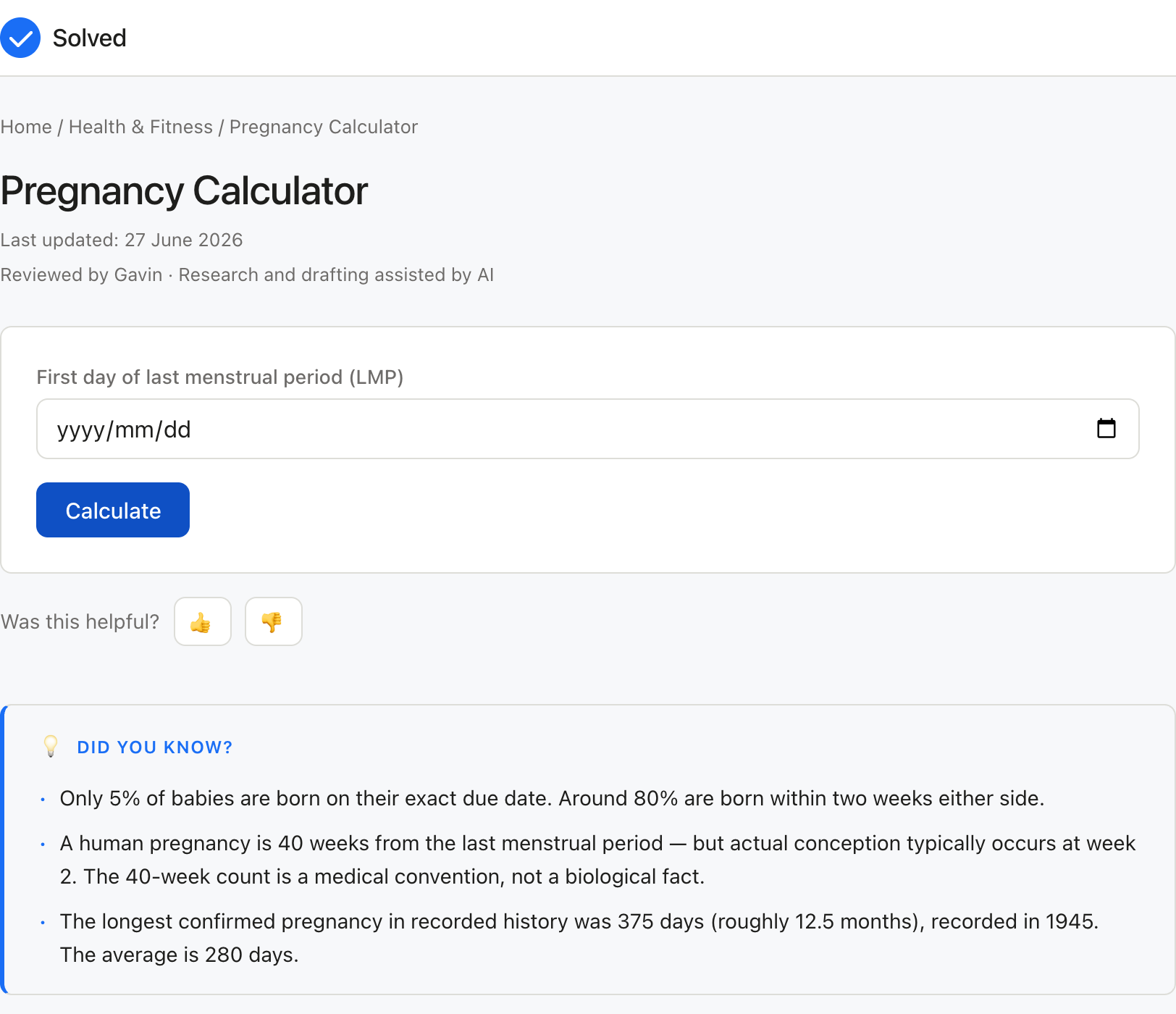
Captured from solved.tools on 10 September 2026.
Frequently Asked Questions
How accurate is the due date calculated from LMP? The EDD is an estimate. Only approximately 4% of babies are born on their due date. Most births occur between 38 and 42 weeks of gestation. If an early ultrasound (before 14 weeks) shows a gestational age significantly different from LMP dates, the sonographer's dates are generally considered more accurate because early ultrasound measurements are a reliable indicator of gestational age.
What is the difference between gestational age and fetal age? Gestational age counts from the first day of the last menstrual period, which is approximately 2 weeks before conception. Fetal age (or conceptual age) counts from the estimated date of conception. Gestational age is always approximately 2 weeks more than fetal age. Healthcare professionals universally use gestational age, so this is the measure your midwife and obstetrician will refer to.
What happens if I go past my due date? It is common to go past 40 weeks. Most hospitals offer a membrane sweep at 40 to 41 weeks to encourage labour to start naturally. If you reach 41 to 42 weeks without going into labour, your midwife or obstetrician will typically recommend induction to reduce the risk of complications, particularly those associated with placental ageing. The decision is always made in consultation with the expectant parent.
Can the pregnancy calculator be used after IVF? Yes, but the standard LMP method is less accurate for IVF pregnancies. For fresh transfers, the embryo's age is known precisely from the egg retrieval date. For frozen embryo transfers (FET), the transfer date and the embryo's development stage (day 3 or day 5 blastocyst) determine the due date calculation. Most IVF clinics will provide an EDD directly based on these known dates, which the pregnancy calculator can verify or cross-check.
Also try these free tools:
Extended Reference Notes
The notes below cover the broader context that informs how to use the Pregnancy Calculator well.
Typical Input Ranges
Most real-world uses of the Pregnancy Calculator fall into a middle band where the result is stable and useful. Very small inputs to the Pregnancy Calculator often round to zero or near-zero, and very large inputs amplify every rounding error in the calculation. The middle band, where the Pregnancy Calculator inputs are ordinary sizes, is where the tool is most reliable.
Assumptions Behind the Formula
The Pregnancy Calculator assumes the inputs stay fixed across the period or scenario being modelled. Rates move, values change, and fees appear, so treat the Pregnancy Calculator output as a clean reference and layer in the frictions your own situation adds.
Common Edge Cases
Three situations change the Pregnancy Calculator answer in ways the formula does not surface: boundary values near zero, rounding cascades across many steps, and unit mismatches between fields. When any of these apply, sanity-check the Pregnancy Calculator result against an independent estimate.
When to Revisit the Calculation
The Pregnancy Calculator output is only as current as its inputs, so re-run the calculation whenever a key value changes materially. A quarterly re-check of the Pregnancy Calculator suits personal planning; monthly suits active business or investment decisions.
Relationship to Other Tools
The Pregnancy Calculator shares inputs and outputs with the other tools in its category. If the same numbers feed several tools, capture them once and run each tool so the comparison stays consistent with the Pregnancy Calculator.
Practical Checklist Before Relying on the Result
Before acting on the Pregnancy Calculator output, run a short mental checklist: inputs in the right units, direction of the result matching intuition, and magnitude plausible. Each check takes seconds and catches the most common classes of Pregnancy Calculator error before they reach a decision.
Putting the Result to Work
A single Pregnancy Calculator run usually narrows the range of plausible answers rather than settling the question. Compare the Pregnancy Calculator result against a benchmark or a previous run, and ask what would have to change for the answer to flip a decision.
Sensitivity to Inputs
Some inputs move the Pregnancy Calculator result more than others; changing each by a small amount shows which ones matter. Spend the effort on the high-impact Pregnancy Calculator inputs and treat the low-impact ones as approximate.
A Note on Stale Inputs
A calculation is only as fresh as the inputs that feed it, so note the date the Pregnancy Calculator inputs were last refreshed. A six-month-old Pregnancy Calculator result can be as wrong as a wrong calculation when the underlying values have moved on.