TDEE Calculator
Last updated: 5 July 2026
Reviewed by Gavin Meiring, Lead research and primary author · Doctoral Candidate (Corporate Governance) · Research and drafting assisted by AI
- The first measurement of human metabolism was made in the 1780s by Antoine Lavoisier, who showed that breathing is a slow form of combustion — his work earned him the title 'father of nutrition science'.
- The Harris–Benedict equation, the granddaddy of calorie formulas, was published in 1919 and refined in 1990 by Mifflin and St Jeor — most TDEE calculators today use the newer version.
- The famous '3,500 calories equals a pound of fat' rule comes from a 1958 paper by Max Wishnofsky — modern research shows weight loss is not that linear, which is why calculators can only ever estimate.
TDEE Calculator
A TDEE (Total Daily Energy Expenditure) calculator works out the total calories your body burns each day, accounting for your resting metabolism plus all physical activity. It is used by people pursuing weight loss, body recomposition, or athletic performance goals, registered dietitians building meal plans for clients, and fitness coaches programming nutrition for athletes.
TDEE is calculated in two steps: first, determine BMR (Basal Metabolic Rate), the calories your body burns at rest to maintain basic functions like breathing, circulation, and cell production. Second, multiply BMR by an activity factor that accounts for calories burned through movement, exercise, and non-exercise activity (fidgeting, posture, etc.). The result is the total calories you burn in a typical day.
How to Use the TDEE Calculator
- Enter your age, sex, height, and weight (the inputs for BMR calculation).
- Select your activity level from sedentary (desk job, no exercise) to very active (physical job + daily training).
- The calculator outputs your BMR (resting calorie burn) and TDEE (total daily burn).
- For weight loss: subtract 250 to 500 calories from TDEE for a 0.5 to 1 kg per week loss rate.
- For muscle gain: add 250 to 500 calories for a 0.5 to 1 kg per week gain rate.
- Optionally, see macronutrient breakdown (protein, carbs, fat) based on your goal.
BMR Formulas
The two most accurate BMR formulas are:
- Mifflin-St Jeor (1990): Most accurate for most adults, especially non-obese populations
- Harris-Benedict (1919, revised 1984): Slightly less accurate but widely used
Mifflin-St Jeor for Men: BMR = 10 x weight(kg) + 6.25 x height(cm) - 5 x age + 5
Mifflin-St Jeor for Women: BMR = 10 x weight(kg) + 6.25 x height(cm) - 5 x age - 161
The Katch-McArdle formula (which uses lean body mass) is more accurate for people with significant muscle mass: BMR = 370 + (21.6 x LBM in kg). However, it requires knowing your body fat percentage.
Activity Multipliers
After calculating BMR, multiply by an activity factor:
- Sedentary (desk job, no exercise): BMR x 1.2
- Lightly active (light exercise 1-3 days/week): BMR x 1.375
- Moderately active (moderate exercise 3-5 days/week): BMR x 1.55
- Very active (hard exercise 6-7 days/week): BMR x 1.725
- Extra active (physical job + daily training): BMR x 1.9
These multipliers are estimates, actual activity calorie burn varies significantly between individuals based on genetics, muscle mass, hormonal status, and non-exercise activity (NEAT, non-exercise activity thermogenesis). For more accuracy, use a fitness tracker for 2-4 weeks to measure actual calorie burn, then adjust your TDEE estimate accordingly.
How to Use TDEE for Weight Goals
For weight loss: TDEE minus 500 calories = ~1 pound (0.45 kg) loss per week. Don't go below BMR for extended periods, as this can slow metabolism, cause muscle loss, and lead to nutritional deficiencies. A 1-2 pound per week loss rate is the safe maximum.
For muscle gain: TDEE plus 300-500 calories = ~0.5-1 pound per week gain. Aim for a "lean bulk" with controlled surplus to minimize fat gain. New lifters can gain faster (beginner gains); experienced lifters need tighter calorie control to avoid fat accumulation.
For maintenance: Eat at TDEE. Track your weight weekly, if trending up, reduce calories by 100; if trending down, increase by 100.
Reference Table: TDEE at each activity level
Total daily energy expenditure for a 32-year-old man of 75 kg and 178 cm, whose basal rate is 1708 calories. Each row multiplies that base by the standard activity factor. The gap between the first and last row is 1195 calories a day.
| Activity level | Factor | TDEE |
|---|---|---|
| Sedentary | 1.2 | 2049 kcal |
| Light exercise, 1 to 3 days | 1.375 | 2348 kcal |
| Moderate, 3 to 5 days | 1.55 | 2647 kcal |
| Heavy, 6 to 7 days | 1.725 | 2945 kcal |
| Very heavy, physical job | 1.9 | 3244 kcal |
Worked Example on Screen
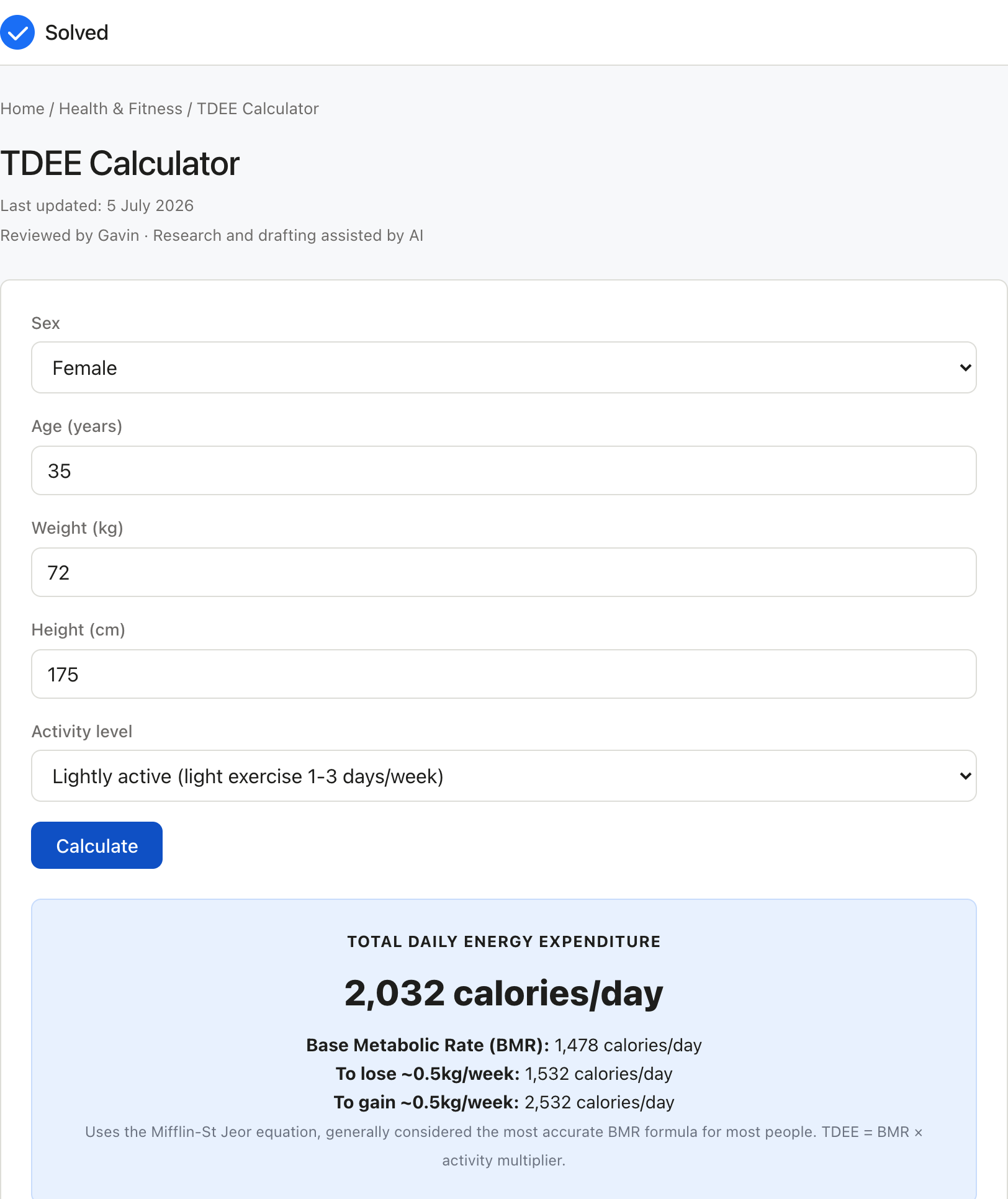
The capture below shows TDEE Calculator after the inputs were entered, with the result on screen. Enter the same values to reproduce it.
Captured from solved.tools on 10 September 2026.
Frequently Asked Questions
How accurate is the TDEE calculator? The Mifflin-St Jeor BMR formula has a margin of error of about 10% for most individuals, meaning your actual TDEE could be 10% higher or lower than the calculated value. The activity multiplier adds another 5-10% uncertainty. For best accuracy, use a fitness tracker (Apple Watch, Garmin, Fitbit) for 2-4 weeks to measure actual calorie burn during exercise and your daily step count for NEAT.
Should I eat below my BMR? Generally, no. Eating significantly below BMR for extended periods slows your metabolism (adaptive thermogenesis), causes muscle loss, and can lead to nutritional deficiencies. A sustainable calorie deficit is 250-500 calories below TDEE, not below BMR. If you want a faster loss, increase your activity level to raise TDEE rather than cutting calories below BMR.
How do I adjust TDEE as I lose weight? As you lose weight, your TDEE decreases because BMR scales with body mass. Recalculate TDEE every 5-10 pounds (2-3 kg) of weight loss, or every 6-8 weeks. Your maintenance calories at 200 lbs are different from your maintenance at 180 lbs. Many people hit weight loss plateaus because they don't recalculate and continue eating at their old (now inflated) calorie target.
Do I need to count calories exactly? Exact counting is ideal but unrealistic for most people. A practical approach: use the TDEE calculator to get a starting point, then track your food intake for 2-4 weeks using an app like MyFitnessPal or Cronometer. If your weight trend matches expectations, your tracking is good. If not, adjust calories by 100-200 per day and recheck after 2 weeks.
Does muscle mass affect TDEE? Yes, significantly. Muscle tissue burns approximately 6 calories per pound per day at rest, while fat tissue burns only 2 calories per pound per day. A 180-lb person with 20% body fat has 36 lbs of muscle (216 cal/day from muscle) and 144 lbs of fat (288 cal/day from fat). A 180-lb person with 35% body fat has only 26 lbs of muscle (156 cal/day from muscle) and 154 lbs of fat (308 cal/day from fat). Higher muscle mass means higher TDEE at the same body weight.
How does aging affect TDEE? TDEE decreases approximately 1-2% per year after age 25 due to age-related muscle loss (sarcopenia) and decreased NEAT. A 35-year-old typically has a TDEE 5-15% lower than their 25-year-old self at the same body composition. Resistance training and adequate protein intake are the most effective interventions to slow age-related TDEE decline.
Inputs and Their Effects
Each field on the TDEE Calculator form plays a distinct part in the calculation.
- your age, sex, height, and weight (the inputs for BMR calculation) - this value feeds the TDEE Calculator directly and shows up in the result.
- your activity level from sedentary (desk job, no exercise) to very active (physical job + daily training) - this value feeds the TDEE Calculator directly and shows up in the result.
- calculator outputs your BMR (resting calorie burn) and TDEE (total daily burn) - this value feeds the TDEE Calculator directly and shows up in the result. Editing one field of the TDEE Calculator changes the output in line with the formula, so a misplaced value is visible in the answer.
Common Mistakes to Avoid
The errors that come up most often with the TDEE Calculator are easy to spot once you know them:
- Entering a value in the wrong unit for your age, sex, height, and weight (the inputs for BMR calculation); the TDEE Calculator answer is only right when the unit matches the label.
- Mixing conventions, such as percentages and decimals, where the TDEE Calculator formula expects one form.
- Rounding the inputs before the TDEE Calculator runs; keep the full values and let the tool round the final answer.
- Treating the TDEE Calculator result as exact when the inputs themselves were estimates.
When to Use the TDEE Calculator
Use the TDEE Calculator whenever you need a quick, reliable answer that fits the tool's scope. Common situations for the TDEE Calculator include homework and study, on-the-job quick checks, sanity-checking a more complex calculation, or exploring a scenario for personal interest. If the TDEE Calculator answer will be used for a decision that has legal, medical, or financial consequences, treat the result as a starting point and verify it with a qualified professional.
How the Math Works
The calculation behind the TDEE Calculator follows the standard form for this kind of problem: The two most accurate BMR formulas are: Mifflin-St Jeor** (1990): Most accurate for most adults, especially non-obese populations Harris-Benedict** (1919, revised 1984): Slightly less accurate but widely used Mifflin-St Jeor for Men**: BMR The TDEE Calculator applies that relationship in the order the algebra prescribes, converting inputs to consistent units first where the formula needs them.
Related Concepts and Where This Fits
The TDEE Calculator fits alongside the other tools in its category, and the choice between them usually comes down to which inputs you already have. If the same numbers feed several tools, run them in one pass so the assumptions stay consistent across the comparison, which is where the TDEE Calculator earns its place.
Worked Examples
A typical TDEE Calculator run takes reasonable inputs, produces a sensible answer, and returns it in a single click. Example: Beyond the worked examples earlier in this page, a few additional cases illustrate how the TDEE Calculator behaves at the edges of its input range. Boundary inputs. Entering the smallest or largest sensible value for a numeric input in the TDEE Calculator should produce a result at the corresponding end of the output range, not a runaway value or a silently clipped result.
References
- FAO/WHO/UNU (2004), Human Energy Requirements, FAO Food and Nutrition Technical Report Series 1, the source of the activity factors used here. https://www.fao.org/3/y5686e/y5686e00.htm
- Mayo Clinic, Counting Calories: Get Back to Weight-Loss Basics, for the calorie balance model behind TDEE. https://www.mayoclinic.org/healthy-lifestyle/weight-loss/in-depth/calories/art-20048065