Tip Calculator
Last updated: 27 June 2026
Reviewed by Gavin Meiring, Lead research and primary author · Doctoral Candidate (Corporate Governance) · Research and drafting assisted by AI
- The word 'tip' may stand for 'To Insure Promptness' — a gratuity paid before service to guarantee quick attention. The practice dates to 18th-century English coffeehouses.
- In Japan, leaving a tip is considered rude — it implies the server needs charity. Japanese service culture considers excellent service a professional duty, not a favour.
- The standard American restaurant tip has risen from 10% in the 1950s to 18–22% today, partly because restaurants use tips to offset lower base wages.
Tip Calculator
A tip calculator works out the tip amount and total bill for a restaurant, taxi, hotel, or any other tipped service, based on the bill total, tip percentage, and number of people splitting the bill. It is used by diners, travellers, and anyone wanting to calculate a fair gratuity quickly without mental arithmetic.
How to Use the Tip Calculator
- Enter the bill total before tip.
- Enter the tip percentage you want to leave (common choices: 10%, 15%, 18%, 20%).
- Enter the number of people splitting the bill (enter 1 if you are not splitting).
- Click calculate to see the tip amount, total bill, and each person's share.
The Formula
Tip amount = Bill total x (Tip percentage / 100)
Total bill = Bill total + Tip amount
Per person amount = Total bill / Number of people
Tip per person = Tip amount / Number of people
For example, a £85 bill with a 15% tip split four ways:
- Tip: £85 x 0.15 = £12.75
- Total: £85 + £12.75 = £97.75
- Per person: £97.75 / 4 = £24.44
Real-World Example
A table of 6 people has a restaurant bill of £210. The service was good, so they want to leave an 18% tip.
- Tip amount: £210 x 0.18 = £37.80
- Total bill: £210 + £37.80 = £247.80
- Per person: £247.80 / 6 = £41.30
- Tip per person: £37.80 / 6 = £6.30
Each person contributes £41.30, including their share of the gratuity.
Tipping Conventions by Country
Tipping norms vary widely. In the United States, 18 to 20% is standard for restaurant service; 15% is considered the minimum for average service. In the United Kingdom, 10 to 12.5% is customary in restaurants, and many establishments add a discretionary service charge automatically; check your bill before tipping separately, as you may already have been charged. In continental Europe, rounding up the bill or leaving small change is more common, and tipping 10 to 15% is considered generous. In Japan and South Korea, tipping is generally not customary and may cause offence. In Australia, tipping is discretionary and not expected but appreciated for good service, typically 10%. When travelling, check local convention to avoid undertipping (which can be seen as rude) or overtipping (which may cause confusion or embarrassment).
Reference Table: Tip amounts and per-person shares
Tips on three bills at 10%, 15% and 20%, with the last column showing a 20% tip split four ways. On a $120 bill a 20% tip is $24.00, and the total per person across four diners is $36.00.
| Bill | 10% tip | 15% tip | 20% tip | 20% tip, 4 ways |
|---|---|---|---|---|
| $40 | $4 | $6 | $8 | $12.00 |
| $80 | $8 | $12 | $16 | $24.00 |
| $120 | $12 | $18 | $24 | $36.00 |
Worked Example on Screen
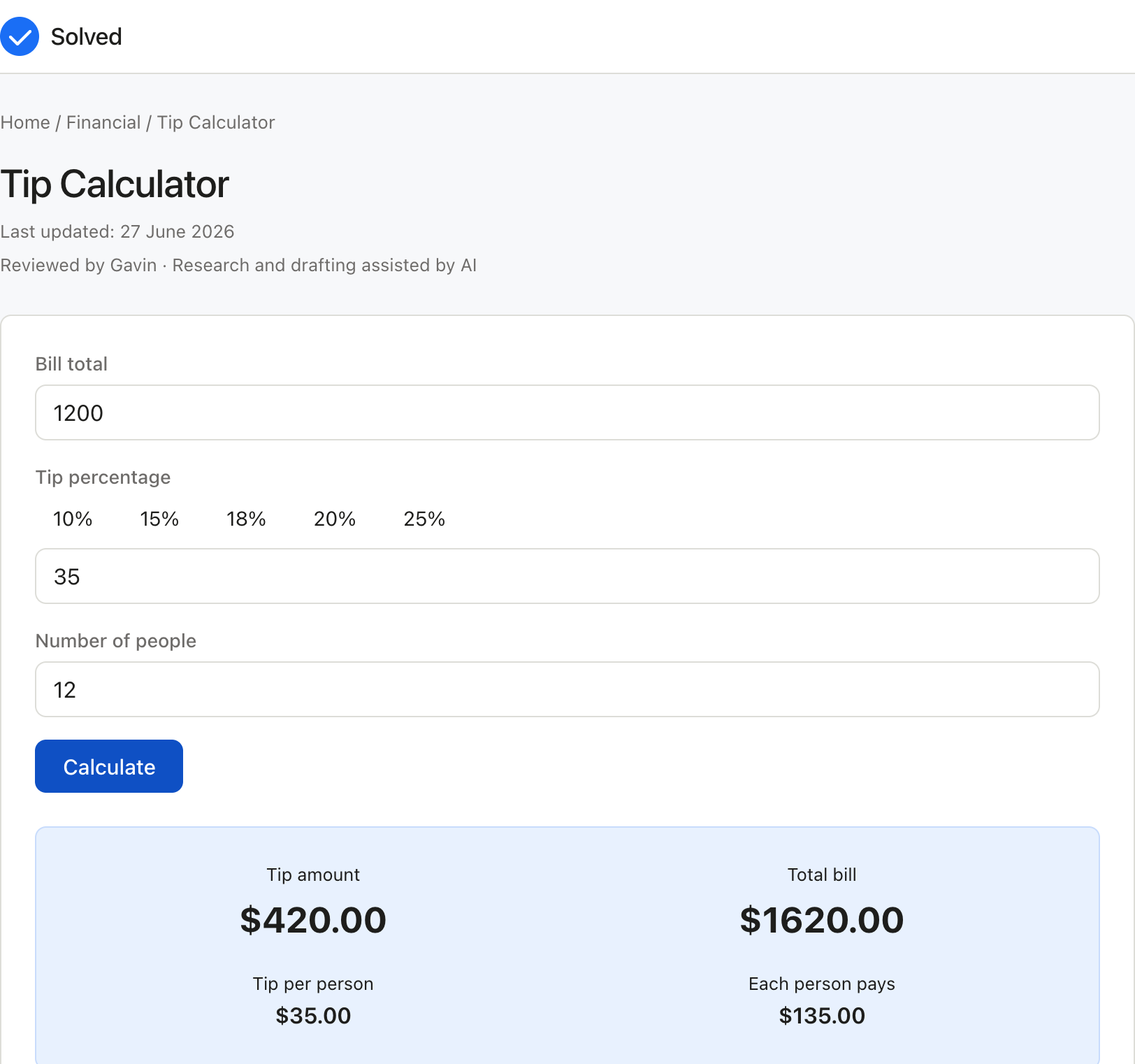
The capture below shows Tip Calculator after the inputs were entered, with the result on screen. Enter the same values to reproduce it.
Captured from solved.tools on 10 September 2026.
Frequently Asked Questions
Should I tip on the pre-tax or post-tax amount? There is no universal rule, but tipping on the pre-tax subtotal is technically more accurate because the service you received does not include the tax. In practice, on a typical restaurant bill the difference is small. If the pre-tax total is £80 and the post-tax total is £88, a 15% tip on pre-tax is £12.00 versus £13.20 on post-tax. Either is acceptable; choose the amount that feels right for the quality of service.
What should I do if a service charge is already included? Check your bill for phrases like "12.5% service charge included" or "discretionary service charge added." If present, you have already tipped and are under no obligation to add more. However, if the service was exceptional, you may add a small additional tip in cash directly to the server, as many venues pool service charges centrally rather than passing them fully to the staff who served you.
How do I handle a split bill where people ordered different amounts? The simplest method is to split the tip proportionally: each person tips in proportion to their individual order total. For example, if you ordered 40% of the bill, you pay 40% of the tip. Some groups find this overly complex and prefer to split the tip equally regardless of individual spend; both approaches are common and accepted.
Is it appropriate to leave no tip for bad service? Tipping is discretionary in most countries, and genuinely poor service is a valid reason to reduce or omit a tip. However, consider whether the issue was within the server's control (attitude, attentiveness) versus the kitchen's (food quality, wait times). In the UK and US, it is also acceptable to speak to a manager directly. If a service charge was automatically added, you are generally entitled to ask for it to be removed.
Worked Example: A Bill That Already Carries a Service Charge
The bill shows food £52.00, drinks £12.00, a subtotal of £64.00, a discretionary service charge of 12.5% at £8.00, and a total of £72.00.
The charge has already done the work of a tip. Leave nothing extra and the gratuity on the meal is £8.00, which is 12.5% of the £64.00 subtotal.
If you want the total gratuity to land near 15%, the arithmetic depends on which figure you tip on.
15% of the £64.00 subtotal is £9.60, so you add £1.60 to the £8.00 already charged. 15% of the £72.00 charged total is £10.80, so you add £2.80.
Adding 10% of the charged total, which is the usual reflex, adds £7.20 and lifts the total gratuity to £15.20. That is 23.75% of the £64.00 subtotal, well above the 15% you had in mind. Tipping on a figure that already contains a tip compounds the tip, and that is the error worth watching for.
Paying £75.00 in cash is a different route to the same place. The tip becomes £11.00 on a £64.00 subtotal, an effective 17.2%, and it sits £3.00 above the charged total.
Bill and Tip Comparison Table
All amounts in pounds, rounded to the nearest penny with halves rounded up.
| Bill | Tip rate | Tip | Total | Each of 2 | Each of 4 | Each of 6 |
|---|---|---|---|---|---|---|
| £50 | 10% | £5.00 | £55.00 | £27.50 | £13.75 | £9.17 |
| £75 | 15% | £11.25 | £86.25 | £43.13 | £21.56 | £14.38 |
| £120 | 18% | £21.60 | £141.60 | £70.80 | £35.40 | £23.60 |
Rounded shares rarely add back to the total. Six people at £9.17 each pay £55.02, two pence more than the bill. Someone has to absorb the extra penny, or the group pays it to the restaurant.
Checking the Tip Before You Pay
Two checks catch nearly every mistake.
A 10% tip is the bill with the decimal point moved one place to the left. On £47.80 that is £4.78.
A 15% tip is the 10% figure plus half of it. £4.78 + £2.39 = £7.17 on that bill, and the calculator agrees.
Card terminals often offer preset rates rather than a free field. On the same £47.80 bill the common presets work out at £8.60 for 18%, £9.56 for 20% and £10.52 for 22%. That is a spread of £1.92 between the lowest and the highest, which is the number that should decide the tap.
Statutory Basis
- The tip percentage applies to the figure you enter. The calculator cannot tell whether your total already includes a service charge, so read the bill first.
- The percentage field takes a whole number. Entering 15 means 15%, not 0.15.
- Tip per person and total per person are different figures. The tip share excludes the food, and the total share includes it.
- Rounding happens once, at the end, to the nearest penny with halves rounded up.
- In the United Kingdom, the Employment (Allocation of Tips) Act 2023 came into force on 1 October 2024. Employers must allocate qualifying tips, gratuities and service charges fairly and transparently, and must have a written policy setting out how they do it.
- The calculator does the arithmetic. It does not check that a service charge reaches the people who served you.
Act Reference
The position in the United Kingdom is set out in the Employment (Allocation of Tips) Act 2023 and the Code of practice on fair and transparent distribution of tips published by the Department for Business and Trade, both in force from 1 October 2024.
Reading the Receipt
The wording on the bill decides what you owe, so it is worth reading closely.
A line that reads discretionary service charge, or 12.5% optional, is an invitation. You can pay it as printed, change it, or ask for it to be removed.
A line that reads service charge with no qualifier is presented as compulsory by most venues, even where the customer has the right to ask for it to come off.
A line that reads gratuity, or tip, is what the venue intends to pass to staff, and it may be a fixed figure rather than a percentage of anything.
Three things are worth checking before you type a number into the calculator. What the charge is a percentage of. Whether it has already been added to the total in front of you. Whether the figure you are entering includes it. Get two of the three wrong and the tip lands at roughly double or roughly half what you intended, and the arithmetic will still look correct on screen.
Also try these free tools: