Salary Calculator
Last updated: 27 June 2026
Reviewed by Gavin Meiring, Lead research and primary author · Doctoral Candidate (Corporate Governance) · Research and drafting assisted by AI
- The word 'salary' comes from the Latin 'salarium', likely derived from 'sal' (salt) — Roman soldiers may have been partially paid in salt, a precious preservative in the ancient world.
- The US federal minimum wage has been $7.25 since 2009 — the longest period without an increase since it was introduced in 1938.
- In Switzerland, the average gross salary is CHF 6,500/month — but a beer costs CHF 7. High pay and high costs tend to move together.
Salary Calculator
A salary calculator converts between annual, monthly, weekly, and hourly pay and works out your take-home pay after income tax and National Insurance. It is used by employees checking a job offer, freelancers setting day rates, and anyone comparing net pay across different employment arrangements.
How to Use the Salary Calculator
- Enter your gross annual salary or hourly rate.
- Select your pay frequency: annual, monthly, weekly, or hourly.
- Enter your tax code (or use the default 1257L for the standard personal allowance).
- Select your student loan plan if applicable.
- Click calculate to see your gross pay, income tax, National Insurance, and net take-home pay.
The Formula
UK income tax for 2024/25 is calculated in bands:
- Personal Allowance: £0 tax on the first £12,570
- Basic rate: 20% on income from £12,571 to £50,270
- Higher rate: 40% on income from £50,271 to £125,140
- Additional rate: 45% on income above £125,140
National Insurance (Employee, Class 1) applies at 8% on earnings between £12,570 and £50,270, and 2% above that. Take-home pay equals gross pay minus income tax minus National Insurance, minus any pension contributions, student loan repayments, or other deductions.
Real-World Example
Gross annual salary of £38,000.
- Personal Allowance: £12,570 (taxed at 0%)
- Taxable income: £38,000 - £12,570 = £25,430
- Income tax at 20%: £25,430 x 0.20 = £5,086
- NI on earnings between £12,570 and £38,000: (£38,000 - £12,570) x 8% = £2,034
- Total deductions: £5,086 + £2,034 = £7,120
- Annual take-home pay: £38,000 - £7,120 = £30,880
- Monthly take-home: £30,880 / 12 = approximately £2,573
Understanding Tax Codes
Your tax code tells your employer how much income to leave tax-free. The most common code is 1257L, which gives the standard personal allowance of £12,570. A letter suffix indicates the type: L means standard allowance, M or N relates to the Marriage Allowance transfer, and W1/M1 means a non-cumulative code used in certain situations. If you have a BR (Basic Rate) code, your entire income from that job is taxed at 20% with no personal allowance. Check your payslip and contact HMRC if your code looks wrong, since an incorrect code can result in underpaying or overpaying tax.
Reference Table: Salary across pay periods
Annual salary converted at 2,080 hours a year, 52 weeks, 12 months and 26 fortnightly periods. A $60,000 salary is $28.85 an hour and $5,000.00 a month before tax.
| Annual | Hourly | Weekly | Monthly | Fortnightly |
|---|---|---|---|---|
| $40,000 | $19.23 | $769.23 | $3,333.33 | $1,538.46 |
| $60,000 | $28.85 | $1,153.85 | $5,000.00 | $2,307.69 |
| $90,000 | $43.27 | $1,730.77 | $7,500.00 | $3,461.54 |
Worked Example on Screen
The capture below shows Salary Calculator after the inputs were entered, with the result on screen. Enter the same values to reproduce it.
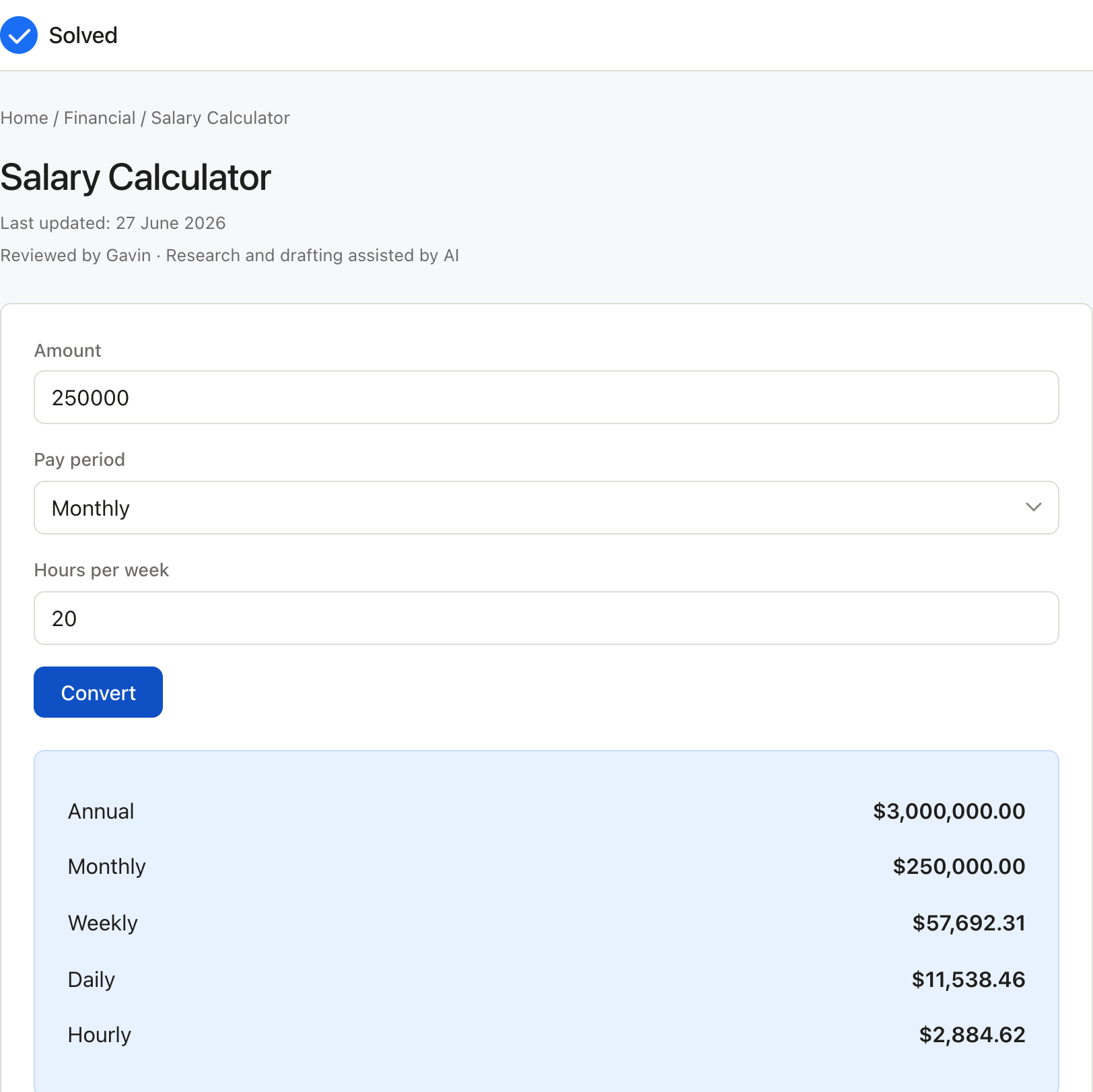
Captured from solved.tools on 10 September 2026.
Frequently Asked Questions
What is the difference between gross and net pay? Gross pay is your salary before any deductions. Net pay, also called take-home pay, is what you receive after income tax, National Insurance, and any other deductions such as pension contributions or student loan repayments. When comparing job offers, always calculate the net pay rather than simply comparing gross figures.
How do pension contributions affect my take-home pay? Workplace pension contributions reduce your taxable income if paid through salary sacrifice, meaning you pay less income tax and NI on the contributed amount. A 5% contribution on a £38,000 salary reduces your taxable income by £1,900, saving you £380 in tax and £152 in NI. Your actual take-home pay decreases by less than the full contribution amount.
What happens if I earn over £100,000? The personal allowance is tapered away at a rate of £1 for every £2 earned above £100,000. Between £100,000 and £125,140 you effectively pay a 60% marginal tax rate on those earnings. Pension contributions can bring your adjusted net income below this threshold and restore the full allowance.
Does this calculator account for Scottish income tax? Scottish taxpayers pay different income tax rates set by the Scottish Parliament. Scottish rates and bands differ from those for the rest of the UK, particularly in the intermediate and higher bands. If you live in Scotland, check the Scottish rate calculator or use HMRC's online tool to get an accurate figure.
The 100,000 taper worked through
The personal allowance is not fixed at every income. Above 100,000 it falls by 1 for every 2 of additional income, and it disappears entirely at 125,140. Take a salary of 110,000 and follow the bands from the formula above.
| Step | Amount |
|---|---|
| Gross salary | 110,000.00 |
| Personal allowance | 7,570.00 |
| Taxable income | 102,430.00 |
| Income tax | 33,432.00 |
| National Insurance | 4,210.60 |
| Annual take-home | 72,357.40 |
| Monthly take-home | 6,029.78 |
The allowance comes out at 7,570 because 110,000 is 10,000 above the threshold, and half of that comes off the standard 12,570. Taxable income is then 102,430. Income tax is 7,540 on the basic band (37,700 at 20%), plus 25,892 on the higher band (64,730 at 40%), which is 33,432. National Insurance is 3,016 on earnings between 12,570 and 50,270, plus 1,194.60 at 2% above that.
Compare the same person at 100,000, where the full allowance survives: tax 27,432.00, National Insurance 4,010.60, take-home 68,557.40, or 5,713.12 a month. The extra 10,000 of salary adds 3,800 to the annual take-home. Of each additional pound, 38p stays with the earner. The other 62p splits into 40p of higher-rate tax on the pound, 20p more in tax because 50p of allowance has vanished, and 2p of National Insurance.
Net pay across a range of salaries
The bands from the formula produce the figures below for the 2024/25 year, on the standard 1257L code with no pension, student loan or salary sacrifice. National Insurance uses the employee Class 1 rates.
| Gross salary | Income tax | National Insurance | Annual take-home | Monthly take-home |
|---|---|---|---|---|
| 25,000 | 2,486.00 | 994.40 | 21,519.60 | 1,793.30 |
| 38,000 | 5,086.00 | 2,034.40 | 30,879.60 | 2,573.30 |
| 60,000 | 11,432.00 | 3,210.60 | 45,357.40 | 3,779.78 |
| 110,000 | 33,432.00 | 4,210.60 | 72,357.40 | 6,029.78 |
| 130,000 | 45,331.50 | 4,610.60 | 80,057.90 | 6,671.49 |
The 38,000 row matches the worked example above. The page prints that example as 5,086 of tax, 2,034 of National Insurance and 30,880 of take-home, which are those figures rounded to the nearest pound. Where the numbers here carry pence and the example does not, the difference is rounding rather than a change of method.
Read the table downwards for the shape of the system. Take-home roughly doubles from 25,000 to 60,000 while the gross more than doubles. The gap between 110,000 and 130,000 is the widest in the table for the smallest change in gross, because the allowance has gone and the additional 45% rate has started.
Scottish rates against the rest of the UK
Scottish taxpayers pay different rates on the same salary. The bands for 2024/25 are published by the Scottish Government, and National Insurance is unchanged because it is set UK-wide.
| Band | Income range | Rate |
|---|---|---|
| Starter | 12,571 to 14,876 | 19% |
| Scottish basic | 14,877 to 26,561 | 20% |
| Intermediate | 26,562 to 43,662 | 21% |
| Higher | 43,663 to 75,000 | 42% |
| Advanced | 75,001 to 125,140 | 45% |
| Top | above 125,140 | 48% |
Income tax on the same salary under each system, with National Insurance left out because it does not vary:
| Gross salary | Scottish income tax | Rest of the UK | Scottish minus rest of the UK |
|---|---|---|---|
| 25,000 | 2,462.94 | 2,486.00 | 23.06 less |
| 28,867 | 3,259.40 | 3,259.40 | equal |
| 40,000 | 5,597.33 | 5,486.00 | 111.33 more |
| 50,000 | 9,028.31 | 7,486.00 | 1,542.31 more |
| 60,000 | 13,228.31 | 11,432.00 | 1,796.31 more |
| 110,000 | 35,278.31 | 33,432.00 | 1,846.31 more |
The crossover sits at 28,867, where the two systems charge the same. Below it a Scottish taxpayer pays slightly less, because the 19% starter band is lower than the UK basic rate. Above it the Scottish system costs more, and the gap widens sharply past 43,662 where the 42% rate begins, five years and roughly 6,600 of income earlier than the 40% rate in the rest of the UK.
The Scottish figures are taken from the Scottish Income Tax 2024 to 2025 factsheet published by the Scottish Government on 19 December 2023, and the same bands appear on mygov.scot. Rates and bands are set each year and change in April.
What the salary calculator leaves out
The figures on this page rest on a short list of assumptions, and each one is a place where a real payslip can differ.
The calculation covers one job held for a full year on the standard 1257L code. It excludes pension contributions, whether taken from net pay or through salary sacrifice, and it excludes student loan repayments, which start at different thresholds for each plan. It excludes taxable benefits such as a company car, and it excludes any income from a second job, which changes both the allowance and the National Insurance position. It assumes the employee Class 1 rates rather than the rates for the self-employed.
An emergency tax code is the error that shows up most often in practice, and it produces a reading that looks like a bug. A W1 or M1 code taxes each pay period in isolation, so a first payslip under that code can show far more tax than the annual figures above. The same applies to a BR code, which taxes the whole of that job at 20% with no allowance. Check the code on the payslip before comparing anything to the figures here.
Rates move in April, and the personal allowance taper applies to Scottish taxpayers as well as to the rest of the UK, because the allowance is set UK-wide.
Also try these free tools: