Income Tax Calculator
Last updated: 27 June 2026
Reviewed by Gavin Meiring, Lead research and primary author · Doctoral Candidate (Corporate Governance) · Research and drafting assisted by AI
2024 US federal income tax estimate. Does not include state taxes, FICA, or credits.
- The first permanent US income tax was introduced in 1913 with the 16th Amendment. The original top rate was 7%, applied only to incomes above $500,000 — about $16 million in today's money.
- Sweden has a top income tax rate of around 57% — one of the world's highest. Yet Swedes consistently rank among the happiest people on earth.
- The UK's PAYE (Pay As You Earn) system was introduced in 1944 specifically to collect wartime taxes efficiently. Most workers today never file a tax return because it's all done automatically.
Tax Calculator
A tax calculator works out how much income tax you owe based on your earnings, tax code, and the applicable rates and bands for the current tax year. It is used by employees, self-employed people, and small business owners who want to estimate their tax liability, plan payments, or check that their PAYE deductions are correct.
How to Use the Tax Calculator
- Enter your total gross income for the year (employment, self-employment, rental income, or a combination).
- Enter any allowable deductions such as pension contributions or Gift Aid donations.
- Select your residency (England, Wales, Scotland, or Northern Ireland, as Scotland has different rates).
- Click calculate to see your income tax breakdown by band, National Insurance, and total deductions.
- Review the marginal rate summary to understand which band additional earnings would fall into.
The Formula
UK income tax (England, Wales, Northern Ireland) for 2024/25:
Tax = 0% on the first £12,570 (Personal Allowance) + 20% on income from £12,571 to £50,270 + 40% on income from £50,271 to £125,140 + 45% on income above £125,140
The personal allowance reduces by £1 for every £2 of income above £100,000, making the effective marginal rate 60% in the £100,000 to £125,140 range. Adjusted net income (gross income minus pension contributions and Gift Aid grossed up) is used to determine allowance tapering.
Real-World Example
Self-employed income of £55,000, pension contributions of £3,000.
- Adjusted net income: £55,000 - £3,000 = £52,000
- Personal Allowance: £12,570 (no tapering as income below £100,000)
- Tax on £12,571 to £50,270: £37,700 x 20% = £7,540
- Tax on £50,271 to £52,000: £1,730 x 40% = £692
- Total income tax: £8,232
- Class 4 NI (self-employed, on profits £12,570 to £50,270): £37,700 x 9% = £3,393
- Class 2 NI (flat rate): £179.40
- Total tax and NI: approximately £11,804
When to Use a Tax Calculator
A tax calculator is most valuable before the January 31 self-assessment deadline, when planning how much to save for a tax bill, or when evaluating a salary increase or bonus. It is also useful for comparing the tax efficiency of taking income as salary versus dividends (for company directors), or for seeing the impact of increasing pension contributions. Remember that this tool provides estimates; complex situations involving multiple income streams, benefits in kind, or prior-year adjustments should be confirmed with a qualified accountant.
Reference Table: Payroll tax components and an effective-rate illustration
The first table lists the United States payroll tax rates, which have been stable for years. The second table shows what those rates take from a range of salaries and then adds a flat 22% income-tax assumption so you can see how a marginal rate becomes a lower effective rate. Confirm current brackets with the IRS before filing.
| Component | Rate | Applies to |
|---|---|---|
| Social Security | 6.2% | On earnings up to the annual wage base, which the SSA resets each year |
| Medicare | 1.45% | On all earnings, no ceiling |
| Additional Medicare | 0.9% | On earnings above $200,000 for single filers |
| Gross pay | Payroll tax | Income tax at 22% | Combined |
|---|---|---|---|
| $30,000 | $2,295 | $6,600 | $8,895 |
| $50,000 | $3,825 | $11,000 | $14,825 |
| $75,000 | $5,738 | $16,500 | $22,238 |
| $100,000 | $7,650 | $22,000 | $29,650 |
| $150,000 | $11,475 | $33,000 | $44,475 |
Worked Example on Screen
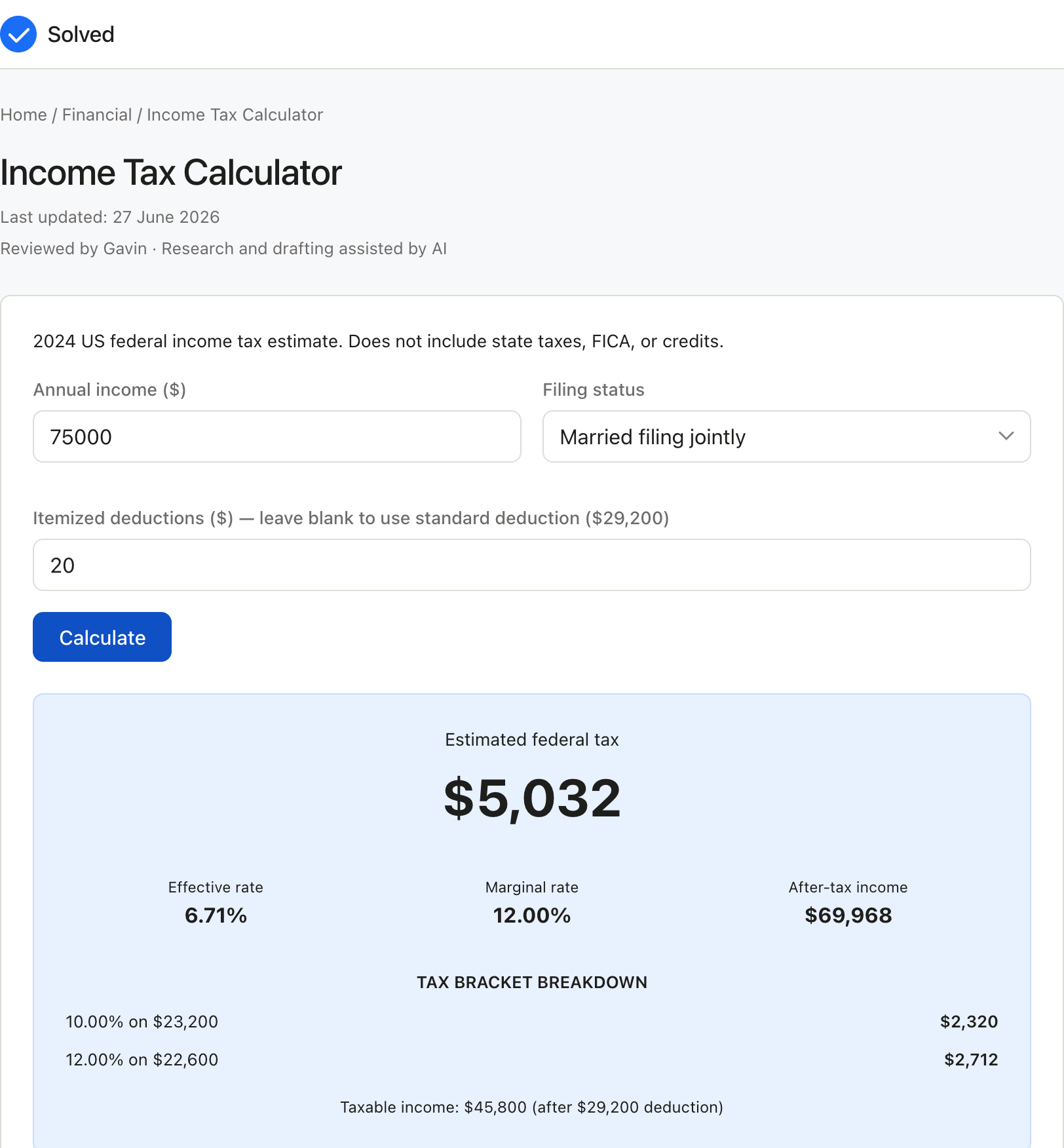
The capture below shows Income Tax Calculator after the inputs were entered, with the result on screen. Enter the same values to reproduce it.
Captured from solved.tools on 10 September 2026.
Frequently Asked Questions
What is self-assessment and who needs to complete it? Self-assessment is the process by which individuals report income to HMRC that is not taxed at source through PAYE. You need to file a self-assessment return if you are self-employed, a company director, earn over £100,000, have untaxed income above £2,500, or receive rental income. The deadline for online filing is 31 January each year.
What is the difference between marginal and effective tax rate? The marginal rate is the rate applied to the next pound of income you earn. The effective rate is the total tax paid divided by total income, giving an average rate across all bands. On a £50,000 salary, your marginal rate is 40% on the last portion above £50,270, but your effective rate is much lower because earlier income is taxed at 20% and some at 0%.
How does Gift Aid affect my tax bill? When you donate to charity under Gift Aid, the charity claims 25% tax relief from HMRC. If you are a higher-rate taxpayer, you can claim an additional 20% relief through self-assessment by declaring the donation. Grossing up your Gift Aid donations also reduces your adjusted net income, which can restore part of the personal allowance if you earn between £100,000 and £125,140.
Can I reduce my tax bill through pension contributions? Yes. Contributions to a registered pension scheme reduce your taxable income. Basic-rate taxpayers receive 20% relief at source (the pension provider claims it from HMRC). Higher-rate taxpayers can claim an additional 20% via self-assessment. Salary sacrifice pension contributions also reduce National Insurance for both employee and employer.
The self-employed example reworked at 2024/25 rates
Two National Insurance rules changed on 6 April 2024, and the worked example above predates them. Class 4 contributions fell from 9 percent to 6 percent on profits between 12,570 and 50,270. Class 2, which was a flat weekly charge, was abolished for most sole traders on the same date. The upper rate of 2 percent on profits above 50,270 did not change.
| Component | Printed example | 2024/25 rates | Difference |
|---|---|---|---|
| Class 4 on 37,700 at the main rate | 3,393.00 at 9 percent | 2,262.00 at 6 percent | 1,131.00 |
| Class 4 on the 4,730 above the upper profits limit | not charged | 94.60 at 2 percent | 94.60 |
| Class 2 flat rate | 179.40 | 0.00 | 179.40 |
| Total with the 8,232.00 of income tax | 11,804.40 | 10,588.60 | 1,215.80 |
Two separate points are in play. The rate cut accounts for most of the difference. The second point is that the printed example charges Class 4 only on profits between 12,570 and 50,270, and a self-employed person with 55,000 of profit also pays 2 percent on the 4,730 above 50,270, which is 94.60. Charging the lower rate on the band and nothing above it understates the bill, and using the superseded 9 percent overstates it by more.
The example's stated total of approximately 11,804 is the sum of its three components, which comes to 11,804.40. On the 2024/25 rules the same inputs give 10,588.60, a fall of 1,215.80. The daily figures a reader takes from this page depend on which year they are planning for, so the year matters more than it looks.
National Insurance for employees and the self-employed
The two systems are not the same, and the difference narrows as income rises. An employee pays Class 1 at 8 percent on earnings between 12,570 and 50,270 and 2 percent above that. A sole trader pays Class 4 at 6 percent on profits in the same band and 2 percent above it.
| Profits or salary | Employee Class 1 | Self-employed Class 4 |
|---|---|---|
| 30,000 | 1,394.40 | 1,045.80 |
| 45,000 | 2,594.40 | 1,945.80 |
| 55,000 | 3,110.60 | 2,356.60 |
| 75,000 | 3,510.60 | 2,756.60 |
| 110,000 | 4,210.60 | 3,456.60 |
| 130,000 | 4,610.60 | 3,856.60 |
At 55,000 the employee pays 754.00 more than the sole trader on the same figure. The gap does not widen above 50,270, because both pay the same 2 percent there. The self-employed also pay no employer contribution on their own profit, while a company employing someone pays employer National Insurance on top of the salary, which is a real cost to the business even though it never appears in the employee's payslip.
Income tax and National Insurance by salary
Adding the two charges together gives the figure that matters to an employee, and the shape of the total is worth seeing across the range:
| Gross salary | Income tax | Employee National Insurance | Total deducted | Take home |
|---|---|---|---|---|
| 30,000 | 3,486.00 | 1,394.40 | 4,880.40 | 25,119.60 |
| 45,000 | 6,486.00 | 2,594.40 | 9,080.40 | 35,919.60 |
| 55,000 | 9,432.00 | 3,110.60 | 12,542.60 | 42,457.40 |
| 75,000 | 17,432.00 | 3,510.60 | 20,942.60 | 54,057.40 |
| 110,000 | 33,432.00 | 4,210.60 | 37,642.60 | 72,357.40 |
| 130,000 | 45,331.50 | 4,610.60 | 49,942.10 | 80,057.90 |
Compare 55,000 with 75,000. Gross pay rises by 20,000, but take home rises by only 11,600, because the extra falls in the higher rate band and the personal allowance is still intact at both points. Now compare 110,000 with 130,000. Gross pay rises by the same 20,000 and take home rises by only 7,700.50, because part of that band sits inside the personal allowance taper, where each extra pound costs 60 pence of income tax and 2 pence of National Insurance. The taper is what makes the second comparison so much worse than the first.
What the pension contribution does to the arithmetic
The example above subtracts the 3,000 pension contribution from 55,000 of income to reach 52,000 of adjusted net income, and then charges income tax on 52,000. That treatment fits a contribution taken from pay before income tax is applied. A personal pension contribution made from income that has already been taxed works differently: the provider claims 20 percent relief from HMRC and adds it to the pot, and any higher-rate relief is claimed through the tax return. The contribution still reduces adjusted net income, which is the figure that governs the personal allowance taper, but it does not reduce taxable income in the same way.
The two routes give different bills on the same inputs. Charging income tax on 52,000 gives 8,232.00, which is the printed figure. Charging it on the full 55,000 gives 9,432.00, which is 1,200.00 more. The page does not say which type of contribution it assumes, so a reader should check their own scheme before using the number.
The two payment dates and what lands on them
Self-employed tax is collected through self assessment, and HMRC collects most of it in advance. Once a bill is established, the following year is paid in two instalments, each half of the previous year's liability, due on 31 January and 31 July. A 10,000 liability therefore gives 5,000 on each date.
The balancing payment, which is any difference between the two instalments and the actual liability for the year, falls due on 31 January as well, together with the first instalment for the year ahead. That is why a January payment can be much larger than half the bill. HMRC does not require instalments at all where the previous year's liability was under 1,000, or where more than 80 percent of it was collected at source.
What the estimate covers and what it leaves out
The figures on this page cover income tax and National Insurance on the stated income. They exclude student loan repayments, which are collected alongside tax and can add 9 percent of income above the repayment threshold, and they exclude tax on savings interest and dividends, which follow different rates. Benefits in kind, capital gains, rental profit and any prior year adjustment are all outside the calculation. Where a business has more than one income stream, or where a director is choosing between salary and dividends, an accountant's figures will beat an estimate.
The published rates behind the figures
The income tax bands and the taper rule are from the UK government's published guidance at gov.uk under "Income Tax rates and Personal Allowances". The National Insurance rates and thresholds are the 2024/25 figures: Class 1 at 8 percent and 2 percent for employees, Class 4 at 6 percent and 2 percent for the self-employed, the Class 2 abolition for most sole traders on 6 April 2024, and a small profits threshold of 6,725 below which no Class 4 is charged. The self-employed keep their State Pension record through the year even when they pay no Class 2, provided their profits exceed that threshold.
Also try these free tools: