Student Loan Calculator
Last updated: 27 June 2026
Reviewed by Gavin Meiring, Lead research and primary author · Doctoral Candidate (Corporate Governance) · Research and drafting assisted by AI
- Americans owe over $1.7 trillion in student loan debt — more than all credit card debt and auto loan debt combined.
- The UK introduced tuition fees in 1998 at $1,000 per year. By 2023, the cap is $9,250. The average English graduate leaves with over $45,000 in debt.
- In Germany, tuition at public universities is free — not just for German students, but for international students too. Several Scandinavian countries have similar policies.
Student Loan Calculator
A student loan calculator estimates your monthly repayments, total amount repaid, and how long it takes to clear your student loan based on your salary, loan balance, and repayment plan. It is used by UK graduates on Plan 1, Plan 2, Plan 4, or Plan 5 who want to understand what they will actually repay and whether their loan will be written off before it is cleared.
How to Use the Student Loan Calculator
- Enter your current or expected gross annual salary.
- Enter your outstanding student loan balance.
- Select your repayment plan (Plan 1, Plan 2, Plan 4, or Plan 5).
- Enter the current interest rate for your plan.
- Click calculate to see monthly deductions, projected repayment period, total repaid, and whether the loan is written off before being cleared.
The Formula
UK student loan repayments are income-contingent, not balance-based:
Monthly Repayment = (Annual Salary - Repayment Threshold) x Repayment Rate / 12
Where the repayment rate is 9% for most plans. If your salary is below the threshold, you pay nothing. The threshold varies by plan: Plan 1 (£24,990), Plan 2 (£27,295), Plan 4 (£31,395), Plan 5 (£25,000). Interest accrues on the outstanding balance simultaneously, at a rate linked to the Retail Prices Index plus a margin depending on income.
Real-World Example
Plan 2 loan: £45,000 balance, salary of £35,000 per year, interest rate 6.25%.
- Repayment: (£35,000 - £27,295) x 9% = £7,705 x 9% = £693.45 per year = £57.79 per month
- Annual interest on £45,000 at 6.25%: £2,812.50
- Balance reduction in year 1: £693.45 - £2,812.50 = balance increases by approximately £2,119
At this salary, repayments do not cover the interest, so the balance grows. It is only when the salary rises substantially or the write-off date arrives (30 years after entering repayment on Plan 2) that the account is resolved. Most Plan 2 graduates are projected never to fully repay their loan before write-off.
Repayment by salary
The repayment depends on salary alone, worked from the Plan 2 threshold of £27,295 and the 9 percent rate.
| Salary | Above the threshold | Annual repayment | Monthly repayment |
|---|---|---|---|
| £25,000 | £0 | £0.00 | £0.00 |
| £30,000 | £2,705 | £243.45 | £20.29 |
| £35,000 | £7,705 | £693.45 | £57.79 |
| £40,000 | £12,705 | £1,143.45 | £95.29 |
| £50,000 | £22,705 | £2,043.45 | £170.29 |
| £60,000 | £32,705 | £2,943.45 | £245.29 |
| £70,000 | £42,705 | £3,843.45 | £320.29 |
The outstanding balance appears in none of those figures. A graduate earning £40,000 pays £95.29 a month whether the balance is £15,000 or £60,000, which is the feature that makes the loan behave more like a tax than a conventional debt. Changing the balance changes the interest and the length of the tail, never the monthly deduction.
The turning point
Whether the balance grows or shrinks depends on whether the repayment covers the interest. On a £45,000 balance at 6.25 percent the annual interest is £2,812.50, and the repayment only matches it once the salary reaches about £58,545.
| Interest rate | Annual interest on £45,000 | Salary that covers it |
|---|---|---|
| 4.30% | £1,935.00 | £48,795 |
| 6.25% | £2,812.50 | £58,545 |
| 7.30% | £3,285.00 | £63,795 |
The salary needed rises by £11.11 for every £1 of extra annual interest, which is the reciprocal of the 9 percent repayment rate. That single ratio explains the whole table: the turning point moves in step with the interest bill, not with the size of the balance on its own.
The write-off race
Take the worked example again: a £45,000 balance, a £35,000 salary, and a 6.25 percent rate. The year 1 repayment is £693.45 and the year 1 interest is £2,812.50, so the balance grows by £2,119.05. On a salary that stays near £35,000 the balance never falls, and the write-off at 30 years clears whatever is left rather than the graduate clearing it.
Raise the salary to £60,000 and the repayment becomes £2,943.45, which is £130.95 more than the interest. The balance falls by about £131 in that first year, before the next year's interest is charged on the barely lower figure. A salary £25,000 higher than the example turns a growing balance into one that shrinks by £131 a year.
That is the scale to hold in mind. Repayment is fast only at salaries far above the threshold, and the write-off date is what resolves the loan for everyone else. Run the calculator with a realistic career salary rather than the current one, because the answer depends on the whole path and not the first year.
Overpayment maths
An overpayment of £5,000 reduces the balance from £45,000 to £40,000, and the following year's interest falls from £2,812.50 to £2,500.00. That saves £312.50 of interest in a single year.
The saving is real on a balance that survives to the write-off date. It is a loss on a balance that would have been written off anyway, because £5,000 of cash has bought £312.50 of avoided interest and the remaining balance disappears either way. The calculator answers the one question that separates the two cases: whether the balance clears before the write-off date at the salary you expect.
Where write-off is likely, the same £5,000 has other uses, and the comparison to make is between the return each of those uses offers and the £312.50. Where clearance before write-off is likely, the overpayment removes interest that would otherwise compound against you for the rest of the term.
Is a Student Loan Actually Debt?
For most UK graduates, a student loan functions more like a graduate tax than a conventional debt. Because repayments are capped at 9% of income above the threshold and the remaining balance is written off after 25 to 30 years (depending on plan), many graduates will repay only a portion of what they borrowed. Overpaying voluntarily rarely makes financial sense unless your projected salary means you will clear the loan before write-off anyway. Before making voluntary repayments, use this calculator to check whether you are likely to repay the full balance or have it written off; if write-off is likely, voluntary overpayments simply increase the total you repay unnecessarily.
Reference Table: Repaying $30,000 of student debt
Standard repayment terms on a $30,000 balance at three rates. The final column is the interest cost of the ten-year plan. A 6% balance costs $9,967 in interest over ten years, against $21,583 over twenty.
| Rate | 10 years | 15 years | 20 years | Interest over 10 years |
|---|---|---|---|---|
| 5% | $318 | $237 | $198 | $8,184 |
| 6% | $333 | $253 | $215 | $9,967 |
| 7% | $348 | $270 | $233 | $11,799 |
Worked Example on Screen
The capture below shows Student Loan Calculator after the inputs were entered, with the result on screen. Enter the same values to reproduce it.
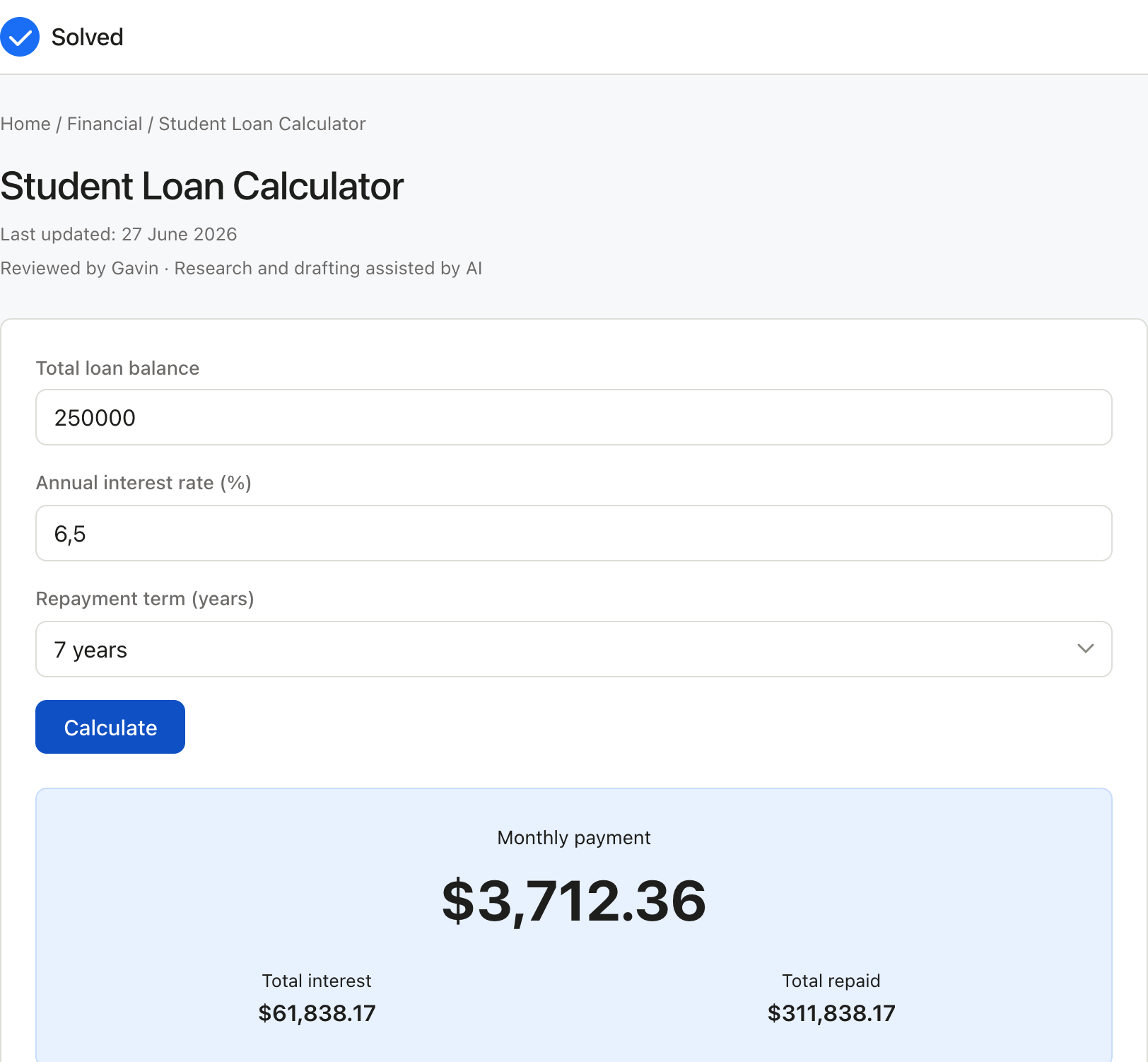
Captured from solved.tools on 10 September 2026.
Frequently Asked Questions
What happens to my student loan if I move abroad? You are still liable for repayments, but the threshold adjusts to the cost of living in your country of residence. You must notify the Student Loans Company and provide income evidence each year. Failure to do so can result in arrears being charged at the maximum repayment rate. Some countries have different thresholds; check the overseas repayment rates on the Student Loans Company website.
Does my student loan affect my credit score or mortgage application? Student loan repayments are not listed on your credit file and do not directly affect your credit score. However, they reduce your net take-home pay, which affects the affordability calculation a mortgage lender uses. Lenders include student loan deductions when calculating how much you can borrow, which can reduce your maximum mortgage offer.
Should I overpay my student loan to reduce the balance? For most Plan 2 graduates, overpaying is not financially beneficial because the balance is likely to be written off before it is cleared. The money used to overpay could earn a higher return in a pension or ISA. Use this calculator to determine whether your loan would be cleared before the write-off date at your expected career earnings. Overpaying only makes sense if the answer is clearly yes.
What is the write-off period for each UK repayment plan? Plan 1 loans are written off when you reach age 65 or 25 years after the April you were first due to repay, whichever comes first. Plan 2 loans are written off 30 years after entering repayment. Plan 4 loans are also written off after 30 years. Plan 5 loans (starting from 2023) are written off after 40 years.
Also try these free tools related to Student Loan Calculator: - Loan Calculator