Debt Payoff Calculator
Last updated: 27 June 2026
Reviewed by Gavin Meiring, Lead research and primary author · Doctoral Candidate (Corporate Governance) · Research and drafting assisted by AI
- The 'debt avalanche' method (paying highest-interest debt first) saves the most money mathematically. The 'debt snowball' method (smallest balance first) is psychologically more effective for most people.
- Total US consumer debt hit $17 trillion in 2023, including mortgages, car loans, student loans, and credit cards.
- Dave Ramsey's 'Baby Steps' programme has guided millions of Americans out of debt. Step 2 — the debt snowball — has been replicated by financial advisors worldwide.
Debt Payoff Calculator
A debt payoff calculator shows how long it will take to become debt-free and how much interest you will pay based on your balances, interest rates, and monthly payments. It is used by anyone managing multiple debts who wants to build a clear repayment plan and see the financial benefit of paying more than the minimum.
How to Use the Debt Payoff Calculator
- Enter each debt separately: name, balance, interest rate, and minimum payment.
- Enter the total monthly amount you can put towards debt repayment.
- Choose a repayment strategy: avalanche (highest rate first) or snowball (lowest balance first).
- Click calculate to see a payoff timeline, total interest paid, and a month-by-month schedule.
- Adjust the monthly amount to see how extra payments accelerate the payoff date.
The Formula
Each month, for every debt:
Interest charged = Balance x (Annual Rate / 12 / 100) New balance = Previous balance + Interest - Payment
Under the avalanche method, the minimum payment goes to every debt and any extra money targets the highest-rate debt first. Under the snowball method, extra money targets the smallest balance first regardless of rate. The same total monthly payment is used in both methods; only the order of priority changes.
Real-World Example
Three debts: credit card £2,500 at 22% APR (minimum £50), personal loan £5,000 at 8% APR (minimum £100), car loan £8,000 at 5% APR (minimum £150). Total minimum: £300. You can pay £500 per month total, so there is £200 extra.
Avalanche: extra £200 goes to the credit card first (22% rate).
- Credit card paid off in approximately 13 months. Interest saved versus paying minimum only: approximately £400.
- After that, the £250 freed up rolls to the personal loan, then the car loan.
- Total payoff: approximately 38 months. Total interest: approximately £1,100.
Snowball: extra £200 goes to the credit card first (smallest balance coincides with highest rate here). Result is similar in this case, but on different debt structures the snowball can cost more in interest while providing faster motivational wins.
Avalanche Versus Snowball: Which Is Better?
The avalanche method saves more money in interest because it eliminates the most expensive debt first. The snowball method can feel more motivating because you clear debts faster in terms of number of accounts, which some people find helps them stay committed. Research suggests that for people who struggle with motivation, the snowball effect of clearing individual debts can improve follow-through. For people focused purely on financial efficiency, the avalanche wins every time. Pick the method you are most likely to stick with; a completed snowball plan beats an abandoned avalanche plan every time.
Reference Table: Sample debt list for snowball and avalanche
Three sample debts with their balances, rates and minimum payments. The snowball method targets the smallest balance first, the avalanche method the highest rate first. With these balances the minimum payments total $330 a month, and any extra payment should go to the target debt while the others keep their minimums.
| Debt | Balance | APR | Minimum payment |
|---|---|---|---|
| Card A | $3,000 | 22.9% | $90 |
| Card B | $1,500 | 19.9% | $60 |
| Loan C | $6,000 | 8.9% | $180 |
Worked Example on Screen
The capture below shows Debt Payoff Calculator after the inputs were entered, with the result on screen. Enter the same values to reproduce it.
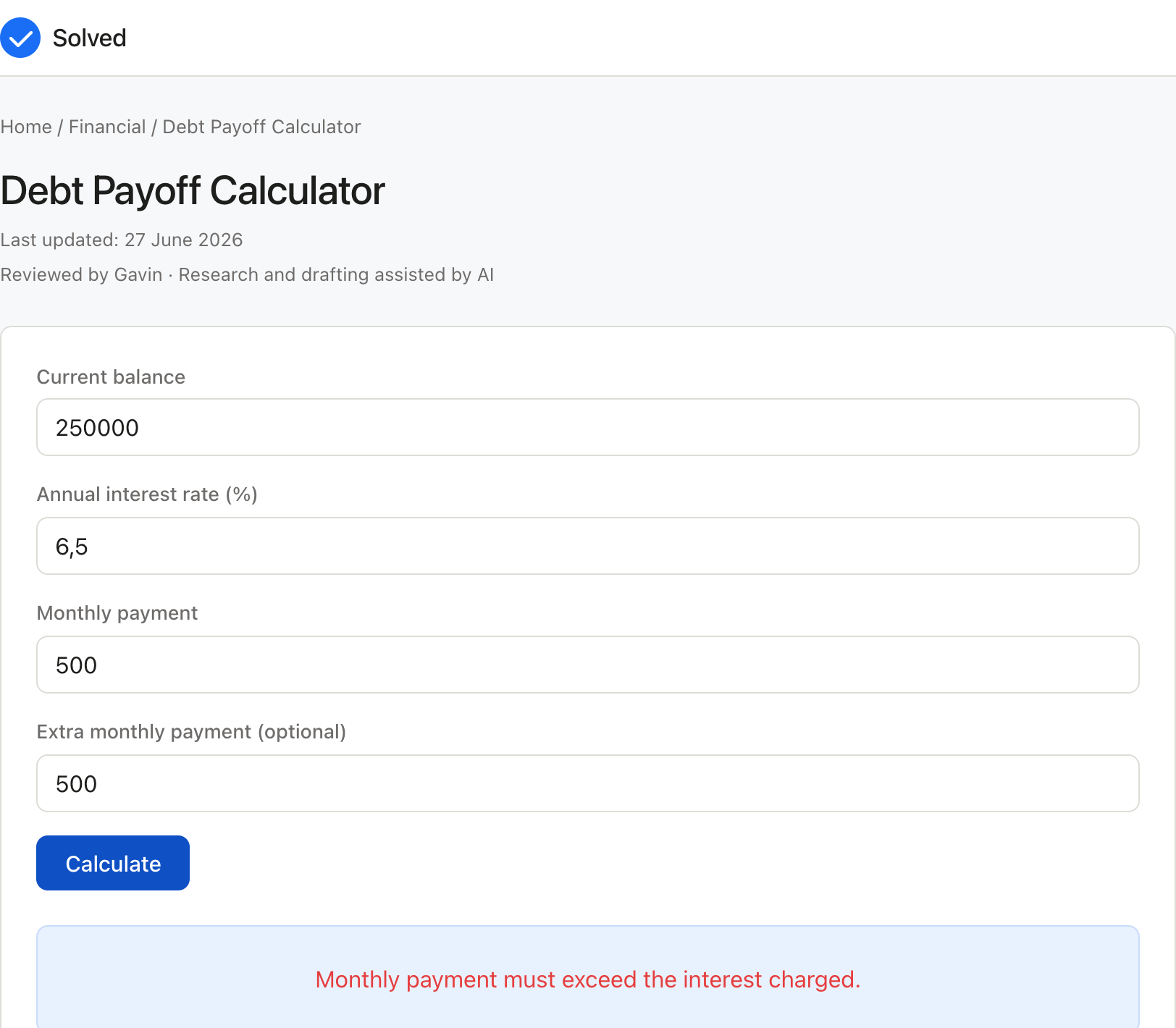
Captured from solved.tools on 10 September 2026.
Frequently Asked Questions
Should I pay off debt or save first? If your debt interest rate is higher than the return on your savings, paying off debt first saves more money. The exception is an emergency fund; most advisers recommend keeping 1 to 3 months of expenses in accessible savings even while repaying debt, to avoid borrowing again when unexpected costs arise.
What is debt consolidation and does it help? Debt consolidation combines multiple debts into a single loan, usually at a lower interest rate. This can reduce your monthly payment and total interest paid. However, consolidation only helps if you do not accumulate new debt on the cleared accounts and if the consolidation loan's rate is genuinely lower than your existing debts. Use this calculator to compare your current total interest against the consolidated scenario.
Does paying off debt improve my credit score? Yes, in most cases. Reducing your credit utilisation (the proportion of your available credit that you are using) improves your score. Clearing accounts removes the associated debt from your utilisation calculation. Paying consistently on time has the largest positive effect on your credit score over time.
How do I stay motivated during a long debt repayment plan? Track every payment and update your remaining balances monthly. Celebrate each account you clear. Set a visible debt-free date and review it regularly. Automate payments so the discipline is built into your routine rather than requiring a decision each month. Reducing one balance to zero, even if it takes 12 months, provides a concrete win that makes continuing easier.
Understanding the Debt Payoff Calculator
The Debt Payoff Calculator is one of the most-requested tools in the debt payoff category because it condenses a calculation that would otherwise require manual work, a spreadsheet, or a specialist program into a single input-and-output step. whether you are a student, a professional, or a curious learner, the Debt Payoff Calculator is designed to deliver a quick and trustworthy answer without forcing you to install anything or sign up for an account. Behind the scenes, the Debt Payoff Calculator applies well-established mathematical or scientific formulas to the values you provide. the aim of Debt Payoff Calculator is to remove the friction of hand calculation while still showing you the underlying method, so you can confidently interpret the result. Every calculation is performed locally in your browser, which means your inputs never leave your device.
When Should You Use the Debt Payoff Calculator?
Use the Debt Payoff Calculator whenever you need a quick, reliable answer that fits the tool's scope. Common situations for the Debt Payoff Calculator include homework problems, workplace tasks, financial planning, fitness or health tracking, and everyday curiosity. If the Debt Payoff Calculator answer will be used for a decision that has legal, medical, or financial consequences, treat the result as a starting point and verify it with a qualified professional. The Debt Payoff Calculator is free to use, requires no sign-up, and works on any device with a modern browser. You can run the Debt Payoff Calculator as many times as you like, change the inputs, and compare results side by side.
Common Inputs and How to Choose Them
Most Debt Payoff Calculator problems revolve around a small set of inputs.
- each debt separately: name, balance, interest rate, and minimum payment is usually the first value to pin down for the Debt Payoff Calculator.
- the total monthly amount you can put towards debt repayment sets the context the Debt Payoff Calculator needs for a sensible result.
- a repayment strategy: avalanche (highest rate first) or snowball (lowest balance first) refines the Debt Payoff Calculator output where the data is available. Identifying the right values is the most important step for the Debt Payoff Calculator, because the answer is only as accurate as the data you put in. If a value is unknown, prefer a conservative estimate over a guess when using the Debt Payoff Calculator.
How to Interpret the Result
The numerical answer from the Debt Payoff Calculator alone is rarely the whole story. Read the units, the precision, and any warnings shown alongside the Debt Payoff Calculator result. Understanding the path from inputs to output in the Debt Payoff Calculator makes it easier to spot errors, communicate the result to others, and reuse the method for related problems in the future.
Worked Examples
A typical Debt Payoff Calculator run takes reasonable inputs, produces a sensible answer, and returns it in a single click. Example: Three debts: credit card £2,500 at 22% APR (minimum £50), personal loan £5,000 at 8% APR (minimum £100), car loan £8,000 at 5% APR (minimum £150). Total minimum: £300. You can pay £500 per month total, so there is £200 extra. Avalanche: extra £200 goes to the credit card first (22% rate). - Credit card paid off in approximately 13 months. Interest saved versus paying minimum only: approximately £4
Common Mistakes to Avoid
Common mistakes with the Debt Payoff Calculator:
- Mixing up units (for example, entering one unit when the Debt Payoff Calculator expects another).
- Forgetting to convert percentages to decimals or vice versa where the Debt Payoff Calculator formula requires it.
- Using a snapshot value that no longer reflects reality for the Debt Payoff Calculator, especially for time-sensitive inputs like prices, rates, or counts.
- Rounding intermediate steps too early and then carrying the rounded value forward in the Debt Payoff Calculator.
- Treating the Debt Payoff Calculator as a substitute for professional advice when the decision is high-stakes.
Limitations and Assumptions
No calculator is a perfect model of reality, and the Debt Payoff Calculator is no exception. The Debt Payoff Calculator makes simplifying assumptions to keep the math tractable: it ignores rare cases, applies default values where inputs are missing, and uses formulas that suit the typical situation rather than the exotic one. When your situation falls outside the typical case, the Debt Payoff Calculator result may drift further from the truth. If you need a more precise answer than the Debt Payoff Calculator provides, the next step is usually a specialist, a more detailed reference, or a domain-specific tool.
Related Tools and References
For more depth on the Debt Payoff Calculator topic, consult textbooks, academic papers, or reputable online resources. Reputable sources for the Debt Payoff Calculator include government statistics agencies, university extension services, and peer-reviewed journals. Wikipedia is a useful starting point for definitions and formulas behind the Debt Payoff Calculator, but always follow the citations to the original source before relying on a number. If you find that you need the same Debt Payoff Calculator calculation repeatedly, consider writing down the inputs and the result in a note so you can build a personal record over time.
Quick Reference
- Free to use: yes, no sign-up required.
- Privacy: all calculations run locally in your browser.
- Units: metric and imperial supported where applicable; check the input labels.
- Speed: instant, no page reload.
- Mobile friendly: yes, works on phones and tablets.
- Offline: once the page has loaded, the calculation continues to work without a network connection.
References - General-purpose math references such as Wolfram MathWorld and Khan Academy for foundational formulas.
- Wikipedia articles on the relevant topic, with citations to primary sources, cover the Debt Payoff Calculator background.
- Peer-reviewed journals and textbooks give the most rigorous treatments of the Debt Payoff Calculator method.Tools/tools/calculator) - Percentage Calculator - Unit Converter
Also try these free tools: